


// Workers AI · dad joke modeWhat did Stufe say to algebra? "You're a step ahead.
In field theory, a branch of mathematics, the Stufe (German pronunciation: [ˈʃtuːfə]; German: "level") s(F) of a field F is the least number of squares that sum to −1. If −1 cannot be written as a sum of squares, s(F) = . In this case, F is a formally real field. Albrecht Pfister proved that the Stufe, if finite, is always a power of 2, and that conversely every power of 2 occurs.[1]

Powers of 2
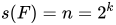
[edit]If then for some natural number .[1][2]


Proof: Let be chosen such that . Let . Then there are elements such that






Both and are sums of squares, and , since otherwise , contrary to the assumption on .


According to the theory of Pfister forms, the product is itself a sum of squares, that is, for some . But since , we also have , and hence





and thus .
Positive characteristic
[edit]Any field with positive characteristic has .[3]


Proof: Let . It suffices to prove the claim for .


If then , so .

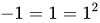

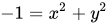
If consider the set of squares. is a subgroup of index in the cyclic group with elements. Thus contains exactly elements, and so does . Since only has elements in total, and cannot be disjoint, that is, there are with and thus .





Properties
[edit]The Stufe s(F) is related to the Pythagoras number p(F) by p(F) ≤ s(F) + 1.[4] If F is not formally real then s(F) ≤ p(F) ≤ s(F) + 1.[5][6] The additive order of the form (1), and hence the exponent of the Witt group of F is equal to 2s(F).[7][8]
Examples
[edit]- The Stufe of a quadratically closed field is 1.[8]
- The Stufe of an algebraic number field is , 1, 2 or 4 (Siegel's theorem).[9] Examples are , , and .[7]
- The Stufe of a finite field is 1 if q ≡ 1 mod 4 and 2 if q ≡ 3 mod 4.[3][8][10]
- The Stufe of a local field of odd residue characteristic is equal to that of its residue field. The Stufe of the 2-adic field is 4.[9]


Notes
[edit]- 1 2 Rajwade (1993), p. 13.
- ↑ Lam (2005), p. 379.
- 1 2 Rajwade (1993), p. 33.
- ↑ Rajwade (1993), p. 44.
- ↑ Rajwade (1993), p. 228.
- ↑ Lam (2005), p. 395.
- 1 2 Milnor & Husemoller (1973), p. 75.
- 1 2 3 Lam (2005), p. 380.
- 1 2 Lam (2005), p. 381.
- ↑ Singh (1974).
References
[edit]- Knebusch, Manfred; Scharlau, Winfried (1980). Algebraic Theory of Quadratic Forms. Generic Methods and Pfister Forms. DMV Seminar. Vol. 1. Notes taken by Heisook Lee. Basel: Birkhäuser. ISBN 3-7643-1206-8. Zbl 0439.10011.
- Lam, Tsit-Yuen (2005). Introduction to Quadratic Forms over Fields. Graduate Studies in Mathematics. Vol. 67. American Mathematical Society. ISBN 0-8218-1095-2. Zbl 1068.11023.
- Milnor, J.; Husemoller, D. (1973). Symmetric Bilinear Forms. A Series of Modern Surveys in Mathematics. Vol. 73. Berlin, Heidelberg: Springer. ISBN 3-540-06009-X. Zbl 0292.10016.
- Rajwade, A. R. (1993). Squares. London Mathematical Society Lecture Note Series. Vol. 171. Cambridge University Press. ISBN 0-521-42668-5. Zbl 0785.11022.
- Singh, Sahib (1974). "Stufe of a finite field". Fibonacci Quarterly. 12 (1): 81–82. doi:10.1080/00150517.1974.12430777. Zbl 0278.12008.