Let  be a q-ary code of length
  , i.e. a subset of
  . Let
. Let  be the minimum distance of , i.e.
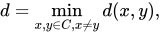
where  is the Hamming distance between
  and
and  .
.
Let  be the set of all q-ary codes with length and minimum distance and let
  denote the set of codes in such that every element has exactly
  nonzero entries.
Denote by  the number of elements in . Then, we define
  to be the largest size of a code with length and minimum distance :

Similarly, we define  to be the largest size of a code in :

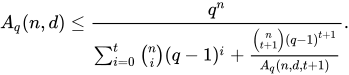
Theorem 1 (Johnson bound for ):
If  ,
,

If  ,
,
Theorem 2 (Johnson bound for ):
(i) If 

(ii) If  , then define the variable
  as follows. If is even, then define through the relation
  ; if is odd, define through the relation
  . Let
. Let  . Then,

where  is the floor function.
Remark: Plugging the bound of Theorem 2 into the bound of Theorem 1 produces a numerical upper bound on .


