


84 (number)
| ||||
|---|---|---|---|---|
| Cardinal | eighty-four | |||
| Ordinal | 84th (eighty-fourth) | |||
| Factorization | 22 × 3 × 7 | |||
| Divisors | 1, 2, 3, 4, 6, 7, 12, 14, 21, 28, 42, 84 (12) | |||
| Greek numeral | ΠΔ´ | |||
| Roman numeral | LXXXIV, lxxxiv | |||
| Binary | 10101002 | |||
| Ternary | 100103 | |||
| Senary | 2206 | |||
| Octal | 1248 | |||
| Duodecimal | 7012 | |||
| Hexadecimal | 5416 | |||
84 (eighty-four) is the natural number following 83 and preceding 85.
In mathematics
[edit]
84 is a semiperfect number,[1] being a multiple of a perfect number. It is the number of four-digit perfect powers in decimal.[2]
It is the third dodecahedral number,[3] and the sum of the first seven triangular numbers (1, 3, 6, 10, 15, 21, 28), which makes it the seventh tetrahedral number.[4]
The number of divisors of 84 is 12.[5] As no smaller number has more than 12 divisors, 84 is a largely composite number.[6]
A hepteract is a seven-dimensional hypercube with 84 penteract 5-faces.[7]
84 is the limit superior of the largest finite subgroup of the mapping class group of a genus surface divided by .[citation needed]

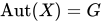
Under Hurwitz's automorphisms theorem, a smooth connected Riemann surface of genus will contain an automorphism group whose order is classically bound to .[8]



84 is the thirtieth and largest for which the cyclotomic field has class number (or unique factorization), preceding 60 (that is the composite index of 84),[9] and 48.[10][11]


There are 84 zero divisors in the 16-dimensional sedenions .[12]

References
[edit]- ↑ Sloane, N. J. A. (ed.). "Sequence A005835 (Pseudoperfect (or semiperfect) numbers n: some subset of the proper divisors of n sums to n)". The On-Line Encyclopedia of Integer Sequences. OEIS Foundation.
- ↑ Sloane, N. J. A. (ed.). "Sequence A075308 (Number of n-digit perfect powers)". The On-Line Encyclopedia of Integer Sequences. OEIS Foundation.
- ↑ Sloane, N. J. A. (ed.). "Sequence A006566 (Dodecahedral numbers)". The On-Line Encyclopedia of Integer Sequences. OEIS Foundation.
- ↑ Sloane, N. J. A. (ed.). "Sequence A000292 (Tetrahedral (or triangular pyramidal) numbers: a(n) = C(n+2,3) = n*(n+1)*(n+2)/6)". The On-Line Encyclopedia of Integer Sequences. OEIS Foundation.
- ↑ Sloane, N. J. A. (ed.). "Sequence A000005 (d(n) (also called tau(n) or sigma_0(n)), the number of divisors of n.)". The On-Line Encyclopedia of Integer Sequences. OEIS Foundation.
- ↑ Sloane, N. J. A. (ed.). "Sequence A067128 (Ramanujan's largely composite numbers)". The On-Line Encyclopedia of Integer Sequences. OEIS Foundation.
- ↑ Sloane, N. J. A. (ed.). "Sequence A046092 (4 times triangular numbers: a(n) = 2*n*(n+1))". The On-Line Encyclopedia of Integer Sequences. OEIS Foundation.
- ↑ Giulietti, Massimo; Korchmaros, Gabor (2019). "Algebraic curves with many automorphisms". Advances in Mathematics. 349 (9). Amsterdam, NL: Elsevier: 162–211. arXiv:1702.08812. doi:10.1016/J.AIM.2019.04.003. MR 3938850. S2CID 119269948. Zbl 1419.14040.
- ↑ Sloane, N. J. A. (ed.). "Sequence A002808 (The composite numbers)". The On-Line Encyclopedia of Integer Sequences. OEIS Foundation.
- ↑ Washington, Lawrence C. (1997). Introduction to Cyclotomic Fields. Graduate Texts in Mathematics. Vol. 83 (2nd ed.). Springer-Verlag. pp. 205–206 (Theorem 11.1). ISBN 0-387-94762-0. MR 1421575. OCLC 34514301. Zbl 0966.11047.
- ↑ Sloane, N. J. A. (ed.). "Sequence A005848 (Cyclotomic fields with class number 1 (or with unique factorization))". The On-Line Encyclopedia of Integer Sequences. OEIS Foundation.
- ↑ Cawagas, Raoul E. (2004). "On the Structure and Zero Divisors of the Cayley-Dickson Sedenion Algebra". Discussiones Mathematicae – General Algebra and Applications. 24 (2). PL: University of Zielona Góra: 262–264. doi:10.7151/DMGAA.1088. MR 2151717. S2CID 14752211. Zbl 1102.17001.
| |||||||||
| |||||||||
| |||||||||
| |||||||||
