// Workers AI · dad joke modeWhat did Prunus virginiana say? Cherry-o.
| Prunus virginiana | |
|---|---|
 | |
| Prunus virginiana var. virginiana (eastern chokecherry) in bloom | |
Scientific classification  | |
| Kingdom: | Plantae |
| Clade: | Embryophytes |
| Clade: | Tracheophytes |
| Clade: | Angiosperms |
| Clade: | Eudicots |
| Clade: | Rosids |
| Order: | Rosales |
| Family: | Rosaceae |
| Genus: | Prunus |
| Subgenus: | Prunus subg. Padus |
| Species: | P. virginiana |
| Binomial name | |
| Prunus virginiana | |
 | |
| Natural range | |
| Synonyms[2] | |
|
List
| |

Prunus virginiana, commonly called bitter-berry,[3] chokecherry,[3] Virginia bird cherry,[3] and western chokecherry[3] (also black chokecherry for P. virginiana var. demissa),[3] is a North American species of bird cherry (Prunus subgenus Padus).
Forming a tree generally up to 6 metres (19+1⁄2 feet) tall, the leaves are oval, green, and smooth, with racemes of white flowers and red to black drupes. The unripe fruits are toxic, as is the stone and much of the plant, but the ripe fruits are edible, being part of Native American cuisine.
Description
[edit]Chokecherry is a suckering shrub or small tree typically growing to 1–6 metres (3+1⁄2–19+1⁄2 feet) tall—rarely to 10 m (33 ft)—and a substantial width of 18 m (60 ft). The trunk is up to 30 centimetres (12 inches) in diameter.[4] The leaves are oval, pointed, dark green above with a paler underside, smooth on both surfaces, 2.5–10 cm (1–4 in) in length, and 1.2–5 cm (1⁄2–2 in) wide, with a serrated margin.[5][6] The stems rarely exceed 2 cm (3⁄4 in) in length.[5]
In late spring, well after leaf emergence, white flowers are produced in racemes measuring 4–11 cm (1+1⁄2–4+1⁄4 in) long, eventually growing up to 15 cm.[6][4] The racemes are about 2.5 cm (1 in) wide, with individual flowers up to about 13 millimetres (1⁄2 in) when open.[7][8]
The fruits (drupes) are about 6–14 mm (1⁄4–1⁄2 in) in diameter, range in color from bright red to black, and possess a very astringent taste, being both somewhat sour and somewhat bitter. They get darker and marginally sweeter as they ripen.[6] They each contain a large stone.[5]
 Chokecherry – habit
 Leaf and drupes of plant in Saskatchewan
 Autumn foliage


Chemistry
[edit]Chokecherries are very high in antioxidant pigment compounds, such as anthocyanins. They share this property with eastern North America's Prunus serotina (black cherry), contributing to confusion.[6]
Similar species
[edit]The chokecherry is closely related to P. serotina, which can reach 30 m (100 ft) tall and has larger, wholly dark green leaves with numerous blunt edges along the margin, in addition to darker fruit.[6][9]
Taxonomy
[edit]The name chokecherry is also used for the related P. maackii (Manchurian cherry or Amur chokecherry).
Varieties
[edit]Distribution and habitat
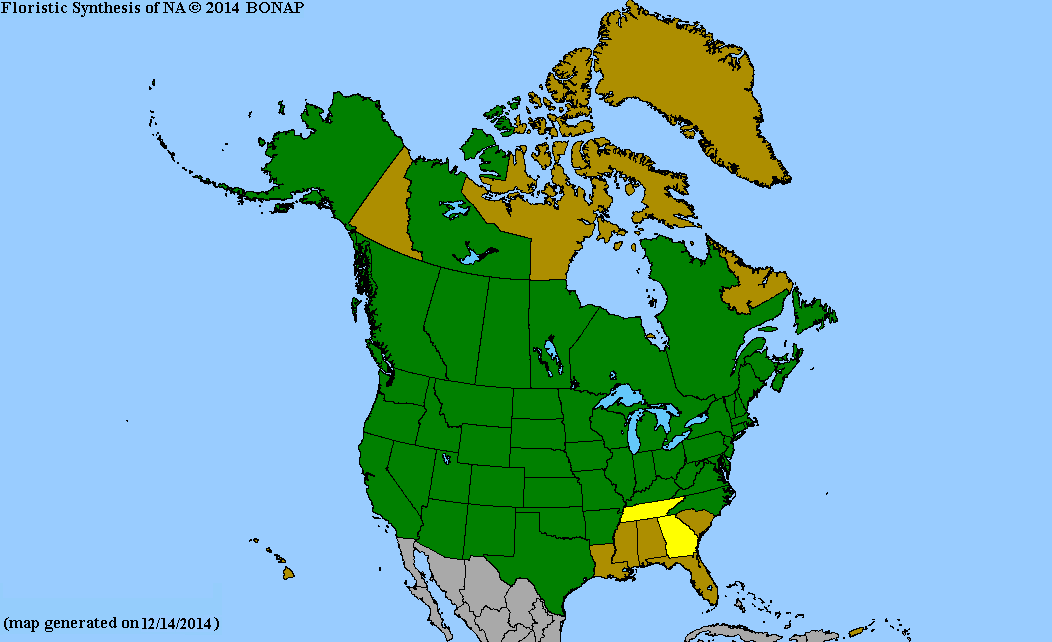
[edit]The natural historic range of P. virginiana includes most of Canada (including Northwest Territories, but excluding Yukon, Nunavut, and Labrador), most of the United States (including Alaska, but excluding some states in the Southeast), and northern Mexico (Sonora, Chihuahua, Baja California, Durango, Zacatecas, Coahuila, and Nuevo León).[11][12][6][additional citation(s) needed]
It can be found in habitats ranging from streambanks to montane forests.[13]
Ecology
[edit]The wild chokecherry is often considered a pest, as it is a host for the tent caterpillar, a threat to other fruit plants. It is also a larval host to the black-waved flannel moth, the blinded sphinx, the cecropia moth, the coral hairstreak, the cynthia moth, the elm sphinx, Glover's silkmoth, the hummingbird clearwing moth, the imperial moth, the Io moth, the polyphemus moth, the promethea moth, the red-spotted purple, the small-eyed sphinx, the spring azure, the striped hairstreak, the tiger swallowtail, the twin-spotted sphinx, and Weidemeyer's admiral.[14]
Many wildlife, including birds and game animals, eat the berries.[5] Moose, elk, mountain sheep, deer and rabbits eat the foliage, twigs, leaves, and buds.[5] Deer and elk sometimes browse the twigs profusely, not letting the plant grow above knee height.[4] The leaves serve as food for caterpillars of various Lepidoptera.
Cultivation
[edit]The chokecherry has a number of cultivars. 'Canada Red' and 'Schubert' have leaves that mature to purple and turn orange and red in the autumn.[15] 'Goertz' has a nonastringent, so palatable, fruit. Research at the University of Saskatchewan seeks to find or create new cultivars to increase production and processing.
Toxicity
[edit]The stone of the fruit is poisonous.[16] Chokecherry, including the foliage, is toxic[5] to moose, cattle, goats, deer, and other animals with segmented stomachs (rumens), especially after the leaves have wilted (such as after a frost or after branches have been broken); wilting releases cyanide and makes the plant sweet. About 4.5–9 kilograms (10–20 pounds) of foliage can be fatal. In horses, symptoms include heavy breathing, agitation, and weakness.[citation needed]
The similar fruits of P. caroliniana are also somewhat toxic.[9]
Uses
[edit]
The chokecherry fruit can be eaten when fully ripe, but otherwise contains a toxin.[17] The fruit can be used to make jam or syrup, but the bitter nature of the fruit requires sugar to sweeten the preserves.[18] Chokecherry is also used to make wine[5] in the Western United States, mainly in the Dakotas and Utah, as well as in Manitoba, Canada.
For many Indigenous tribes of the Northern Rockies, Northern Plains, and boreal forest region of Canada and the US, chokecherries are the most important fruit in their traditional diets and part of pemmican, a staple traditional food.[citation needed] The Plains Indians pound up the whole fruits—including the pits—in a mortar, from which they make sun-baked cakes.[19]
The bark of the root is made into an asperous-textured concoction used to ward off or treat colds, fever and stomach maladies by Indigenous people.[20] The inner bark of the chokecherry, as well as red osier dogwood, or alder, is also used by some tribes in ceremonial smoking mixtures, known as kinnikinnick.[21] Nlaka'pamux traditional knowledge holds that when chokecherry starts blooming, bitterroot is ready to be dug up and harvested.[22]
In culture
[edit]In 2007, North Dakota governor John Hoeven signed a bill naming the chokecherry the state's official fruit.[23]
See also
[edit]References
[edit]- ↑ Botanic Gardens Conservation International (BGCI).; IUCN SSC Global Tree Specialist Group (2018). "Prunus virginiana". IUCN Red List of Threatened Species. 2018 e.T64133468A135957714. doi:10.2305/IUCN.UK.2018-2.RLTS.T64133468A135957714.en. Retrieved 18 November 2021.
- 1 2 "Prunus virginiana". Royal Botanic Gardens Edinburgh. Retrieved January 27, 2014 – via The Plant List. Note that this website has been superseded by World Flora Online
- 1 2 3 4 5 "Prunus virginiana". Germplasm Resources Information Network. Agricultural Research Service, United States Department of Agriculture. Retrieved February 28, 2013.
- 1 2 3 Arno, Stephen F.; Hammerly, Ramona P. (2020) [1977]. Northwest Trees: Identifying & Understanding the Region's Native Trees (field guide ed.). Seattle: Mountaineers Books. pp. 242–245. ISBN 978-1-68051-329-5. OCLC 1141235469.
- 1 2 3 4 5 6 7 Angier, Bradford (1974). Field Guide to Edible Wild Plants. Harrisburg, PA: Stackpole Books. p. 52. ISBN 0-8117-0616-8. OCLC 799792.
- 1 2 3 4 5 6 Rohrer, Joseph R. (2014). "Prunus virginiana". In Flora of North America Editorial Committee (ed.). Flora of North America North of Mexico (FNA). Vol. 9. New York and Oxford: Oxford University Press – via eFloras.org, Missouri Botanical Garden, St. Louis, MO & Harvard University Herbaria, Cambridge, MA.
- ↑ Hilty, John (2020). "Chokecherry (Prunus virginiana)". Illinois Wildflowers. Retrieved 3 August 2026.
- ↑ Chayka, Katy; Dziuk, Peter (2016). "Prunus virginiana (Chokecherry)". Minnesota Wildflowers. Retrieved 7 June 2023.
- 1 2 Elias, Thomas S.; Dykeman, Peter A. (1990). Edible Wild Plants A North American Field Guide. New York: Sterling Publishing. p. 204. ISBN 0-8069-7488-5.
- ↑ Farrar, J.L. (1995). Trees in Canada. Markham, Ontario: Fitzhenry & Whiteside. ISBN 978-1-55041-199-7.
- ↑ Kartesz, John T. (2014). "Prunus virginiana". State-level distribution map from the North American Plant Atlas (NAPA). Biota of North America Program (BONAP).
- ↑ "Prunus virginiana: photos, partial distribution map". SEINet, Arizona–New Mexico chapter.
- ↑ Turner, Mark; Kuhlmann, Ellen (2014). Trees & Shrubs of the Pacific Northwest (1st ed.). Portland, OR: Timber Press. p. 253. ISBN 978-1-60469-263-1.
- ↑ The Xerces Society (2016), Gardening for Butterflies: How You Can Attract and Protect Beautiful, Beneficial Insects, Timber Press.
- ↑ "Prunus virginiana--Chokecherry". Ornamental Plants plus Version 3.0. Michigan State University Extension. Michigan State University. Archived from the original on 2001-11-26.
- ↑ Whitney, Stephen (1985). Western Forests (The Audubon Society Nature Guides). New York: Knopf. p. 423. ISBN 0-394-73127-1.
- ↑ Benoliel, Doug (2011). Northwest Foraging: The Classic Guide to Edible Plants of the Pacific Northwest (Rev. and updated ed.). Seattle, WA: Skipstone. p. 69. ISBN 978-1-59485-366-1. OCLC 668195076.
- ↑ Gibbons, Euell (1962). Stalking the Wild Asparagus. New York: David McKay.
- ↑ Peattie, Donald Culross (1953). A Natural History of Western Trees. New York: Bonanza Books. pp. 540–41.
- ↑ Smith, Norman F. (2002). Trees of Michigan and the Upper Great Lakes (6th ed.). Thunder Bay Press. p. 81.
- ↑ "Bearberry". Discovering Lewis and Clark. The Lewis and Clark Fort Mandan Foundation. 2009. Archived from the original on 2010-12-18. Retrieved 2011-04-29.
- ↑ Turner, Nancy J.; Reid, Andrea J. (November 2022). ""When the Wild Roses Bloom": Indigenous Knowledge and Environmental Change in Northwestern North America". GeoHealth. 6 (11). doi:10.1029/2022GH000612. ISSN 2471-1403. PMC 9665002. PMID 36398276. Retrieved 2026-03-31.
- ↑ "Chokecherry | 4th Grade North Dakota Studies". North Dakota Studies Grade 4 Curriculum. Retrieved 2026-08-04.
External links
[edit]
- "Prunus virginiana". Plants for a Future.
- North Dakota State University Agriculture, Chokecherry
- Nutrition Facts for Chokecherries
- Flora of Pennsylvania
| National | |
|---|---|
| Other | |