// Workers AI · dad joke modeWhat did C/1937 P1 say to Hubble? You're stellar.
| Discovery[1] | |
|---|---|
| Discovered by | Edwin P. Hubble |
| Discovery site | Mount Wilson Observatory |
| Discovery date | 4 August 1937 |
| Designations | |
| 1936 V, 1937g[2] | |
| Orbital characteristics[3] | |
| Epoch | 8 November 1936 (JD 2428480.5) |
| Observation arc | 85 days |
| Number of observations | 58 |
| Aphelion | ~140 AU |
| Perihelion | 1.954 AU |
| Semi-major axis | 71.039 AU |
| Eccentricity | 0.97249 |
| Orbital period | ~600 years |
| Inclination | 11.581° |
| 97.796° | |
| Argument of periapsis | 147.49° |
| Mean anomaly | –0.010° |
| Last perihelion | 14 November 1936 |
| Next perihelion | ~2530s |
| TJupiter | 1.759 |
| Physical characteristics | |
| 13.5 (1937 apparition) | |
Comet Hubble, formally designated C/1937 P1, is a long-period comet with a roughly 600-year orbit around the Sun. It is the first and only comet discovered by astronomer Edwin Hubble.[1]
Observational history
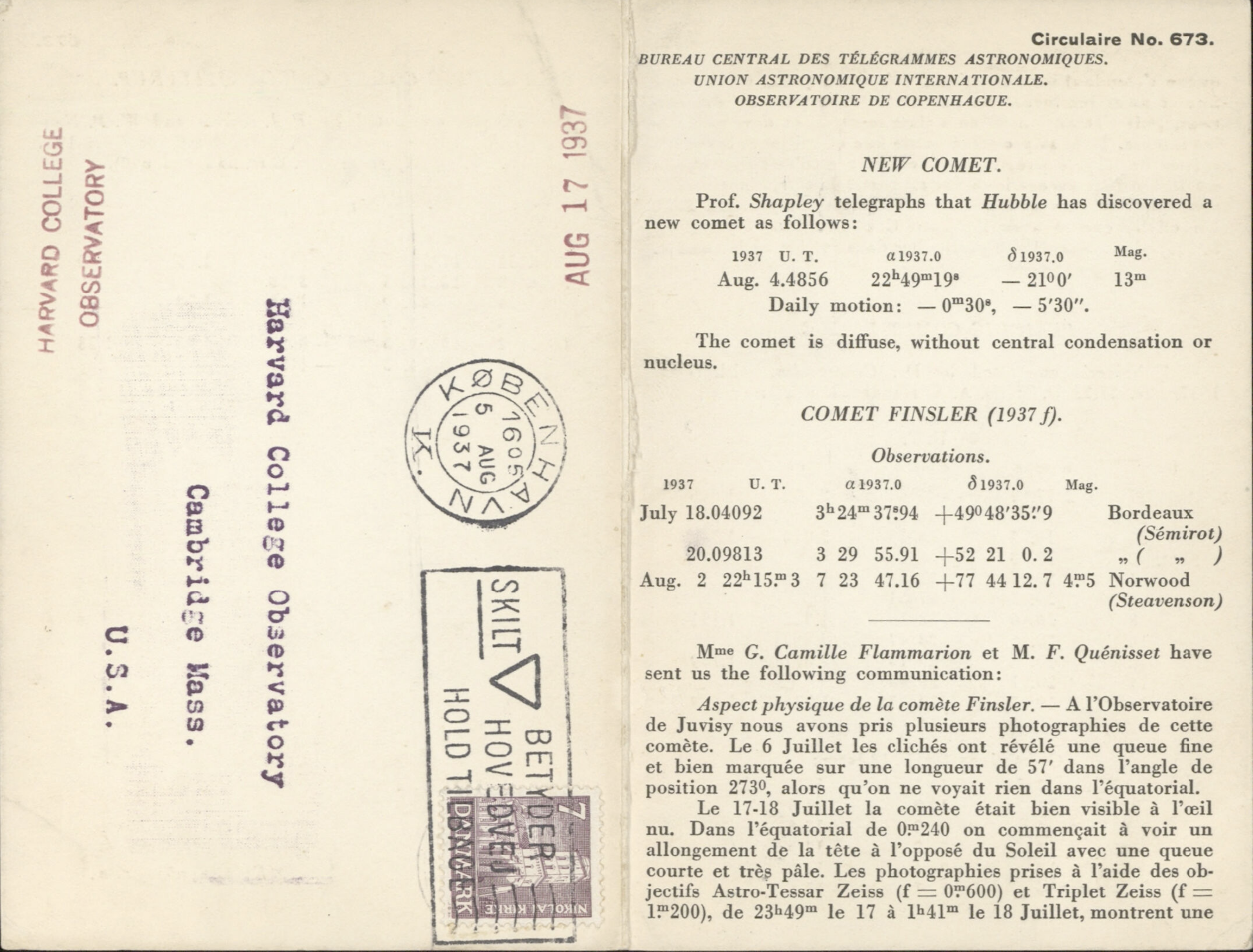
[edit]The comet was already on its outbound flight when it was first spotted in August 1937 as a magnitude 13.5 object in the constellation Aquarius.[4][5][a] Initially, the comet was reported to be diffuse without a central condensation or nucleus.[6] It is the fourth comet discovered in 1937.[7]
Follow-up observations were noticeably difficult due to its apparent close proximity to the Sun and low altitude over the horizon.[8][9] Despite being faint in the entirety of its visibility, numerous observations were conducted at the Union Observatory in Johannesburg, South Africa.[8] By 7 September 1937, the comet continued to fade at apparent magnitude 14.5 as reported from the Crossley telescope.[10] C/1937 P1 was last seen on 28 October 1937.[6]
Orbit
[edit]The first orbital calculations were made by L. E. Cunningham and A. D. Maxwell on 9 August 1937,[6] and the comet was later known to have an elliptical orbit by 1938.[8] At one point, it was briefly considered to be the same object as 9P/Tempel, which at the time was considered lost.[11] Further calculations in 1952 showed that the comet came to perihelion on 14 November 1936, about nine months prior to discovery, and has a long-periodic orbit of about 600 years.[5]
Notes
[edit]References
[edit]- 1 2 E. P. Hubble; H. Shapley (5 August 1937). E. Strömgren (ed.). "New Comet". IAU Circular. 673 (1).
- ↑ "Comet Names and Designations". International Comet Quarterly. Retrieved 9 December 2024.
- ↑ "C/1937 P1 (Hubble) – JPL Small-Body Database Browser". ssd.jpl.nasa.gov. Jet Propulsion Laboratory. Retrieved 30 October 2024.
- ↑ G. van Biesbroeck (October 1937). "Comet Notes". Popular Astronomy. 45: 437–438. Bibcode:1937PA.....45..437V.
- 1 2 A. Pryzybylski (1952). "Definitive Orbit of Comet 1937 g (Hubble)". Journal des Observateurs. 35: 113–120. Bibcode:1952JO.....35..113P.
- 1 2 3 4 G. W. Kronk (2009). Cometography: A Catalog of Comets. Vol. 4: 1933–1959. Cambridge University Press. pp. 75–76. ISBN 978-0-521-58507-1.
- ↑ F. L. Whipple (September 1937). "The Comets of 1937". The Scientific Monthly. 45 (3): 281–284. JSTOR 16438.
- 1 2 3 A. C. D. Crommelin (1938). "Comets" (PDF). Monthly Notices of the Royal Astronomical Society. 98 (4): 347–350. doi:10.1093/mnras/98.4.347.
- ↑ G. van Biesbroeck (1938). "Observations of Comets at the Yerkes Observatory". The Astronomical Journal. 47: 157–163. Bibcode:1938AJ.....47..157V. doi:10.1086/105506.
- ↑ H. M. Jeffers (1937). "Comet Notes". Publications of the Astronomical Society of the Pacific. 49 (291): 271–273. Bibcode:1937PASP...49..271J. doi:10.1086/124845.
- ↑ E. P. Hubble; L. E. Cunningham; J. P. Möller (1937). "Comet Notes". The Observatory. 60: 251. Bibcode:1937Obs....60..246.
External links
[edit]- C/1937 P1 at the JPL Small-Body Database

.png)