Carex stricta
| Carex stricta | |
|---|---|
 | |
Scientific classification  | |
| Kingdom: | Plantae |
| Clade: | Embryophytes |
| Clade: | Tracheophytes |
| Clade: | Angiosperms |
| Clade: | Monocots |
| Clade: | Commelinids |
| Order: | Poales |
| Family: | Cyperaceae |
| Genus: | Carex |
| Subgenus: | Carex subg. Carex |
| Section: | Carex sect. Phacocystis |
| Species: | C. stricta |
| Binomial name | |
| Carex stricta | |
| Synonyms | |
| |

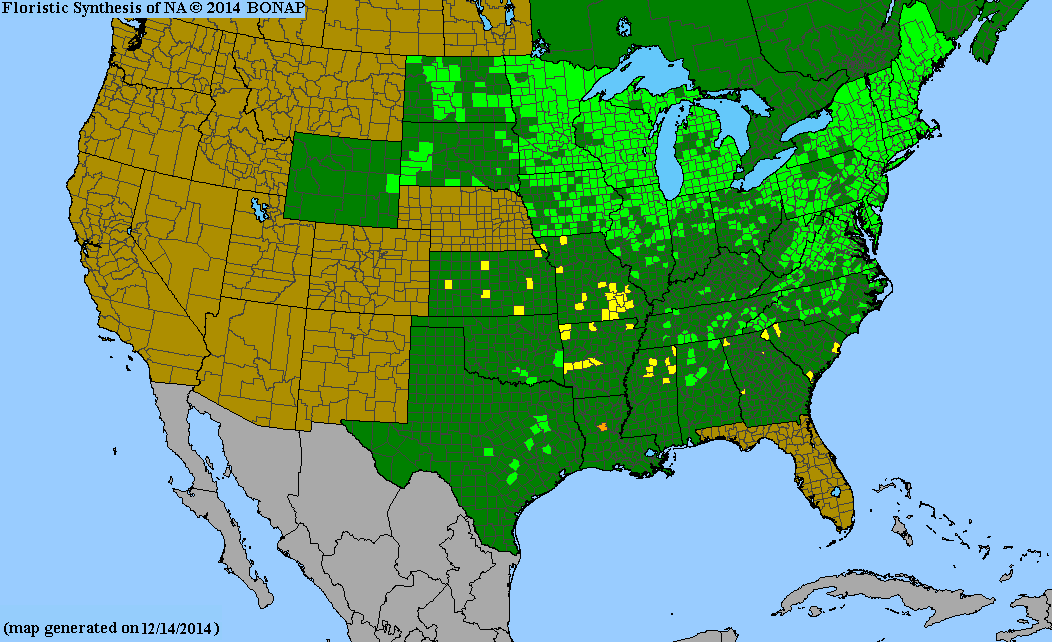
Carex stricta is a species of sedge known by the common names upright sedge[1] and tussock sedge.[2] The plant grows in moist marshes, forests and alongside bodies of water.[3] It grows up to 2 feet (0.61 m) tall and 2 feet (0.61 m) wide. When the leaves die, they build on top of or around the living plant, making a "tussock".[3] Widely distributed in and east of the Great Plains,[4] it is one of the most common wetland sedges in eastern North America.[5]
Their seeds are carried by the wind.[citation needed] When seeds land, they are eaten by birds such as dark-eyed junco, northern cardinal, wild turkey, and ducks such as mallard and wood duck. The seeds are also eaten by squirrels and other mammals.[3] The plant can also reproduce vegetatively via rhizomes, and often form colonies.[3]
It is a larval host to the black dash, the dun skipper, the eyed brown,[6] and the mulberry wing.[7]
References
[edit]- ↑ "Carex stricta Lam., upright sedge". PLANTS Profile. United States Department of Agriculture. Retrieved May 22, 2013.
- ↑ Coladonato, M. 1994. Carex stricta. In: Fire Effects Information System, USDA Forest Service Rocky Mountain Research Station, Fire Sciences Laboratory.
- 1 2 3 4 Carex stricta. Archived 2012-10-01 at the Wayback Machine Study of Northern Virginia Ecology. Fairfax County Public Schools.
- ↑ Kartesz, John T. (2014). "Carex stricta". County-level distribution map from the North American Plant Atlas (NAPA). Biota of North America Program (BONAP). Retrieved 15 April 2019.
- ↑ Carex stricta. Flora of North America.
- ↑ The Xerces Society (2016), Gardening for Butterflies: How You Can Attract and Protect Beautiful, Beneficial Insects, Timber Press.
- ↑ "Find a Butterfly". Mass Audubon. Retrieved 2026-06-18.