


Portal:Telecommunication

The Telecommunication Portal

Telecommunication, often used in its plural form or abbreviated as telecom, is the transmission of information over a distance using electrical or electronic means, typically through cables, radio waves, or other communication technologies. These means of transmission may be divided into communication channels for multiplexing, allowing for a single medium to transmit several concurrent communication sessions. Long-distance technologies invented during the 19th, 20th and 21st centuries generally use electric power, and include the electrical telegraph, telephone, television, and radio.
Early telecommunication networks used metal wires as the medium for transmitting signals. These networks were used for telegraphy and telephony for many decades. In the first decade of the 20th century, a revolution in wireless communication began with breakthroughs including those made in radio communications by Guglielmo Marconi, who won the 1909 Nobel Prize in Physics. Other early pioneers in electrical and electronic telecommunications include co-inventors of the telegraph Charles Wheatstone and Samuel Morse, numerous inventors and developers of the telephone including Antonio Meucci, Philipp Reis, Elisha Gray and Alexander Graham Bell, inventors of radio Edwin Armstrong and Lee de Forest, as well as inventors of television like Vladimir K. Zworykin, John Logie Baird and Philo Farnsworth.
Since the 1960s, the proliferation of digital technologies has meant that voice communications have gradually been supplemented by data. The physical limitations of metallic media prompted the development of optical fibre. The Internet, a technology independent of any given medium, has provided global access to services for individual users and further reduced location and time limitations on communications. (Full article...)
Selected article -

Electrical engineering is an engineering discipline concerned with the study, design, and application of equipment, devices, and systems that use electricity, electronics, and electromagnetism. It emerged as an identifiable occupation in the latter half of the 19th century after the commercialization of the electric telegraph, the telephone, and electrical power generation, distribution, and use.
Electrical engineering is divided into a wide range of different fields, including computer engineering, systems engineering, power engineering, telecommunications, radio-frequency engineering, signal processing, instrumentation, control engineering, photovoltaic cells, electronics, and optics and photonics. Many of these disciplines overlap with other engineering branches, spanning a huge number of specializations including hardware engineering, power electronics, electromagnetics and waves, microwave engineering, nanotechnology, electrochemistry, renewable energies, mechatronics/control, and electrical materials science. Machine learning and computer science techniques are also further studied due to being historically developed as fields of electrical engineering. (Full article...)
General images
-
 Oliver Lodge's 1894 lectures on Hertz demonstrated how to transmit and detect radio waves. (from History of radio)
 -
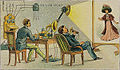 Artist's conception: 21st-century videotelephony imagined in the early 20th century (1910) (from History of videotelephony)
 -
 Portrait of John Reith, 1st Baron Reith, in 1925, founding director general of the BBC from 1922 to 1938 (from History of broadcasting)
 -
 Lee DeForest broadcasting Columbia phonograph records on New York station 2XG, 1916 (from History of broadcasting)
 -
 The Australian Broadcasting Corporation logo, first introduced in 1975 and based on the Lissajous curve (from History of broadcasting)
 -
 Color bars used in a test pattern, sometimes used when no program material is available (from History of television)
 -
 AT&T magazine advertisement announcing commercial launch of Picturephone service. (from History of videotelephony)
 -
 Top of cellular telephone tower (from History of the telephone)
 -
 Receiver schematic, c.1906 (from History of the telephone)
 -
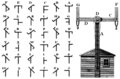 Code of letters and symbols for Chappe telegraph (Rees's Cyclopaedia) (from History of telecommunication)
 -
 The earliest photograph of a television picture, showing the face of Oliver Hutchinson in June 1926. The television picture was projected using Baird's television camera. (from History of television)
 -
 "Fiction becomes fact": Imaginary "Edison" combination videophone-television, conceptualized by George du Maurier and published in Punch magazine. The drawing also depicts then-contemporary speaking tubes, used by the parents in the foreground and their daughter on the viewing display (1878). (from History of videotelephony)
 -

-
 The Kyocera VP-210 Visual Phone was the first commercial mobile videophone. The Personal Handy-phone System (PHS) phone was introduced in Japan (1999). (from History of videotelephony)
 -
 DBS satellite dishes (from History of television)
 -
 Naomi ("Joan") Melwit and Norman Banks at the 3KZ microphone, in the late 1930s (from History of broadcasting)
 -
 A replica of one of Claude Chappe's semaphore towers (optical telegraph) in Nalbach, Germany (from History of telecommunication)
 -
 Reginald Fessenden, the "father" of radio broadcasting in the U.S. (from History of broadcasting)
 -
 Swedish Prime Minister Tage Erlander using an Ericsson videophone to speak with Lennart Hyland, a popular TV show host (1969) (from History of videotelephony)
 -
 Replica of the telettrofono at Museo Nazionale Scienza e Tecnologia Leonardo da Vinci of Milan, Italy, invented by Antonio Meucci and credited by several sources as the first telephone. (from History of the telephone)
 -
 The first commercial AM Audion vacuum tube radio transmitter, built in 1914 by Lee De Forest who invented the Audion (triode) in 1906 (from History of radio)
 -
 An early experiment demonstrating the refraction of microwaves by a paraffin lens by John Ambrose Fleming in 1897 (from History of radio)
 -
 Australian radio sets usually had the positions of radio stations marked on their dials. The illustration is a dial from a transistorised, mains-operated Calstan radio, c. 1960s. (Click image for a high resolution view, with readable callsigns.) (from History of broadcasting)
 -
 Charles Logwood broadcasting at New York station 2XG, 1916 (from History of broadcasting)
 -
 Reis's telephone around 1861, first device called telephone (from History of the telephone)
 -
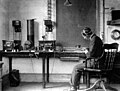 The Marconi Company was formed in England in 1910. The photo shows a typical early scene, from 1906, with Marconi employee Donald Manson at right. (from History of broadcasting)
 -
 Antonio Meucci, 1849, developing a voice-communication apparatus that several sources credit as the first telephone. (from History of the telephone)
 -
 First television test broadcast transmitted by the NHK Broadcasting Technology Research Institute in May 1939 (from History of television)
 -
 Alexander Graham Bell was awarded the first U.S. patent for the invention of the telephone in 1876. (from History of the telephone)
 -
Donald Manson working as an employee of the Marconi Company (England, 1906) (from History of radio)
-
 A French Gower telephone of 1912 at the Musée des Arts et Métiers in Paris (from History of the telephone)
 -

-
 The Regency TR-1, which used Texas Instruments' NPN transistors, was the world's first commercially produced transistor radio in 1954. Size: 3×5×1.25 inch (7.6×12.7×3.2 cm) (from History of radio)
 -
 The Philco Predicta, 1958. In the collection of The Children's Museum of Indianapolis (from History of television)
 -
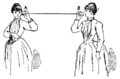 A 19th century acoustic tin can or "lovers' telephone" (from History of the telephone)
 -
 The master telephone patent, 174465, granted to Bell, March 7, 1876 (from History of telecommunication)
 -
 Reconstruction of Aeneas Tacticus' hydraulic telegraph (4th c. B.C.) in Kotsanas Museum of Ancient Greek Technology, Athens, Greece. (from History of telecommunication)
 -
 Screen idol Rudolph Valentino at the microphone of WSB in Atlanta, 1923 (from History of broadcasting)
 -
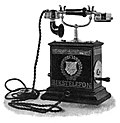 1896 telephone (Sweden) (from History of the telephone)
 -
 AT&T Picturephone (Mod II) fully enclosed in its housing, control pad at bottom (from History of videotelephony)
 -
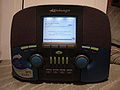 The "Kerbango Internet Radio" was the first stand-alone product that let users listen to Internet radio without a computer. (from History of broadcasting)
 -

-
 Ad for the beginning of experimental television broadcasting in New York City by RCA in 1939 (from History of television)
 -
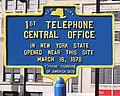 Historical marker commemorating the first telephone central office in New York State (1878) (from History of the telephone)
 -
 Around 1920, radio broadcasting started to get popular. The Brox Sisters, a popular singing group, gathered around the radio at the time. (from History of radio)
 -
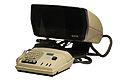 The French Matra videophone (1970) (from History of videotelephony)
 -
 Thomas Edison invented the carbon microphone which produced a strong telephone signal. (from History of the telephone)
 -
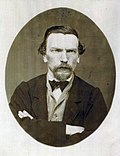 Innocenzo Manzetti considered the idea of a telephone in 1844 (from History of the telephone)
 -
 Early pioneers of radio science and technology in the United States, including Charles Steinmetz, David Sarnoff, Irving Langmuir, and Alfred Goldsmith in 1921, photographed next to the antenna feed wires of the New Brunswick Marconi Station, one of the first transatlantic radio links. The photo includes Albert Einstein as a visiting guest. (from History of radio)
 -
 RCA 630-TS, the first mass-produced television set, which sold in 1946–1947 (from History of television)


_%E2%80%93_National_Portrait_Gallery,_London.jpg)

.svg)


._Photograph_by_L._Alman._Wellcome_V0026857.jpg)


.jpg)


_LCCN2014717186.jpg)


Things to do
 |
Here are some tasks awaiting attention:
|
Selected biography -

Samuel Finley Breese Morse (April 27, 1791 – April 2, 1872) was an American inventor and painter. After establishing his reputation as a portrait painter, Morse, in his middle age, contributed to the invention of a single-wire telegraph system based on European telegraphs. He was a co-developer and the namesake of Morse code in 1837 and helped to develop the commercial use of telegraphy. (Full article...)
Did you know (auto-generated) -

- ... that ChatGPT developer John Schulman said that his first period of serious self-directed study was inspired by the television show BattleBots?
- ... that television director Diana Edwards-Jones introduced earpieces to permit direct communication between a control room and newsreaders?
- ... that a radio station requested changes to a light-rail project?
- ... that Angelito de Canal 13, the mascot of the Chilean television network Canal 13, was inspired by its creator's son?
- ... that Yang Pao'an refused to forsake the Chinese Communist Party, reportedly even after a telephone call with Chiang Kai-shek?
- ... that on every Christmas Eve since 1994, Willem Lange's story about the fruitcake-delivering farmer Favor Johnson is broadcast on public radio stations in Vermont?
Related portals


Topics


{ }}
Subcategories

Associated Wikimedia
The following Wikimedia Foundation sister projects provide more on this subject:
-
 Commons
Free media repository -
 Wikidata
Free knowledge base -
 Wikiquote
Collection of quotations -
 Wikisource
Free-content library -
 Wikiversity
Free learning tools -
 Wiktionary
Dictionary and thesaurus


