


Portal:United Kingdom

_Wikivoyage_Banner.JPG)
The United Kingdom Portal
.svg) |
 |

| |
The United Kingdom of Great Britain and Northern Ireland, commonly known as the United Kingdom (UK) or Britain, is a country in northwestern Europe, off the coast of the continental mainland. It comprises England, Scotland, Wales and Northern Ireland, with a population of over 69 million in 2024. The UK includes the island of Great Britain, the north-eastern part of the island of Ireland, and most of the smaller islands within the British Isles, covering 94,354 square miles (244,376 km2). It shares a land border with the Republic of Ireland and is surrounded by the Atlantic Ocean, the North Sea, the English Channel, the Celtic Sea and the Irish Sea, while maintaining sovereignty over the Crown Dependencies and the British Overseas Territories. The capital and largest city of England and the UK is London; Edinburgh, Cardiff and Belfast are the national capitals of Scotland, Wales and Northern Ireland, respectively.
The British Isles have been continuously inhabited since the Neolithic. In AD 43 the Roman conquest of Britain began. The Roman departure between 383 and 410 was followed by Anglo-Saxon settlement beginning around 450. In 1066 the Normans conquered England. Over the 17th century the role of the British monarchy was reduced, particularly as a result of the English Civil War. In 1707 the Kingdom of England and the Kingdom of Scotland united under the Treaty of Union to create the Kingdom of Great Britain. The Acts of Union 1800 incorporated the Kingdom of Ireland to create the United Kingdom of Great Britain and Ireland in 1801. Most of Ireland seceded from the UK in 1922 as the Irish Free State, and the Royal and Parliamentary Titles Act 1927 created the present United Kingdom.
The UK became the first industrialised country and was the world's foremost power for the majority of the 19th and early 20th centuries, particularly during the Pax Britannica between 1815 and 1914. The British Empire was the leading economic power for most of the 19th century, a position supported by its agricultural prosperity, its role as a dominant trading nation, a massive industrial capacity, significant technological achievements, and the rise of 19th-century London as the world's principal financial centre. At its height in the 1920s, the empire encompassed around a quarter of the world's landmass and population, and was the largest in history. However, its involvement in the First World War and in the Second World War damaged Britain's economic power, and a global wave of decolonisation led to the independence of most British colonies. (Full article...)
Featured article

Carrington Moss is a large area of peat bog near Carrington in Greater Manchester, England. It is south of the River Mersey, approximately 10 miles (16 km) south-west of Manchester, and occupies an area of about 1,100 acres (445 hectares). The depth of peat varies between 17 feet (5 m) and 20 feet (6 m). Originally an unused area of grouse moorland, the Moss was reclaimed in the latter half of the 19th century for farming and the disposal of nearby Manchester's waste. A system of tramways was built to connect the Moss with the Manchester Ship Canal and a nearby railway line. During World War II the land was used as a Starfish site, and in the latter half of the 20th century a large industrial complex was built along its northern edge. More recently several sporting facilities have been built on Carrington Moss. Today, the land is still used for farming, and several nature reserves have been established within its bounds. Parts of the Moss are accessible to the public over several rights of way. (Full article...)
Featured biography

Stanley Green (1915–1993) was a sandwich man who became a well-known figure in London, England, during the latter half of the 20th century. For 25 years Green patrolled Oxford Street, carrying a placard that advocated "Less Lust, By Less Protein: Meat Fish Bird; Egg Cheese; Peas Beans; Nuts. And Sitting"—the wording, and punctuation, changing somewhat over the years. Arguing that protein made people lustful and aggressive, his solution was "protein wisdom," a low-protein diet for "better, kinder, happier people." For a few pence, passers-by could buy his 14-page pamphlet, Eight Passion Proteins with Care, which reportedly sold 87,000 copies over 20 years. Green became one of London's much-loved eccentrics, though his campaign to suppress desire, as one commentator put it, was not invariably popular, leading to two arrests for obstruction and the need to wear green overalls to protect himself from spit. He nevertheless took great delight in his local fame. The Sunday Times interviewed him in 1985, and his "less passion, less protein" slogan was used by Red or Dead, the London fashion house. When he died in 1993 at the age of 78, The Daily Telegraph, The Guardian, and The Times published his obituary, and his pamphlets, placards, and letters were passed to the Museum of London. (Full article...)
General images -
-
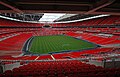 Wembley Stadium, London, home of the England football team and FA Cup finals. Wembley also hosts concerts: Adele's 28 June 2017 concert was attended by 98,000 fans, a stadium record for a music event in the UK. (from Culture of the United Kingdom)
 -
 William III and Mary II Presenting the Cap of Liberty to Europe, 1716, Sir James Thornhill. Enthroned in heaven with the Virtues behind them are the royals William and Mary who had taken the throne after the Glorious Revolution and signed the English Bill of Rights of 1689. William tramples on arbitrary power and hands the red cap of liberty to Europe where, unlike Britain, absolute monarchy stayed the normal form of power execution. Below William is the French king Louis XIV. (from Culture of the United Kingdom)
 -
 The British Heart Foundation is the biggest funder of cardiovascular research in the UK. (from Culture of the United Kingdom)
 -
 Smeaton's Eddystone Lighthouse, 9 miles out to sea. John Smeaton pioneered hydraulic lime in concrete which led to the development of Portland cement in England and thus modern concrete. (from Culture of the United Kingdom)
 -

-
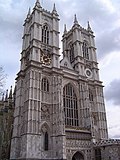 Westminster Abbey is an example of English Gothic architecture. Since 1066, when William the Conqueror was crowned, the coronations of British monarchs have been held here. (from Culture of the United Kingdom)
 -
 The British Shorthair was an inspiration for the Cheshire Cat in Lewis Carroll's Alice in Wonderland. (from Culture of the United Kingdom)
 -
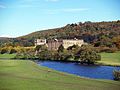 One of the UK's many stately homes, Chatsworth House in Derbyshire, surrounded by an English garden. The house is one of the settings of Jane Austen's novel Pride and Prejudice. (from Culture of the United Kingdom)
 -
 The Oxford Union debate chamber. Called the "world's most prestigious debating society", the Oxford Union has hosted leaders and celebrities. (from Culture of the United Kingdom)
 -
 Tea, biscuits, jam and cakes. Tea is the most popular beverage in the UK. (from Culture of the United Kingdom)
 -
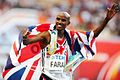 Mo Farah is the most successful British track athlete in modern Olympic Games history, winning the 5000 m and 10,000 m events at two Olympic Games. (from Culture of the United Kingdom)
 -
 The Notting Hill Carnival is Britain's biggest street festival. Led by members of the British African-Caribbean community, the annual carnival takes place in August and lasts three days. (from Culture of the United Kingdom)
 -
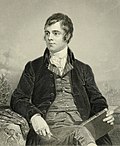 Robert Burns is regarded as the national poet of Scotland.
 -
 The wizard Merlin features as a character in many works of fiction, including the BBC series Merlin. (from Culture of the United Kingdom)
 -
 Two of the current Ravens of the Tower of London. The ravens' presence is traditionally believed to protect the Crown and the tower; a superstition holds that "if the Tower of London ravens are lost or fly away, the Crown will fall and Britain with it". (from Culture of the United Kingdom)
 -
 Ice dancers Torvill and Dean in 2011. Their historic gold medal-winning performance at the 1984 Winter Olympics was watched by a British television audience of more than 24 million people. (from Culture of the United Kingdom)
 -
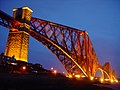 The Forth Railway Bridge is a cantilever bridge over the Firth of Forth in the east of Scotland. It was opened in 1890, and is designated as a Category A listed building. (from Culture of the United Kingdom)
 -
 Trooping the Colour is an annual ceremony, most notably associated with the British Army, and involves a grand parade featuring hundreds of soldiers, horses, and musicians. (from Culture of the United Kingdom)
 -
 King Edward's Chair in Westminster Abbey. A 13th-century wooden throne on which the British monarch sits when he or she is crowned at the coronation, swearing to uphold the law and the church. The monarchy is apolitical and impartial, with a largely symbolic role as head of state. (from Culture of the United Kingdom)
 -
 Emmeline Pankhurst. Named one of the 100 Most Important People of the 20th Century by Time, Pankhurst was a leading figure in the suffragette movement. (from Culture of the United Kingdom)
 -
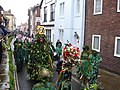 Jack in the Green, a traditional English folk custom being celebrated in Hastings Old Town, known for its many historic buildings. (from Culture of the United Kingdom)
 -
 Centre Court at Wimbledon. The world's oldest tennis tournament, it has the longest sponsorship in sport with Slazenger supplying tennis balls to the event since 1902. (from Culture of the United Kingdom)
 -
 Typical 20th-century, three-bedroom semi-detached houses in England (from Culture of the United Kingdom)
 -
 Naomi Campbell appeared on the era-defining January 1990 cover of British Vogue. (from Culture of the United Kingdom)
 -
 Peter O'Toole as T. E. Lawrence in David Lean's 1962 epic Lawrence of Arabia (from Culture of the United Kingdom)
 -
 King Alfred the Great statue in Winchester, Hampshire. The 9th-century English king encouraged education in his kingdom, and proposed that primary education be taught in English, with those wishing to advance to holy orders to continue their studies in Latin. (from Culture of the United Kingdom)
 -
 Welsh native Roald Dahl is frequently ranked the best children's author in British polls.
 -
 Statue of Minnie the Minx, a character from The Beano, in Dundee, Scotland. Launched in 1938, The Beano is known for its anarchic humour, with Dennis the Menace appearing on the cover. (from Culture of the United Kingdom)
 -
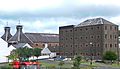 Old Bushmills Distillery, County Antrim, Northern Ireland. Founded in 1608, it is the oldest licensed whiskey distillery in the world. (from Culture of the United Kingdom)
 -
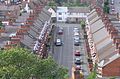 Terraced houses are typical in inner cities and places of high population density. (from Culture of the United Kingdom)
 -
 Bodiam Castle is a 14th-century moated castle in East Sussex. Today there are thousands of castles throughout the UK. (from Culture of the United Kingdom)
 -
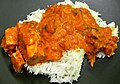 Chicken tikka masala, served atop rice. An Anglo-Indian meal, it is among the UK's most popular dishes. (from Culture of the United Kingdom)
 -

-
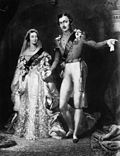 Queen Victoria in her white wedding dress with Prince Albert on their return from the marriage service at St James's Palace, London, 10 February 1840 (from Culture of the United Kingdom)
 -

-
 A 21st-century detached Mock Tudor house in Scotland. Its timber framing is typical of English Tudor architecture. (from Culture of the United Kingdom)
 -
 Titanic Belfast museum on the former shipyard in Belfast where the RMS Titanic was built (from Culture of the United Kingdom)
 -
 The Beatles are the most commercially successful and critically acclaimed band in popular music, with estimated sales of over one billion.
 -
 Sunday league football (a form of amateur football). Amateur matches throughout the UK often take place in public parks. (from Culture of the United Kingdom)
 -
 The Grenadier Guards band playing "The British Grenadiers" at Trooping the Colour. Formed in 1685 the band performs at British ceremonial events. (from Culture of the United Kingdom)
 -
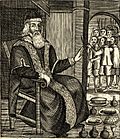 The Examination and Trial of Father Christmas (1686), published after Christmas was reinstated as a holy day in England (from Culture of the United Kingdom)
 -
 Featherweight champion "Prince" Naseem Hamed was a major name in boxing and 1990s British pop culture. (from Culture of the United Kingdom)
 -
 The Proms are held annually at the Royal Albert Hall during the summer. Regular performers at the Albert Hall include Eric Clapton who has played at the venue over 200 times. (from Culture of the United Kingdom)
 -
 Hadrian's Wall was built in the 2nd century AD. It is a lasting monument from Roman Britain. It is the largest Roman artefact in existence. (from Culture of the United Kingdom)
 -
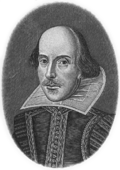 William Shakespeare has had a significant impact on British theatre and drama. (from Culture of the United Kingdom)
 -

-
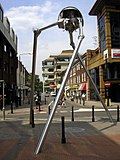 Statue of a tripod from The War of the Worlds in Woking, England, the hometown of author H. G. Wells. The book is a seminal depiction of a conflict between mankind and an extraterrestrial race. (from Culture of the United Kingdom)
 -
 Queen Victoria's Christmas tree at Windsor Castle, published in the Illustrated London News, 1848 (from Culture of the United Kingdom)
 -
 The Christmas Pantomime 1890. Pantomime plays a prominent role in British culture during the Christmas and New Year season. (from Culture of the United Kingdom)
 -
 The founder of modern nursing Florence Nightingale tending to a patient in 1855. An icon of Victorian Britain, she is known as The Lady with the Lamp. (from Culture of the United Kingdom)


.jpg)
_Moscow_2013.jpg)


.jpg)


_zoom.jpg)


.jpg)


Subportals


WikiProjects
Things you can do
- Visit the British Wikipedians' notice board.
- The noticeboard is the central forum for information and discussion on editing related to the United Kingdom.
- Comment at the British deletion sorting page.
- This page lists deletion discussions on topics relating to the United Kingdom.
Featured pictures
-
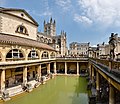 Photograph credit: David IliffThe Roman Baths complex is a site of historical interest in the English city of Bath, Somerset. It is a well-preserved site dating from Roman Britain once used for public bathing. The Roman baths themselves are below the modern street level. There are four main features: the Sacred Spring, the Roman Temple, the Roman Bath House, and the museum which holds finds from the Roman town. The buildings above street level date from the 19th century. The Baths are a major tourist attraction and, together with the Grand Pump Room, received more than 1.3 million visitors in 2018. Visitors can tour the baths and museum but cannot enter the water.
This picture shows the Great Bath of the Roman Baths complex, with Bath Abbey visible in the background. The entire structure above the level of the pillar bases is of later construction. -
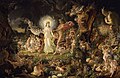 The Quarrel of Oberon and Titania is an oil painting on canvas by the Scottish artist Joseph Noel Paton. Painted in 1849, it depicts the scene from William Shakespeare's comedy play A Midsummer Night's Dream, in which the fairy queen Titania and fairy king Oberon quarrel. When exhibited in Edinburgh in 1850, it was declared the "painting of the season". The painting was acquired by the National Galleries of Scotland in 1897, having initially been bought by the Royal Association for Promoting the Fine Arts.
 -
 Book credit: Anne de FelbriggeThe Felbrigge Psalter, an illuminated manuscript Psalter, is the oldest book from England to have an embroidered bookbinding. The needlework on this mid-thirteenth century manuscript probably dates from the early fourteenth century, which puts it more than a century earlier than the next oldest embroidered binding to have survived. Both the design and execution depicting the Annunciation are exceptionally high quality. The cover is made with linen and gold on linen with later leather binding edge.
 -
 Photo credit: Chalmers ButterfieldShaftesbury Avenue from Piccadilly Circus, in the West End of London, c. 1949. The Circus, a famous traffic intersection and public space in the City of Westminster was built in 1819 to connect Regent Street with the major shopping street of Piccadilly. Its status as a major traffic intersection has made it a busy meeting point and a tourist attraction in its own right.
 -
 Photo credit: David IliffA 360° panorama of London taken from the dome of St Paul's Cathedral. Built from 1675 to 1708, the Cathedral is still one of the tallest buildings in the City of London.
 -
 Photo: Saffron BlazeArlington Row, a row of Cotswold stone cottages in Bibury, Gloucestershire, England. Built in 1380 as a monastic wool store, the buildings were converted into weavers' cottages in the 17th century. William Morris declared the village to be the most beautiful in England.
 -
 A map of Gibraltar, a British overseas territory located near the southernmost tip of the Iberian Peninsula overlooking the Strait of Gibraltar. The territory shares a border with Spain to the north. Gibraltar has historically been an important base for the British Armed Forces and is the site of a Royal Navy base.
 -
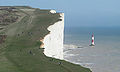 Photo: David IliffBeachy Head is a chalk headland on the south coast of England, close to the town of Eastbourne in the county of East Sussex. The cliff there is the highest chalk sea cliff in Britain, rising to 162 m (530 ft) above sea level. The peak allows views of the south east coast from Dungeness to the east, to Selsey Bill in the west.
 -
 Photo credit: DiliffA stitched image of the Radcliffe Camera in Oxford, England, as seen from the tower of the Church of St Mary the Virgin. The building, often abbreviated as 'Rad Cam', was built by James Gibbs in 1737–1749 to house the Radcliffe Science Library. After the Radcliffe Science Library moved into another building, the Radcliffe Camera became a reading room of the Bodleian Library.
 -
 Caterpillar, Alice's Adventures in WonderlandArtist: Sir John TennielSir John Tenniel's illustration of the Caterpillar for Lewis Carroll's classic children's book, Alice's Adventures in Wonderland. The illustration is noted for its ambiguous central figure, which can be viewed as having either a human male's face with pointed nose and protruding lower lip or as the head end of an actual caterpillar, with the right three "true" legs visible. The small symbol in the lower left is composed of Tenniel's initials, which was how he signed most of his work for the book. The partially obscured word in the lower left-center is the last name of Edward Dalziel, the engraver of the piece.
 -
 Artist: Attributed to John TaylorThe Chandos portrait is a famous painting believed to depict William Shakespeare, and is named after James Brydges, 1st Duke of Chandos, who owned the portrait. It has not been possible to solve the question of who painted the portrait or whether it really depicts Shakespeare. However, in 2006 the National Portrait Gallery in London concluded that the Chandos portrait was the most likely to be a representation of Shakespeare.
 -
 Painting: Portrait of Henry VIII, workshop of Hans Holbein the YoungerHenry VIII of England (1491–1547) was King of England from 1509 until his death. Henry was the second Tudor monarch, succeeding his father, Henry VII. Perhaps best known for his six marriages, his disagreement with the Pope on the question of annulment led Henry to initiate the English Reformation, separating the Church of England from papal authority and making the English monarch the Supreme Head of the Church of England. He also instituted radical changes to the English Constitution, expanded royal power, dissolved monasteries, and united England and Wales. In this, he spent lavishly and frequently quelled unrest using charges of treason and heresy.
 -
 Photo credit: Bain News ServiceMary of Teck was the queen consort of King George V as well as the Empress of India. Before her accession, she was successively Duchess of York, Duchess of Cornwall and Princess of Wales. By birth, she was a princess of Teck, in the Kingdom of Württemberg, with the style Her Serene Highness. To her family, she was informally known as May, after her birth month. Queen Mary was known for setting the tone of the British royal family, as a model of regal formality and propriety, especially during state occasions. She was the first Queen Consort to attend the coronation of her successors. Noted for superbly bejewelling herself for formal events, Queen Mary left a collection of jewels now considered priceless.
 -
 Photograph credit: Daniel CaseKew Gardens is a botanic garden in southwest London. Founded in 1840, its living collections include some 27,000 taxa while the herbarium houses over 8.5 million preserved plant and fungal specimens. This photograph shows the Davies Alpine House, which opened in 2006. The design of the greenhouse encourages natural airflow, the automatically operated blinds prevent overheating, and the glass is of a special type that allows maximum transmission of ultraviolet light. The structure houses a collection of alpine plants that grow above the tree line in their localities of origin.
 -
 Photo credit: DiliffThe quadrangle of Windsor Castle, one of the principal official residences of the British monarch. On the far left is the State Apartments, at the end of the quad is the Private Apartments, where Queen Elizabeth II resides on weekends, and on the right, the South Wing. Located at Windsor in the English county of Berkshire, it is the largest inhabited castle in the world and, dating back to the time of William the Conqueror, the oldest in continuous occupation.


Did you know -

- ... that Anne was the last circus elephant in the United Kingdom?
- ... that Thelma Adams protested milk quotas in the United Kingdom by sitting in a bathtub of milk, while dressed as Cleopatra?
- ... that the Labour Party received their highest share of the vote to date in the 1951 UK general election but still lost to the Conservatives, who received fewer votes?
- ... that by losing her constituency of South West Norfolk in 2024, Liz Truss became the first former UK prime minister since 1935 to lose their seat?
- ... that the size of the entrance hall at the British legation in Uruguay was increased after a diplomat complained that there was not enough room to hold dances?
- ... that a £142 wine fridge was smuggled into Downing Street on 11 December 2020, during the height of the COVID-19 lockdown in the United Kingdom?
In the news

- 31 July 2026 –
- A cancer patient at the Christie hospital in Manchester, United Kingdom, becomes the first to receive the ZI-MA4-1 therapy. (BBC) (The Independent)
- 21 July 2026 – Middle Eastern crisis
- A tanker is attacked by Iran in the coast of Oman near the Strait of Hormuz in the wake of the U.S. military conducting strikes for a 10th consecutive night yesterday, forcing crew to abandon ship. The United Kingdom Maritime Trade Operations also confirms the attack. (Military.com)
- 20 July 2026 – 2026 Labour Party leadership crisis
- Sir Keir Starmer resigns as Prime Minister of the United Kingdom, and is succeeded by Andy Burnham. (CNN) (The Guardian) (The Telegraph)
- 17 July 2026 – 2026 Labour Party leadership election
- Andy Burnham is elected as the new leader of the British Labour Party. He will formally succeed Keir Starmer as prime minister on Monday. (BBC News) (CNN) (The Guardian)
- 15 July 2026 – United Kingdom–European Union relations
- Effect of Brexit on Gibraltar
- The United Kingdom and the European Union remove the land-border fence between Gibraltar and Spain under a post-Brexit treaty, allowing free movement while introducing joint British-Spanish checks at Gibraltar's airport and port. (AP)
Categories

Other UK-connected Wikipedias
Wikimedia
The following Wikimedia Foundation sister projects provide more on this subject:
-
 Commons
Free media repository -
 Wikidata
Free knowledge base -
 Wikiquote
Collection of quotations -
 Wikisource
Free-content library -
 Wikiversity
Free learning tools -
 Wikivoyage
Free travel guide -
 Wiktionary
Dictionary and thesaurus


