


Portal:Wine

The Wine Portal


Wine is an alcoholic beverage made from fermentation of grape juice. The natural chemical balance of grapes is such that they can ferment without the addition of sugars, acids, enzymes, or other nutrients. Although fruits other than grapes can also be fermented, the resultant wines are normally named after the fruit from which they are produced (for example, apple wine) and are known as fruit wine (or country wine). Others, such as barley wine and rice wine (e.g. sake), are made from starch-based materials and resemble beer more than wine; ginger wine is fortified with brandy. In these cases, the use of the term "wine" is a reference to the higher alcohol content, rather than the production process. The commercial use of the word "wine" (and its equivalent in other languages) is protected by law in many jurisdictions. Wine is produced by fermenting crushed grapes using various types of yeast which consume the sugars found in the grapes and convert them into alcohol. Various varieties of grapes and strains of yeasts are used depending on the types of wine produced.
Wine stems from an extended and rich history dating back about 8,000 years and is thought to have originated in present-day Georgia or Iran. Wine is thought to have appeared in Europe about 6,500 years ago in present-day Bulgaria and Greece and was very common in ancient Greece and Rome; the Greek god Dionysos, and his Roman counterpart Liber represented wine. Wine continues to play a role in religious ceremonies, such as Kiddush in Judaism and the Eucharist in Christianity. (Full article...)
Selected articles -
-
![Image 1 Ripe Sauvignon blanc grapes Sauvignon blanc (French pronunciation: [soviɲɔ̃ blɑ̃] ⓘ) is a green-skinned grape variety that most likely originated in the Loire Valley wine region in France, though it has also been historically cultivated in Bordeaux. The grape most likely gets its name from the French words sauvage ("wild") and blanc ("white") due to its early origins as an indigenous grape in South West France. It is possibly a descendant of Savagnin. Sauvignon blanc is widely cultivated in many of the world's wine regions, including France, Argentina (also in Patagonia) Chile, Romania, Canada, Australia, New Zealand, South Africa, Bulgaria, and the states of Oregon, Washington, and California in the US. Some New World Sauvignon blancs, particularly from California, may also be called "Fumé Blanc", a marketing term coined by Robert Mondavi in reference to Pouilly-Fumé. (Full article...)](https://upload.wikimedia.org/wikipedia/en/d/d2/Blank.png)
Sauvignon blanc (French pronunciation: [soviɲɔ̃ blɑ̃] ⓘ) is a green-skinned grape variety that most likely originated in the Loire Valley wine region in France, though it has also been historically cultivated in Bordeaux. The grape most likely gets its name from the French words sauvage ("wild") and blanc ("white") due to its early origins as an indigenous grape in South West France. It is possibly a descendant of Savagnin.
Sauvignon blanc is widely cultivated in many of the world's wine regions, including France, Argentina (also in Patagonia) Chile, Romania, Canada, Australia, New Zealand, South Africa, Bulgaria, and the states of Oregon, Washington, and California in the US. Some New World Sauvignon blancs, particularly from California, may also be called "Fumé Blanc", a marketing term coined by Robert Mondavi in reference to Pouilly-Fumé. (Full article...) -
White wine is a wine that is fermented without undergoing the process of maceration, which involves prolonged contact between the juice and the grape skins, seeds, and pulp. The wine color can be straw-yellow, yellow-green, or yellow-gold. It is produced by the alcoholic fermentation of the noncolored pulp of grapes, which may have a skin of any color. White wine has existed for at least 4,000 years.
The wide variety of white wines comes from the large number of varieties, methods of winemaking, and ratios of residual sugar. White wine is mainly from "white" grapes, which are green or yellow in color, such as the Chardonnay, Sauvignon blanc and Riesling. Some white wine is also made from grapes with colored skin, provided that the obtained must is not stained. Pinot noir, for example, is commonly used to produce champagne. (Full article...) -
Copia: The American Center for Wine, Food & the Arts was a non-profit museum and educational center in downtown Napa, California, dedicated to wine, food and the arts of American culture. The center, planned and largely funded by vintners Robert and Margrit Mondavi, was open from 2001 to 2008. The 78,632-square-foot (7,305.2 m2) museum had galleries, two theaters, classrooms, a demonstration kitchen, a restaurant, a rare book library, and a 3.5-acre (1.4 ha) vegetable and herb garden; there it hosted wine and food tasting programs, exhibitions, films, and concerts. The main and permanent exhibition of the museum, "Forks in the Road", explained the origins of cooking through to modern advances. The museum's establishment benefited the city of Napa and the development and gentrification of its downtown.
Copia hosted its opening celebration on November 18, 2001. Among other notable people, Julia Child helped fund the venture, which established a restaurant named Julia's Kitchen. Copia struggled to achieve its anticipated admissions, and had difficulty in repaying its debts. Proceeds from ticket sales, membership and donations attempted to support Copia's payoff of debt, educational programs and exhibitions, but eventually were not sufficient. After numerous changes to the museum to increase revenue, Copia closed on November 21, 2008. Its library was donated to Napa Valley College and its Julia Child cookware was sent to the National Museum of American History. The 12-acre (4.9 ha) property was then placed for sale; the Culinary Institute of America purchased the northern portion of the property in October 2015. The college opened its campus—the Culinary Institute of America at Copia, which houses the CIA's new Food Business School—in 2016. (Full article...) -
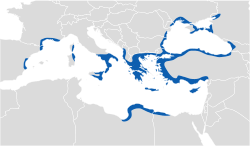
Greek influence in the 6th century BC
The influence of wine in ancient Greece helped ancient Greece trade with neighboring countries and regions. Many mannerisms and cultural aspects were associated with wine. It led to great change in Ancient Greece as well.
The ancient Greeks pioneered new methods of viticulture and wine production that they shared with early winemaking communities in what are now France, Italy, Austria and Russia, as well as others, through trade and colonization. Along the way, they markedly influenced the ancient European winemaking cultures of the Celts, Etruscans, Scythians and ultimately the Romans. (Full article...) -

A glass of champagne exhibiting the characteristic bubbles associated with the wine
Champagne (/ʃæmˈpeɪn/; French: [ʃɑ̃paɲ] ⓘ) is a sparkling wine originated and produced in the Champagne wine region of France under the AOC rules of the appellation, which demand specific vineyard practices, sourcing of grapes exclusively from designated places within it, specific grape-pressing methods and secondary fermentation of the wine in the bottle to cause carbonation.
The grapes Pinot noir, Pinot meunier, and Chardonnay are used to produce almost all champagne, but small amounts of Pinot blanc, Pinot gris (called Fromenteau in Champagne), Arbane, Chardonnay rosé, and Petit Meslier are vinified as well. (Full article...) -
Sangiovese is a red Italian wine grape variety that derives its name from the Latin sanguis Jovis, "blood of Jupiter".
Sangiovese Grosso, used for traditionally powerful and slow maturing red wines, is primarily grown in the central regions of Italy, particularly in Tuscany, where it is the dominant grape variety. Here, Sangiovese thrives in various subregions, including Chianti, Montalcino, and Montepulciano,
whose diverse terroirs winemakers put to good use to craft wines that reflect the land's unique nuances. (Full article...) -
Roussanne (French pronunciation: [ʁusan] ⓘ) is a white wine grape grown originally in the Rhône wine region in France, where it is often blended with Marsanne. It is the only other white variety, besides Marsanne, allowed in the northern Rhône appellations of Crozes-Hermitage AOC, Hermitage AOC and Saint-Joseph AOC. In the southern Rhône appellation of Châteauneuf-du-Pape AOC it is one of six white grapes allowed, where it may be blended into red wines. Roussanne is also planted in various wine-growing regions of the New World, such as California, Washington, Texas, South Africa and Australia as well as European regions such as Crete, Tuscany and Spain.
The berries are distinguished by their russet color when ripe—roux is French for the reddish-brown color russet, and is probably the root for the variety's name. The aroma of Roussanne is often reminiscent of a flowery herbal tea. In warm climates, it produces wines of richness, with flavors of honey and pear, and full body. In cooler climates it is more floral and more delicate, with higher acidity. In many regions, it is a difficult variety to grow, with vulnerability to mildew, poor resistance to drought and wind, late and/or uneven ripening, and irregular yields. (Full article...) -

Fermenting must
The process of fermentation in winemaking turns grape juice into an alcoholic beverage. During fermentation, yeasts transform sugars present in the juice into ethanol and carbon dioxide (as a by-product). In winemaking, the temperature and speed of fermentation are important considerations as well as the levels of oxygen present in the must at the start of the fermentation. The risk of stuck fermentation and the development of several wine faults can also occur during this stage, which can last anywhere from 5 to 14 days for primary fermentation and potentially another 5 to 10 days for a secondary fermentation. Fermentation may be done in stainless steel tanks, which is common with many white wines like Riesling, in an open wooden vat, inside a wine barrel and inside the wine bottle itself as in the production of many sparkling wines. (Full article...) -
Nebbiolo (/ˌnɛbiˈoʊloʊ/, Italian: [nebˈbjɔːlo]; Piedmontese: nebieul [neˈbjøl]) is an Italian red wine grape variety predominantly associated with its native Piedmont region, where it makes the Denominazione di Origine Controllata e Garantita (DOCG) wines of Barolo, Barbaresco, Gattinara, Ghemme, and Roero, together with numerous DOC wines. Nebbiolo is thought to derive its name from the Italian nebbia or Piedmontese nebia, meaning 'fog'. During harvest, which generally takes place late in October, a deep, intense fog sets into the Langhe region where many Nebbiolo vineyards are located. Alternative explanations refer to the fog-like glaucous veil that forms over the berries as they reach maturity, or that perhaps the name is derived instead from the Italian word nobile, meaning 'noble'. Nebbiolo produces lightly-colored red wines which can be highly tannic in youth with scents of tar and roses. As they age, the wines take on a characteristic brick-orange hue at the rim of the glass and mature to reveal other aromas and flavours such as violets, tar, wild herbs, cherries, raspberries, truffles, tobacco, and prunes. Nebbiolo wines can require years of ageing to balance the tannins with other characteristics. (Full article...) -

An Italian sommelier (F.I.S.A.R.) with a tastevin around his neck
A sommelier (UK: /ˈsɒməljeɪ, sɒˈmɛlieɪ/ SOM-əl-yay, som-EL-ee-ay, US: /ˌsʌməlˈjeɪ/ SUM-əl-YAY, French: [sɔməlje] ⓘ), chef de vin or wine steward, is a trained and knowledgeable wine professional, normally working in fine restaurants, who specializes in all aspects of wine service as well as wine and food pairing. The role of the sommelier in fine dining today is much more specialized and informed than that of a wine waiter. Sommeliers Australia states that the role is strategically on par with that of the chef de cuisine. (Full article...) -
Grenache (/ɡrəˈnæʃ/, pronounced [ɡʁənaʃ] ⓘ) or Garnacha (pronounced [ɡaɾˈnatʃa]) is one of the most widely planted red wine grape varieties in the world. It ripens late, so it needs hot, dry conditions such as those found in Spain, where the grape is believed to have originated. It is also grown in the Italian island of Sardinia, the south of France, Australia, and California's Monterey AVA, Paso Robles, Santa Barbara County, San Joaquin Valley and Willcox, Arizona.
It is generally spicy, berry-flavored and soft on the palate and produces wine with a relatively high alcohol content, but it needs careful control of yields for best results. Characteristic flavor profiles on Grenache include red fruit flavors (raspberry and strawberry) with a subtle, white pepper spice note. Grenache wines are highly prone to oxidation, with even young examples having the potential to show browning (or "bricking") coloration that can be noticed around the rim when evaluating the wine at an angle in the glass. As Grenache ages the wines tend to take on more leather and tar flavors. Wines made from Grenache tend to lack acid, tannin and color, and it is often blended with other varieties such as Syrah, Carignan, Tempranillo, Mourvèdre and Cinsaut. (Full article...) -

Hellenistic mosaics discovered close to the city of Paphos depicting Dionysos, god of wine
The earliest known traces of wine were found near Tbilisi, Georgia (c. 6000 BCE). The earliest known winery, from c. 4100 BCE, is the Areni-1 winery in Armenia. The subsequent spread of wine culture around the Mediterranean was probably due to the influence of the Phoenicians (from c. 1000 BCE) and Greeks (from c. 600 BCE). The Phoenicians exported the wines of Byblos, which were known for their quality into Roman times. Industrialized production of wine in ancient Greece spread across the Italian peninsula and to southern Gaul. The ancient Romans further increased the scale of wine production and trade networks, especially in Gaul around the time of the Gallic Wars. The Romans discovered that burning sulfur candles inside empty wine vessels kept them fresh and free from a vinegar smell, due to the antioxidant effects of sulfur dioxide, which is still used as a wine preservative.
The altered consciousness produced by wine has been considered religious since its origin. The ancient Greeks worshiped Dionysus or Bacchus and the Ancient Romans carried on his cult. Consumption of ritual wine, probably a certain type of sweet wine originally, was part of Jewish practice since Biblical times and, as part of the eucharist commemorating Jesus's Last Supper, became even more essential to the Christian Church. Although Islam nominally forbade the production or consumption of wine, during its Golden Age, alchemists such as Geber pioneered wine's distillation for medicinal and industrial purposes such as the production of perfume. (Full article...) -
Washington wine is a wine produced from grape varieties grown in the U.S. state of Washington. Washington ranks third in the United States in the production of wine, behind California and New York. By 2017, the state had over 55 thousand acres (220 square kilometres) of vineyards, a harvest of 229 thousand short tons (208 thousand tonnes) of grapes, and exports going to over 40 countries around the world from the 940+ wineries located in the state. While there are some viticultural activities in the cooler, wetter western half of the state, the majority (99.9%) of wine grape production takes place in the shrub-steppe eastern half. The rain shadow of the Cascade Range leaves the Columbia River Basin with around 8 inches (20 cm) of annual rain fall, making irrigation and water rights of paramount interest to the Washington wine industry. Viticulture in the state is also influenced by long sunlight hours (on average, two more hours a day than in California during the growing season) and consistent temperatures.
The early history of the Washington wine industry can be traced to the introduction of Cinsault grapes by Italian immigrants to the Walla Walla region. Grapes are not indigenous to the Columbia Valley viticultural area, but both Vinifera and Labruscavines are grown. The oldest planted Vinifera vines still in existence were planted by German immigrants in the Tampico vicinity, west of Union Gap, in 1871. Others were planted in the Kennewick area in 1895, and in the Walla Walla area by 1899. Planting of premium Vinifera grapes began in the Columbia Valley in the mid-1960s. By 1981 there were over 6,610 acres (2,675 ha) of Vinifera grapes including 2,700 acres (1,093 ha) of cultivated vineyards. In the 1950s and 1960s, the precursors of the state's biggest wineries (Chateau Ste. Michelle and Columbia Winery) were founded. Throughout the rest of the 20th century, the wine world discovered a new aspect of Washington wines with each passing decade – starting with Rieslings and Chardonnays in the 1970s, the Merlot craze of the 1980s and the emergence of Cabernet Sauvignon and Syrah in the 1990s. Washington has twenty federally defined American Viticultural Area (AVA)s with all but one located in Eastern Washington. The largest is the Columbia Valley AVA, which extends into a small portion of northern Oregon and encompasses most of the states's AVAs. They are Lewis-Clark Valley AVA, the Ancient Lakes AVA, Walla Walla Valley AVA, which encompasses Oregon's The Rocks District of Milton-Freewater AVA, Horse Heaven Hills AVA, the Wahluke Slope AVA, Lake Chelan AVA, Naches Heights AVA, and the Yakima Valley AVA, which in turn also encompasses the Rattlesnake Hills AVA, Snipes Mountain AVA, the Red Mountain AVA, Goose Gap AVA and the Candy Mountain AVA. The Columbia Gorge AVA is west of the Columbia Valley AVA. As of 2023, Washington's only AVA located west of the Cascades is the Puget Sound AVA and a petition has been submitted to Alcohol and Tobacco Tax and Trade Bureau (TTB) proposing a new American Viticultural Area named "Mount St. Helens" covering parts of Clark County, Cowlitz County, Skamania County and Lewis County. (Full article...) -

Contemporary cellarette, built in 2009
A cellarette or cellaret is a small furniture cabinet, available in various sizes, shapes, and designs which is used to store bottles of alcoholic beverages such as wine or whiskey. They usually come with some type of security such as a lock to protect the contents. Such wooden containers for alcoholic beverages appeared in Europe as early as the fifteenth century. They first appeared in America in the early eighteenth century and were popular through the nineteenth century. They were usually made of decorative wood and sometimes had special designs so as to conceal them from the casual observer. They were found in pubs, taverns, and homes of the wealthy. (Full article...) -
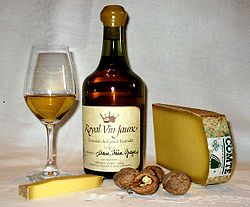
A pairing of vin jaune with walnuts and Comté cheese
Wine and food pairing is the process of pairing food dishes with wine to enhance the dining experience. In many cultures, wine has had a long history of being a staple at the dinner table and in some ways both the winemaking and culinary traditions of a region have evolved together over the years. Rather than following a set of rules, local cuisines were paired simply with local wines. The modern "art" of food pairings is a relatively recent phenomenon, fostering an industry of books and media with guidelines for pairings of particular foods and wine. In the restaurant industry, sommeliers are often present to make food pairing recommendations for the guest. The main concept behind pairings is that certain elements (such as texture and flavor) in both food and wine interact with each other, and thus finding the right combination of these elements can make the entire dining experience more enjoyable. However, taste and enjoyment are subjective and what may be a "textbook perfect" pairing for one taster could be less enjoyable to another.
While there are many books, magazines and websites with detailed guidelines on how to pair food and wine, most food and wine experts believe that the most basic element of food and wine pairing is understanding the balance between the "weight" of the food and the weight (or body) of the wine. Heavy, robust wines like Cabernet Sauvignon can overwhelm a light, delicate dish like a quiche, while light-bodied wines like Pinot Grigio would be similarly overwhelmed by a hearty stew. Beyond weight, flavors and textures can either be contrasted or complemented. From there a food and wine pairing can also take into consideration the sugar, acid, alcohol and tannins of the wine and how they can be accentuated or minimized when paired with certain types of food. (Full article...)
![Image 1 Ripe Sauvignon blanc grapes Sauvignon blanc (French pronunciation: [soviɲɔ̃ blɑ̃] ⓘ) is a green-skinned grape variety that most likely originated in the Loire Valley wine region in France, though it has also been historically cultivated in Bordeaux. The grape most likely gets its name from the French words sauvage ("wild") and blanc ("white") due to its early origins as an indigenous grape in South West France. It is possibly a descendant of Savagnin. Sauvignon blanc is widely cultivated in many of the world's wine regions, including France, Argentina (also in Patagonia) Chile, Romania, Canada, Australia, New Zealand, South Africa, Bulgaria, and the states of Oregon, Washington, and California in the US. Some New World Sauvignon blancs, particularly from California, may also be called "Fumé Blanc", a marketing term coined by Robert Mondavi in reference to Pouilly-Fumé. (Full article...)](/location/wiki/File:Blank.png)


Did you know (auto-generated) -

- ... that both scholars and activists believe that diet culture is often intertwined with racism and other forms of prejudice?
- ... that Silver Iocovozzi, a Food & Wine Best New Chef, first dreamed of becoming an architect?
- ... that the magazine Acoustic Guitar said that Dan Erlewine "might be the most famous guitar repairperson on earth"?
- ... that illustrator Abigail Larson once designed a wine-bottle label for the Edgar Allan Poe Museum?
- ... that a £142 wine fridge was smuggled into Downing Street on 11 December 2020, during the height of the COVID-19 lockdown in the United Kingdom?
- ... that a men's soccer team hired Jenna Winebrenner to analyze game film and practice with the squad?
- ... that Sam Jaffe brought "wine, cheese and live caterpillars" to gallery openings of his photographs?
- ... that Eminem promoted "Houdini" with a video in which David Blaine eats a wine glass?
Selected quote
| “ | Once... in the wilds of Afghanistan, I lost my corkscrew, and we were forced to live on nothing but food and water for days | ” |
| — W. C. Fields My Little Chickadee |
Related portals


Selected winery
Mas de Daumas Gassac is a French winery located in the wine region Languedoc in the southeast of France, in the commune of Aniane. The wine produced here is classified as Vin de Pays de l'Hérault due to its use of grape varieties outside specifications of its AOC. Despite its modest designation and location, the vineyard has received widespread acknowledgement, described by the The Times to taste like a “Latour” and by the French magazine Gault-Milau as the "Lafite Rothschild of the Languedoc-Roussillon", it is frequently referred to as the Grand Cru of the Languedoc.
On land sold by the Daumas family to a former glove manufacturer Aimé Guibert, wines were first planted at this vineyard in 1974. Following the recommendation of Henri Enjalbert, a professor of Geography at the University of Bordeaux, whose assessment of the terroir determined the microclimate to be uncharacteristically favourable for cultivation of wine in such a warm region, the first vintage was produced in 1978 with the assistance of the oenologist Émile Peynaud. Aimé Guibert has since featured in the documentary film Mondovino, stating that "wine is dead". (Full article...)
General images -
-
 Dionysus in a vineyard, depicted on an amphora from the late 6th century BC. (from History of wine)
 -
 Shipping wine in Roman Gaul: amphoras (top) were the traditional Mediterranean vessels, but the Gauls introduced the use of barrels. (from History of wine)
 -
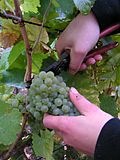 Manual grape gathering (from Viticulture)
 -
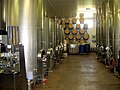 Stainless steel fermentation vessels and new oak barrels at the Three Choirs Vineyard, Gloucestershire, England (from Winemaking)
 -
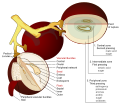 Anatomy of a grape, showing the components extracted from each pressing (from Winemaking)
 -
 Georgian Kvevri, a jar dated to the 6th millennium BC found at the Shulaveri site (Georgian National Museum). (from History of wine)
 -
 Vineyards in Italy (from Winemaking)
 -
 A wine labelling machine with adhesive labels in France (from Winemaking)
 -
 The corkscrew-shaped feed auger sits on top of a mechanical crusher-destemmer. Grape clusters are fed into the machine, where they are first crushed, then destemmed. Stems exit at the end, while juice, skins, seeds, and some debris exit the bottom. (from Winemaking)
 -
 Monastic cellarer tasting wine as depicted in Li Livres dou Santé, a late 13th century French manuscript. (from History of wine)
 -
 Crushed grapes leaving the crusher (from Winemaking)
 -
 Central component of a mechanical destemming. Paddles above the small circular slots rotate to remove the larger chunks of stems. Grapes are pulled off the stems and fall through the holes. Some small amount of stem particles are usually desired to be kept with the grapes for tannin structure. (from Winemaking)
 -
 Antique wooden wine press in front of World Heritage vineyards (from Winemaking)
 -
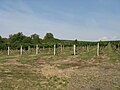
-

-
 A Napa Valley vineyard on the side of a road (from Viticulture)
 -
 A mechanical destemming machine in use at Chateau Montelena winery in Napa Valley (from Winemaking)
 -
 A cap of grape skins forms on the surface of fermenting red wine (from Winemaking)
 -
 Harvested Cabernet Sauvignon grapes (from Winemaking)
 -
 Vineyard rows illustrating grape cultivation practices (from Viticulture)
 -
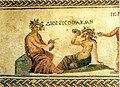 Hellenistic mosaics discovered close to the city of Paphos depicting Dionysos, god of wine (from History of wine)
 -
 In ancient times, berries were crushed by foot in a barrel or pit (from Winemaking)
 -

-
 Testing wine for sulphur dioxide level (from Winemaking)
 -
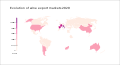 The world wine export 2020 shows the annual wine export production of various countries. (from Winemaking)
 -
 Wine grapes on Long Island (from Viticulture)
 -
 Satyr working at a wine press of wicker-work mats (1st century AD relief). (from History of wine)
 -
 Entrance to the Areni-1 cave in southern Armenia near the town of Areni where a winery dated to c. 4100 BC was found in 2007. (from History of wine)
 -
 Night harvest by hand of wine grapes in Napa, California (from Winemaking)
 -
 Wine grapes from the Guadalupe Valley in Ensenada, Baja California, Mexico (from Winemaking)

.png)


Selected picture

Topics
Wines and winemaking | |||||||||||||||||||
|---|---|---|---|---|---|---|---|---|---|---|---|---|---|---|---|---|---|---|---|
| |||||||||||||||||||
List articles

Categories

Related WikiProjects
| Parent project: WikiProject Food and Drink | |
| Child projects: | Task forces: (All inactive) |
|
|
| Related projects: | |

Things you can do
 |
Here are some tasks you can do for WikiProject Wine:
|
Associated Wikimedia
The following Wikimedia Foundation sister projects provide more on this subject:
-
 Commons
Free media repository -
 Wikidata
Free knowledge base -
 Wikiquote
Collection of quotations -
 Wikisource
Free-content library -
 Wikispecies
Directory of species -
 Wikiversity
Free learning tools -
 Wikivoyage
Free travel guide -
 Wiktionary
Dictionary and thesaurus


