


p-adic exponential function
In mathematics, particularly p-adic analysis, the p-adic exponential function is a p-adic analogue of the usual exponential function on the complex numbers. As in the complex case, it has an inverse function, named the p-adic logarithm.
Definition
[edit]The usual exponential function on is defined by the infinite series

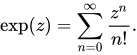
Entirely analogously, one defines the exponential function on , the completion of the algebraic closure of , by


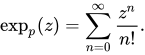
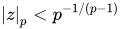
However, unlike exp which converges on all of , only converges on the disc

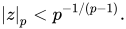
This is because p-adic series converge if and only if the summands tend to zero, and since the in the denominator of each summand tends to make them large p-adically, a small value of z is needed in the numerator. It follows from Legendre's formula that if then tends to , p-adically.



Although the p-adic exponential is sometimes denoted , the number e itself has no p-adic analogue. This is because the power series does not converge at . It is possible to choose a number to be a p-th root of for ,[a] but there are multiple such roots and there is no canonical choice among them.[1]


p-adic logarithm function
[edit]The power series
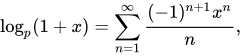
converges for in satisfying and so defines the p-adic logarithm function for satisfying the usual property . The function can be extended to all of ×
p (the set of nonzero elements of ) by imposing that it continues to satisfy this last property and setting . Specifically, every element of ×
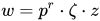
p can be written as with a rational number, a root of unity, and ,[2] in which case .[b] This function on ×
p is sometimes called the Iwasawa logarithm to emphasize the choice of . In fact, there is an extension of the logarithm from to all of ×
p for each choice of in .[3]






Properties
[edit]If and are both in the radius of convergence for , then their sum is too and we have the usual addition formula: .


Similarly if and are nonzero elements of then .
For in the domain of , we have and .


The roots of the Iwasawa logarithm are exactly the elements of of the form where is a rational number and is a root of unity.[4]

Note that there is no analogue in of Euler's identity, . This is a corollary of Strassmann's theorem.

Another major difference to the situation in is that the domain of convergence of is much smaller than that of . A modified exponential function — the Artin–Hasse exponential — can be used instead which converges on .

Notes
[edit]References
[edit]Citations
[edit]- ↑ Robert 2000, p. 252
- ↑ Cohen 2007, Proposition 4.4.44
- ↑ Cohen 2007, §4.4.11
- ↑ Cohen 2007, Proposition 4.4.45
List of references
[edit]- Chapter 12 of Cassels, J. W. S. (1986). Local fields. London Mathematical Society Student Texts. Cambridge University Press. ISBN 0-521-31525-5.
- Cohen, Henri (2007), Number theory, Volume I: Tools and Diophantine equations, Graduate Texts in Mathematics, vol. 239, New York: Springer, doi:10.1007/978-0-387-49923-9, ISBN 978-0-387-49922-2, MR 2312337
- Robert, Alain M. (2000), A Course in p-adic Analysis, Springer, ISBN 0-387-98669-3