


Dyson's transform
Dyson's transform is a fundamental technique in additive number theory for transforming a pair of integer sequences into another pair of integer sequences.[1] It was developed by Freeman Dyson as part of his proof of Mann's theorem on the Schnirelmann density of sumsets,[2]: 17 is used to prove such fundamental results of additive number theory as the Cauchy–Davenport theorem on the size of restricted sumsets,[1] and was used by Olivier Ramaré in his work (related to the Goldbach conjecture) that proved that every even integer is the sum of at most 6 prime numbers.[3]: 700–701 The term Dyson's transform for this technique is used by Ramaré.[3]: 700–701 Halberstam and Roth call it the τ-transformation.[2]: 58
Formulation
[edit]This formulation of the transform is from Ramaré.[3]: 700–701 Let be a sequence of natural numbers, and be any real number. Write for the number of elements of which lie in . Suppose and are two sequences of natural numbers. We write for the sumset, that is, the set of all elements where is in and is in ; and similarly for the set of differences . For any element in , Dyson's transform consists in forming the sequences and .


![{\displaystyle [1,x]}](https://wikimedia.org/api/rest_v1/media/math/render/svg/63470e8fe9faf7ae30b257d12486bf1730330e5f)






Properties
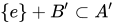
[edit]The transformed sequences have the properties:



Related transforms
[edit]Other closely related transforms are sometimes referred to as Dyson transforms. This includes the transform defined by , , , for sets in a (not necessarily abelian) group. This transformation has the property that





- ,



It can be used to prove a generalisation of the Cauchy-Davenport theorem.[4]
References
[edit]- 1 2 Nathanson, Melvyn B. (1996-08-22). Additive Number Theory: Inverse Problems and the Geometry of Sumsets. Springer Science & Business Media. ISBN 978-0-387-94655-9.
- 1 2 Halberstam, H.; Roth, K. F. (1983). Sequences (revised ed.). Berlin: Springer-Verlag. ISBN 978-0-387-90801-4.
- 1 2 3 O. Ramaré (1995). "On šnirel'man's constant". Annali della Scuola Normale Superiore di Pisa. Classe di Scienze. Serie IV. 22 (4): 645–706. Retrieved 2009-03-13.
- ↑ DeVos, Matt (2016). "On a Generalization of the Cauchy-Davenport Theorem". Integers. 16.