


Direction cosine
 | This article includes a list of references, related reading, or external links, but its sources remain unclear because it lacks inline citations. (January 2017) |
In analytic geometry, the direction cosines (or directional cosines) of a vector are the cosines of the angles between the vector and the three positive coordinate axes. Equivalently, they are the contributions of each component of the basis to a unit vector in that direction.
Three-dimensional Cartesian coordinates
[edit]


If v is a Euclidean vector in three-dimensional Euclidean space,


where ex, ey, ez are the standard basis in Cartesian coordinates notation, then the direction cosines are
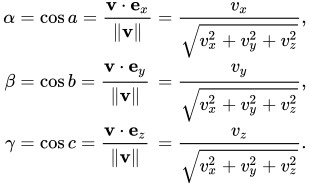
It follows that by squaring each equation and adding the results

Here α, β, γ are the direction cosines and the Cartesian coordinates of the unit vector and a, b, c are the direction angles of the vector v.

The direction angles a, b, c are acute, right, obtuse, or straight angles, i.e., 0 ≤ a ≤ π, 0 ≤ b ≤ π and 0 ≤ c ≤ π (There are two opposite angles between two vectors, and the direction angle between the vectors is the one satisfying 0 ≤ x ≤ π.), and they denote the angles formed between v and the unit basis vectors ex, ey, ez.

General meaning
[edit]More generally, direction cosine refers to the cosine of the angle between any two vectors starting at a same point. They are useful for forming direction cosine matrices that express one set of orthonormal basis vectors in terms of another set, or for expressing a known vector in a different basis. Simply put, direction cosines provide an easy method of representing the direction of a vector in a Cartesian coordinate system.
Applications
[edit]Determining angles between two vectors
[edit]Let u and v have direction cosines (αu, βu, γu) and (αv, βv, γv), respectively, having an angle θ between them. Their unit vectors arerespectively.

Taking the scalar product of these two unit vectors yield,The geometric interpretation of the scalar product of these two unit vectors is equivalent to the projection of one vector onto another; linking the two definitions we find the following.


There exist two choices for θ (because cosine is even); one is acute, right, obtuse, or straight angle (0 ≤ θ ≤ π), another is the reflex angle (π < θ < 2π), between the vectors. The convention is to choose the former, so we get θ from the scalar product by using the inverse cosine function:

See also
[edit]References
[edit]- Kay, D. C. (1988). Tensor Calculus. Schaum’s Outlines. McGraw Hill. pp. 18–19. ISBN 0-07-033484-6.
- Spiegel, M. R.; Lipschutz, S.; Spellman, D. (2009). Vector analysis. Schaum’s Outlines (2nd ed.). McGraw Hill. pp. 15, 25. ISBN 978-0-07-161545-7.
- Tyldesley, J. R. (1975). An introduction to tensor analysis for engineers and applied scientists. Longman. p. 5. ISBN 0-582-44355-5.
- Tang, K. T. (2006). Mathematical Methods for Engineers and Scientists. Vol. 2. Springer. p. 13. ISBN 3-540-30268-9.
- Weisstein, Eric W. "Direction Cosine". MathWorld.
 | This geometry-related article is a stub. You can help Wikipedia by adding missing information. |