


// Workers AI · dad joke modeWhy did Whitney topologies go to therapy? They had boundary issues.
In mathematics, and especially differential topology, functional analysis and singularity theory, the Whitney topologies are a countably infinite family of topologies defined on the set of smooth mappings between two smooth manifolds. They are named after the American mathematician Hassler Whitney.
Construction
[edit]Let M and N be two real, smooth manifolds. Furthermore, let C∞(M,N) denote the space of smooth mappings between M and N. The notation C∞ means that the mappings are infinitely differentiable, i.e. partial derivatives of all orders exist and are continuous.[1]
Whitney Ck-topology
[edit]For some integer k ≥ 0, let Jk(M,N) denote the k-jet space of mappings between M and N. The jet space can be endowed with a smooth structure (i.e. a structure as a C∞ manifold) which make it into a topological space. This topology is used to define a topology on C∞(M,N).
For a fixed integer k ≥ 0 consider an open subset U ⊂ Jk(M,N), and denote by Sk(U) the following:

The sets Sk(U) form a basis for the Whitney Ck-topology on C∞(M,N).[2]
Whitney C∞-topology
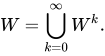
[edit]For each choice of k ≥ 0, the Whitney Ck-topology gives a topology for C∞(M,N); in other words the Whitney Ck-topology tells us which subsets of C∞(M,N) are open sets. Let us denote by Wk the set of open subsets of C∞(M,N) with respect to the Whitney Ck-topology. Then the Whitney C∞-topology is defined to be the topology whose basis is given by W, where:[2]
Dimensionality
[edit]Notice that C∞(M,N) has infinite dimension, whereas Jk(M,N) has finite dimension. In fact, Jk(M,N) is a real, finite-dimensional manifold. To see this, let ℝk[x1,...,xm] denote the space of polynomials, with real coefficients, in m variables of order at most k and with zero as the constant term. This is a real vector space with dimension
![{\displaystyle \dim \left\{\mathbb {R} ^{k}[x_{1},\ldots ,x_{m}]\right\}=\sum _{i=1}^{k}{\frac {(m+i-1)!}{(m-1)!\cdot i!}}=\left({\frac {(m+k)!}{m!\cdot k!}}-1\right).}](https://wikimedia.org/api/rest_v1/media/math/render/svg/8d57349e25231e1fd2d038235c68eb60cdfce818)
Writing a = dim{ℝk[x1,...,xm]} then, by the standard theory of vector spaces ℝk[x1,...,xm] ≅ ℝa, and so is a real, finite-dimensional manifold. Next, define:
![{\displaystyle B_{m,n}^{k}=\bigoplus _{i=1}^{n}\mathbb {R} ^{k}[x_{1},\ldots ,x_{m}],\implies \dim \left\{B_{m,n}^{k}\right\}=n\dim \left\{A_{m}^{k}\right\}=n\left({\frac {(m+k)!}{m!\cdot k!}}-1\right).}](https://wikimedia.org/api/rest_v1/media/math/render/svg/b7e1aa9a61f20453ab1cb31847b90d1116055b79)
Using b to denote the dimension Bkm,n, we see that Bkm,n ≅ ℝb, and so is a real, finite-dimensional manifold.
In fact, if M and N have dimension m and n respectively then:[3]

Topology
[edit]Given the Whitney C∞-topology, the space C∞(M,N) is a Baire space, i.e. every residual set is dense.[4]
References
[edit]- ↑ Golubitsky, M.; Guillemin, V. (1974), Stable Mappings and Their Singularities, Springer, p. 1, ISBN 0-387-90072-1
- 1 2 Golubitsky & Guillemin (1974), p. 42.
- ↑ Golubitsky & Guillemin (1974), p. 40.
- ↑ Golubitsky & Guillemin (1974), p. 44.