Unity Theatre, London
 Poster c. 1937 | |
| Formation | 1936 |
|---|---|
| Founded at | London, England |
| Defunct | 1994 |
| Type | Amateur theatre club |
| Legal status | Cooperative society |
Professional title | Unity Theatre Society Ltd. |
| Origins | Workers' Theatre Movement |
| Products |
|
Main organ | Management committee |
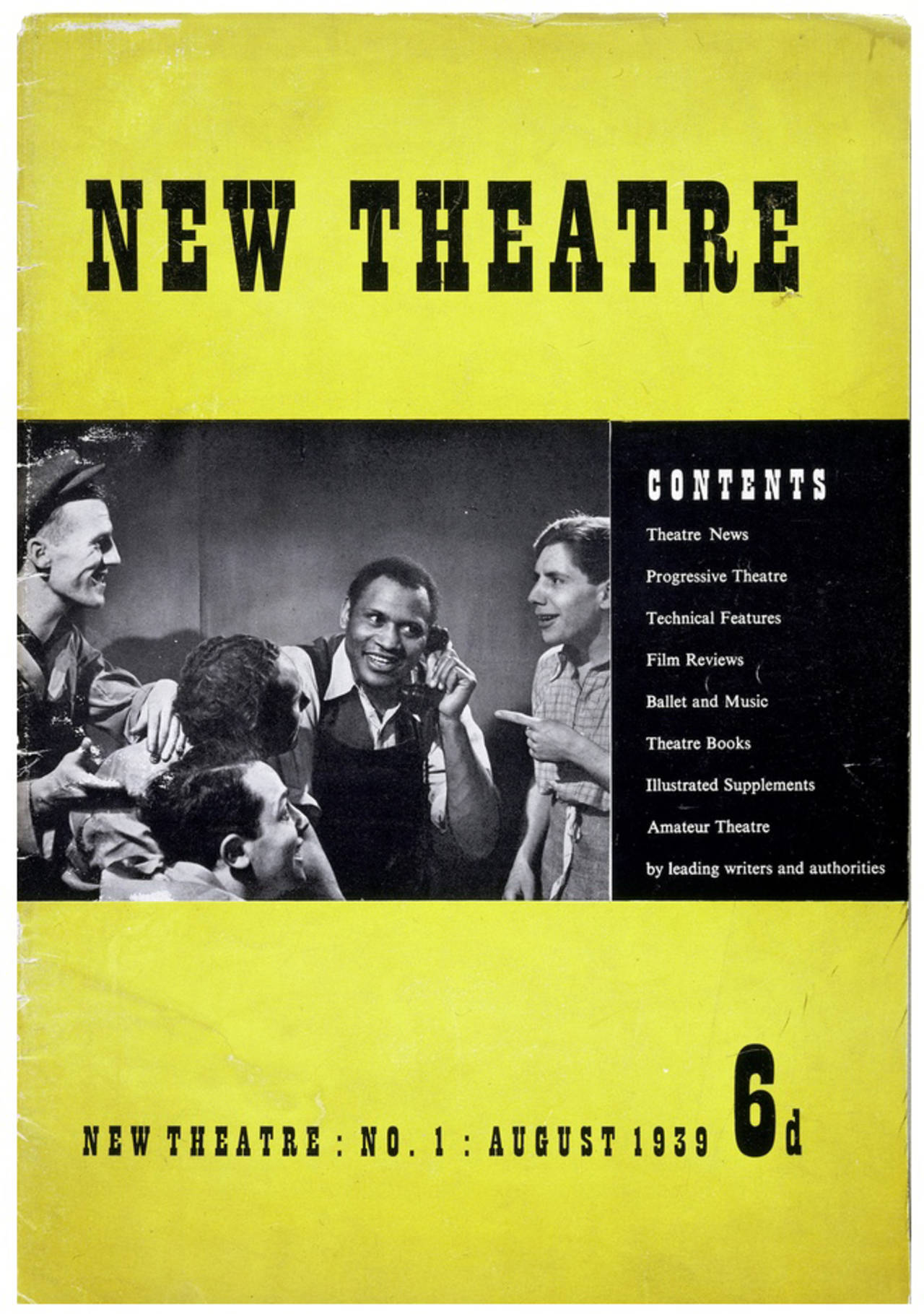
Publication | New Theatre[1] |
Unity Theatre was a left-wing amateur theatre club based in several venues in London between 1936 and 1994. It had links with the Left Book Club Theatre Guild and the Communist Party.[2]: 32 During its lifetime, Unity mounted over 250 productions, most of which were new plays, and toured extensively.[3]: 17
Initially operating from St. Judes Hall, Britannia Street, in Somers Town, Unity moved in 1937 to a converted former chapel in Goldington Street in the same area. After the theatre was destroyed by fire in 1975, productions continued sporadically in other venues till 1994. The original site was sold for social housing, becoming Unity Mews: a plaque commemorates the theatre.[4]
History
[edit]Origin and aim
[edit].jpg)
Unity Theatre emerged from the coming together in the 1930s of the Workers' Theatre Movement[a] with Left Theatre,[b] Group Theatre,[c] and other London-based workers' theatre groups.[d] It attempted to create "a single focus for socialist drama",[5]: 121 proclaiming that:[7]: 99
Its aim is to help in the vitally urgent struggle for world peace, and a better social and economic order, by establishing a drama which deals with realities, and reflects contemporary life, instead of plays which merely provide a dream world of escape, and at best depict false ideas of life.
After moving to Goldington Street in 1937, Unity Theatre registered as a cooperative society, Unity Theatre Society Ltd.,[8]: 15 and set up the Unity Theatre Club. The club organised a multitude of cultural and social activities including folk, film, and poetry clubs, a choir, an orchestra, rambles, and parties and dances.[5]: 123 The society established a school of dramatic studies,[8]: 28 [3]: 137 and in 1939 launched a glossy magazine, New Theatre.[1][3]: 182
First decade
[edit]In its early productions, Unity used several then-novel dramatic forms – satirical pantomime, Living Newspaper,[3]: 141 and mass declamation[3]: 80 [e] – and brought an international perspective to the London stage with plays by American, Irish, continental European and Russian dramatists.[5]: 126, 132
Satirical pantomimes
[edit]In 1938, Unity's political version of Babes in the Wood, a traditional English children's tale and pantomime, lampooned Neville Chamberlain's appeasement policy during the Munich Crisis. Its cast included Bill Owen, Mark Cheney, Vida Hope, Alfie Bass, and Una Brandon-Jones.[3]: 165–176 Ann Davies (the principal boy) portrayed the Popular Front as Robin Hood, appearing in the uniform of a Soviet soldier at the end of the show to declare:[5]: 130
When strife disturbs and wars corrupt our age
Keen satire is the business of the stage.
When the curtain falls upon our pantomime tonight
Join with the workers in the social fight.
The programme included lyrics for some of the production's songs.[10]: 9 Babes in the Wood ran for seven months, and the critic Montagu Slater said the play "had more direct effect on current politics than any other single production in the history of the English stage".[11]
Living Newspapers
[edit]Living Newspaper No.1: Busmen, the first British Living Newspaper, dramatised the London busmen's strike of May 1937. Busmen who had been strikers were involved in devising the staging and researching material for the play, which incorporated newspaper reports, meeting minutes, transcripts of speeches, statistics, and conversations overheard in bus queues. A series of short scenes interwove factual material with fictional reconstructions of events, switching between the formal discourse of politicians and trades union officials, opinions in the press, statements of facts and figures, and the views of busmen. Alan Bush composed the music, Montagu Slater wrote verse, and the play was produced by John Allen and André van Gyseghem. It ran for three months in 1938, and attracted generally favourable reviews.[8]: 7 [12]: 341, 345–346
Living Newspaper No.2: Crisis covered the appeasement crisis of September 1938. Put together by the company in 36 hours, it opened on 29 September, the day Chamberlain met Hitler and Mussolini in Munich. The production was updated as events unfolded.[8]: 7 [3]: 162–165
Mass declamations
[edit]Who are the English? was the first of several mass declamations[e] written by Jack Lindsay. Performed in 1936 first by Unity and then by other left-wing theatre groups, it invoked and celebrated radicals and revolutionaries in British history in an alternative to the traditional imperialist account:[13][5]: 127–128
I call on those who left the little farms
and left the common lands at Parliament's voice
to chase the grave and comely henpecked king.
I call on Cromwell's Ironsides and the men
who listened to the many voices blown, distracted,
birdcries out of the thicket of blood-darkness...
Come, you Anabaptists and you Levellers,
come, you Muggletonians, all you Bedlamites...
Come, you Luddites, come you men of the Charter,
singing your songs of defiance on the blackened hills.
Spain
[edit]Who are the English? was followed in 1937 by a reworking of Lindsay's poem On Guard for Spain!,[14] transformed by Unity into a declamatory piece for voices and chorus. There were several versions, with Lindsay writing extra stanzas at Unity's request. On Guard was performed by theatre groups across Britain as part of the anti-fascist movement in support of the Spanish Republic during Spain's civil war:[3]: 82–85
spanish man –
Workers,
drive off the fascist vultures gathering
to pick the bones of Spanish cities,
to leave the Spanish fields
dunged with peasant dead
that greed may reap the fattened crops.
spanish woman –
Fuse your unity in the furnace of our pain.
spanish man –
Enter this compact of steel.
spanish man & spanish woman –
And then we shall not complain.
all women –
On guard for the human future!
all men –
On guard for the people of Spain!
Wartime
[edit]In May 1939, the society recorded 7,000 members, with affiliated organisations (such as trades union branches and cooperative societies) accounting for another 250,000.[8]: 14
On 3 September that year, Britain declared war on Germany at the outbreak of World War II, and all theatres and other places of public entertainment were immediately closed. Unity Theatre re-opened two weeks later (the first theatre to do so), staging a revue, Sandbag Follies,[17] and then another, Turn Up the Lights.[18] Both criticised government policy, with Unity declaring in a pamphlet that "We are the first theatre to attack the war policy of a government in wartime since Euripedes' Trojan Women was performed in Athens in 415 BC."[19]: 128
The theatre was bombed several times and many of the troupe's actors and writers were conscripted. Unity remained active throughout the conflict: besides staging plays, pantomimes and revues, its Outside Shows (later Mobile) Group presented plays and sketches in factories, hospitals, parks, and air-raid shelters, putting on over 1,000 performances. Ann Davies described performing in a shelter in Belsize Park tube station:[19]: 129
Swanee River, John Brown's Body, Roll out the Barrel, etc., got them interested ... prepared the way for a couple of sketches, solos, songs and jokes. Ten minutes at one end of the platform, and ten the other ... and finally a show at each end of the liftshafts. Even when these items had to be done sideways-on ... they went over big, and the crowd was almost as pleased as we were.[g]
In addition, Unity members were involved with the Army Bureau of Current Affairs, whose small Play Unit, set up in 1943, included several prominent members of the troupe, such as Jack Lindsay, Ted Willis, Mulk Raj Anand, and André van Gyseghem. The Play Unit toured military bases in Britain and abroad.[5]: 131–132
Critical reception
[edit]The chief theatre critic of The Sunday Times, writing in 1990, said:[20]
The best work of the Unity Theater was done in the 1930s and during World War II. At a time of great poverty and ideological confusion, it provided a political and artistic outlet for people who were getting tired of being patronized and who were increasingly suspicious of their politicians.
Postwar
[edit]
After the war, the satirical and documentary approaches taken in Unity Theatre productions became mainstream both in professional theatres in London and popular television programmes. According to Chambers (1989), "Unity turned inwards and failed either to find a new role or to renew with sufficient vigour its traditional one."[3]: 349–350 The London theatre closed after a fire in 1975.[3]: 395–397 In the view of Peter (1990), "[Unity Theatre] finally expired ... because it represented a spirit of old-fashioned opposition and could not find its place in a more strident and increasingly prosperous age."[20]
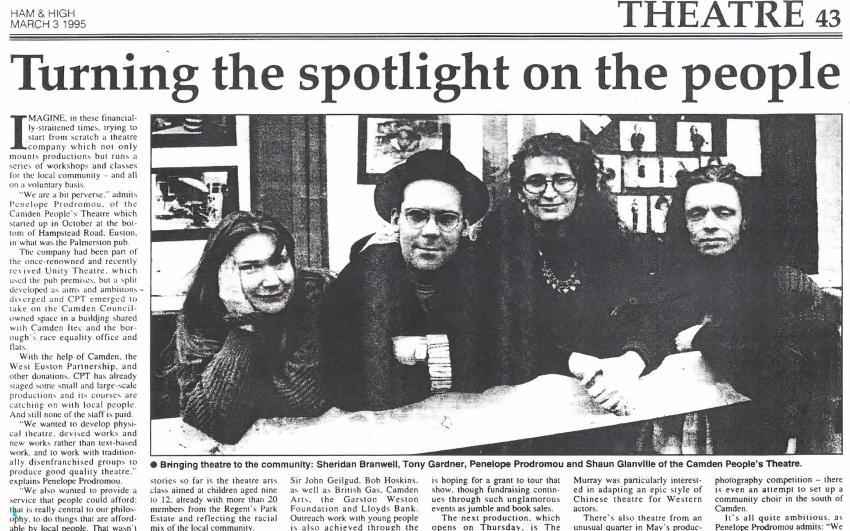
Attempts were made to revive the theatre in the late 1980s and early 1990s with a studio theatre in the space now occupied by Camden People's Theatre.[21] The Merseyside Left Theatre, which became an affiliate of Unity Theatre in 1939, has, since 1944, operated first as Merseyside Unity Theatre and then as Unity Theatre Liverpool.[22] Unity Theatre Cardiff, formed in 1942, left the Unity Theatre movement in 1948 and was renamed Everyman Theatre Cardiff.[23]
The Unity Theatre Trust was established in 1962 as a registered charity with the aim of "[advancing] the education of the public by fostering, promoting and increasing the interest of the public in the art of drama and the co-related arts."[24] It maintains an archive and awards grants.[25]
Archives
[edit]Several archives have collections of material related to Unity Theatre. The Unity Theatre Trust's archive[26] is housed at a branch of the Victoria and Albert Museum in London.[27] Salford's Working Class Movement Library also has a collection,[28] as does the People's History Museum in Manchester.[29] The Bishopsgate Institute in London hosts two collections: one accumulated by Harry Landis,[30] and the other by Ron Travis, who undertook research towards a PhD in the history of Unity Theatre.[31] The Herbert P. J. Marshall collection is held by Southern Illinois University.[32]
Notable people
[edit]
Dramatists
[edit]Unity introduced several international dramatists to the British stage, presenting premieres of Odets' Waiting for Lefty (1936), Brecht's Señora Carrar's Rifles (1938), O'Casey's The Star Turns Red (1940), Sartre's Nekrassov (1956), and Adamov's Spring '71 (1962).[34] The theatre also helped popularise the plays of Gorky.[3]: 220
Actors
[edit]Notable actors associated with Unity Theatre included Alfie Bass, Una Brandon-Jones, Michael Gambon, Julian Glover, Vida Hope, Bob Hoskins, David Kossoff, Harry Landis, Herbert Lom, Warren Mitchell, Bill Owen, Eric Paice, Michael Redgrave, Paul Robeson, actor-manager Hazel Vincent Wallace, Ted Willis, and Roger Woddis.[3]: 22–23, 240, 189, 151, 300–301, 331–332
Musicians
[edit]Notable musicians associated with the theatre included composers Alan Bush and Christian Darnton, conductor David Ellenberg, pianist James Gibb, baritone John Goss, piano duo Mary and Geraldine Peppin, composer John Sykes, and composer and songwriter Lionel Bart. Bart's earliest contributions were lyrics for Turn It Up, a revue. He also wrote the lyrics for an agitprop version of Cinderella and the revue Peacemeal, and composed the musical Wally Pone, based on Ben Jonson's Volpone.[3]: 331, 335, 350
Designers
[edit]The designers of Unity Theatre's sets, costumes, and programmes included James Friell and Lawrence Gowing (sets for Babes in the Wood); James Boswell, who designed the programme for Giant Ripper (1940); and John Heartfield, who contributed to the translation and design of the Soviet thriller Comrade Detective (1944).[35]: 104 Rivka Black and Ern Brooks created sets and costumes for various productions.[35]: 39 During the 1950s and 1960s, Ken Sprague designed several sets for productions of Shaw's The Apple Cart, Chekov's The Cherry Orchard, and Miller's The Crucible.[36]: 45 Sean Kenny designed the sets and lighting for Bloomsday (1960), an adaptation of Joyce's novel Ulysses.[3]: 352
Managers
[edit]Managers, at various times, of the theatre or its sectional activities included Heinz Bernard (director),[37] Alec Bernstein (chair),[3]: 265 Raymond Cross (business manager),[33] Jack Firestein (who ran Unity's folk club and bookstall),[3]: 357 Oscar Lewenstein (general manager, and secretary of the national society),[3]: 265 and André van Gyseghem (president).[8]: 28
Productions
[edit]Chambers (1989) chronicles productions in Unity's two principal theatres: Britannia Street, covering 1936 and 1937, and Goldington Street, from 1937 to 1975 (when the theatre burnt down). He also lists performances that took place in various venues from 1976 to 1983[h] and touring productions.[3]: 403–408 The Unity Theatre Trust lists productions from 1936 to 1994.[38]
Selected productions
[edit]1936–1939
[edit]- Waiting for Lefty (1936)[8]: 5, 11
- Where's That Bomb? (1936)[8]: 5
- Bury the Dead (1938)[8]: 7
- Busmen (1938)[8]: 7–8
- Plant in the Sun (1938)[8]: 9
- Señora Carrar's Rifles (1938)[8]: 11
- Babes in the Wood (1938)[8]: 11–14
- Sandbag Follies (1939)[17]
1940s
[edit]- The Star Turns Red (1940)
- The Match Girls (1940)[39]: 46–47
- Jack the Giant-Killer (1940)[40]
- Till the Day I Die (1941)
- Sabotage! (1942)
- One-Third of a Nation (1943)
- Comrade Detective (1944)
- Alice in Thunderland (1945)[5]: 160–161
- All God's Chillun Got Wings (1946)
- Enemies (1947)
- The Russian Question (1947)
- What's Left? (1948)[39]: 48
- The Ragged-Trousered Philanthropists (1949)[39]: 49
1950s
[edit]- Longitude 49 (1950)[41]
- The Cradle Will Rock (1951)
- The Wages of Eve (1952)[42]
- The Rosenbergs (1953)[39]: 45
- Reedy River (1954)
- The Pillars of Society (1955)
- Nekrassov (1956)[43]
- World on Edge (1956)[39]: 45–46
- Cyanamide (1957)[44]
- Wally Pone (1958)[45]
- Anna Christie (1959)[46][47]
1960s
[edit]- Bloomsday (1960)[48]
- The Visions of Simone Machard (1961)[49]
- Spring '71 (1962)[34]
- The Fury of Philip Hotz (1963)[50]
- The Good Woman of Setzuan (1964)[51]
- There's a Megabutton on My Living-room Floor (1965)[52]
- Death of a Salesman (1966)[53]
- Antigone (1967)[54]
- Harold Muggins is a Martyr (1968)[5]: 185 [55]
- The Frogs and Co ... Axed! (1969)[56][57]
See also
[edit]- Documentary theatre – Theatre based on presenting factual material
- English drama – 1901–1945 and 1945–2000
- Interwar Britain – British history, 1918–1939
- Music hall – Type of British theatrical entertainment popular between 1850 and 1960
- Political theatre – Drama with a political component
- Social history of post-war Britain (1945–1979)
Notes
[edit]- ↑ The Workers' Theatre Movement in Britain was established in 1926.[5]: 89–90
- ↑ Left Theatre was founded in 1933 by a group involving André van Gyseghem, Barbara Nixon, and Montagu Slater. Wound up in 1937, it was associated with the radical journal Left Review.[6]: 179
- ↑ Group Theatre, established in 1932, performed poetic dramas written for the troupe by T. S. Eliot, W. H. Auden, and Christopher Isherwood (including Auden and Isherwood's The Ascent of F6). Group Theatre drew inspiration from popular theatrical forms such as variety shows and pantomime.[6]: 183–185
- ↑ For a detailed account of the emergence of Unity Theatre from the Workers' Theatre Movement, see: Saville, Ian (1990). "Chapter Six: 1933–1935. The End of the Workers' Theatre Movement" (PDF). Ideas, forms and development in the British workers' theatre, 1925–1935 (PDF) (PhD thesis). London: City University. pp. 208–225. Retrieved 16 September 2026.
- 1 2 In mass declamation, a group of actors (the mass) performs choral speech, chanting and song accompanied by choreographed movements.[9]
- ↑ Breden (2020) reproduces an acting script based on the version used by Bristol Unity Players[16] with amendments drawn from London Unity Theatre archives and versions of Lindsay's original poem.[15]: 239–240
- ↑ During the war, Ann Davies became the theatre's first woman president.[11]
- ↑ Chambers stops in 1983 because, in his view, "arguments intensified over who could legitimately represent Unity to such an extent that further additions would have been meaningless".
References
[edit]- 1 2 "New Theatre issue no. 1" (front cover). Unity Theatre. August 1939. Retrieved 5 September 2026 – via V&A.
- ↑ Leach, Robert (2006). Theatre Workshop: Joan Littlewood and the Making of Modern British Theatre. University of Exeter Press. ISBN 978-0-859-89759-4. OCLC 76937072.
- 1 2 3 4 5 6 7 8 9 10 11 12 13 14 15 16 17 18 19 Chambers, Colin (1989). The Story of Unity Theatre. New York: St. Martin's Press. ISBN 978-0-312-03580-8. OCLC 19975636. Retrieved 24 August 2026 – via Internet Archive.
- ↑ Unity Theatre, a theatre run by the people for the people 1936–1975. London Remembers (metal plaque recessed into brickwork). Chalton Street, Somers Town, London: St. Pancras Housing Association. 1992. Retrieved 29 August 2026.
- 1 2 3 4 5 6 7 8 9 Leach, Robert (2023). British Socialist and Workers Theatre: Red Stages. Palgrave Macmillan. doi:10.1007/978-3-031-25682-0. ISBN 978-3-031-25681-3. OCLC 1360301150. Full access available to users of The Wikipedia Library.
- 1 2 Wallis, Mick (2008) [2004]. "Social commitment and aesthetic experiment, 1895–1946". In Kershaw, Baz (ed.). The Cambridge History of British Theatre. Volume 3: since 1895. Cambridge University Press. pp. 167–192. doi:10.1017/CHOL9780521651325.009. ISBN 978-1-139-05407-2. OCLC 457145443. Full access available to users of The Wikipedia Library.
- ↑ Marshall, Norman (1948) [1947]. The Other Theatre. London: John Lehmann. OCLC 862437. Retrieved 2 September 2026 – via Internet Archive.
- 1 2 3 4 5 6 7 8 9 10 11 12 13 Unity Theatre Society (1939). "Unity Theatre Handbook". London: Vail & Co. OCLC 562512600. MSS.148/UCW/6/13/42/9. Retrieved 1 September 2026 – via Modern Records Centre, University of Warwick.
- ↑ Paget, Derek (2002). "Mass declamation". In Chambers, Colin (ed.). The Continuum Companion to Twentieth Century Theatre (1st ed.). London: Continuum. pp. 483–484. ISBN 978-0-826-44959-7. OCLC 49506807.
- ↑ Unity Theatre (c. 1938). "Innocence Outraged" (programme for Babes in the Wood). Retrieved 28 August 2026 – via Internet Archive.
- 1 2 Borg, James M. (2010) [2004]. "Davies, Ann Lorraine". Oxford Dictionary of National Biography (online ed.). Oxford University Press. doi:10.1093/ref:odnb/68985. ISBN 978-0-19-861412-8. Retrieved 28 August 2026. (Subscription, Wikipedia Library access or UK public library membership required.)
- ↑ Watson, Don (1981). "Busmen: Documentary and British Political Theatre in the 1930s". Media, Culture & Society. 3 (4): 339–350. doi:10.1177/016344378100300404. ISSN 0163-4437. Full access available to users of The Wikipedia Library.
- ↑ Croft, Andy (27 October 2014). "Jack Lindsay: poet of the crisis years". Morning Star. Retrieved 14 September 2026.
- ↑ "On Guard for Spain: A Poem for Mass Recitation". AustLit. Retrieved 14 September 2026.
- 1 2 Breden, Simon (2020). El Unity Theatre y la Guerra Civil española [Unity Theatre and the Spanish Civil War] (in Spanish). Madrid: Guillermo Escolar Editor. ISBN 978-8-418-09359-3. OCLC 1203145608.
- ↑ Lindsay, Jack. "On Guard for Spain : A Massed Chant" (c. 1938) [typescript]. Bristol Unity Players' Club, File: On Guard for Spain : Scripts, ID: MSS.212/L/1/8/2. University of Warwick Digital Collections. Retrieved 14 September 2026.
- 1 2 "We Haven't Got the Jitters". Time. Vol. 34, no. 14. 2 October 1939. p. 38, col 2. Retrieved 11 September 2026 – via Time Vault.
- ↑ Cole, Sidney (24 November 1939). "Unity's New Show". Tribune. p. 10. Retrieved 27 September 2026.
- 1 2 Davies, Andrew (1987). Other Theatres: The Development of Alternative and Experimental Theatre in Britain. Communications and Culture. Basingstoke: Macmillan Education. ISBN 978-0-333-32433-2. OCLC 14168851.
- 1 2 Peter, John (28 January 1990). "The View From Stage Left". New York Times (review of The Story of Unity Theatre by Colin Chambers). Section 7, p. 28. Retrieved 25 August 2026.
- ↑
"Turning the spotlight on the people". Ham & High. Camden People's Theatre. 3 March 1995. p. 43. Retrieved 29 August 2026.
[The company] started up [in] Hampstead Road, Euston, in what was the Palmerston pub ... [it] had been part of ... [the] recently revived Unity Theatre, which used the pub premises.
- ↑ Ashworth, Megan; Merkin, Ros (May 2026). "A Radical Re-imagining: the history of Merseyside Unity Theatre 1937–1987" (PDF) (exhibition guide). Liverpool John Moores University. pp. 4–5, 10. Retrieved 29 August 2026.
- ↑ "About Everyman Theatre". Everyman Theatre Cardiff. 2026. Retrieved 29 August 2026.
- ↑ "Unity Theatre Trust". Charity Commission. 2025. See tab "Governing document". Retrieved 29 August 2026.
- ↑ "The Trust". Unity Theatre Trust. 2026. Retrieved 29 August 2026.
- ↑ "Archives". Unity Theatre Trust. Retrieved 4 September 2026.
- ↑ Unity Theatre, theatre company: records, c. 1930s–2000, ID: GB 71 THM/9. London: V&A East Storehouse Study Centre, V&A Theatre and Performance Collections. Retrieved 4 September 2026. – via Jisc Archives Hub.
- ↑ London Unity Theatre papers, 1936–1998, ID: ORG/UNITY/2. Salford: Working Class Movement Library. Retrieved 4 September 2026.
- ↑ Unity Theatre, theatre company: records, c. 1930s–2000, ID: UNITY. Manchester: Labour History Archive and Study Centre, People's History Museum. Retrieved 4 September 2026. – via National Archives (United Kingdom).
- ↑ Harry Landis Unity Theatre Collection, ID: LANDIS. London: Bishopsgate Institute. Retrieved 4 September 2026.
- ↑ Ron Travis Unity Theatre Collection, ID: TRAVIS. London: Bishopsgate Institute. Retrieved 4 September 2026.
- ↑ Unity Theatre records, Herbert P. J. Marshall collection, ID: MSS 029. Carbondale: Special Collections Research Center, Southern Illinois University. Retrieved 4 September 2026.
- 1 2 Newley, Patrick [in Dutch] (20 January 2000). "Raymond Cross". The Stage. London. p. 30, col 4.
- 1 2 Cottis, Eileen (2003). "Unity Theatre". In Kennedy, David (ed.). The Oxford Encyclopedia of Theatre & Performance. Vol. 2. New York: Oxford University Press. p. 1392. ISBN 978-0-198-60671-0. OCLC 1019957899. Retrieved 2 September 2026.
- 1 2 Lindey, Christine (2018). Art for All: British Socially Committed Art from the 1930s to the Cold War. London: Artery Publications. ISBN 978-0-95582-288-9. OCLC 1010955299.
- ↑ Green, John (2002). Ken Sprague: People's Artist. Stroud: Hawthorn Press with Artery Publications. ISBN 978-1-903-45834-1. OCLC 52632515.
- ↑ Kaut-Howson, Helena (21 January 1995). "Heinz Bernard". The Independent.
- ↑ "Unity Theatre productions from 1936 to 1994". Unity Theatre Trust. Retrieved 7 September 2026.
- 1 2 3 4 5 Chambers, Colin (2009). "History in the Driving Seat: Unity Theatre and the Embrace of the 'Real'". In Forsyth, Alison; Megson, Chris (eds.). Get Real: Documentary Theatre Past and Present. Performance Interventions. Basingstoke: Palgrave Macmillan. pp. 38–54. doi:10.1057/9780230236943. ISBN 978-0-230-22115-4. OCLC 277068245. Full access available to users of The Wikipedia Library.
- ↑ "Jack the Giant-Killer" (extract of words and music of songs). London: Workers' Music Association. c. 1941. Retrieved 11 September 2026 – via V&A.
- ↑ Tank, Herb (1952). Longitude 49: A play by Herb Tank. New York: New Playwrights. Retrieved 20 September 2026 – via Internet Archive. p. iii:
On October 27, 1950, Longitude 49 was presented under the author's direction at Unity Theatre, London.
- ↑ Williams, Jared (n.d.). "The Wages of Eve". Theatricalia. Retrieved 20 September 2026.
- ↑ Findlater, Richard (13 January 1956). "First-class theatre – third-class politics". Tribune. p. 8. Retrieved 20 September 2026.
- ↑ Macleod, Alison (6 July 1957). "See This Play – And Save Unity" (PDF). The Newsletter. Vol. 1, no. 9. London: Peter Fryer. p. 68. OCLC 866840848. Retrieved 20 September 2026 – via Marxists Internet Archive.
- ↑ O'Brien, Richard (2020). "Adapting Jonson: Three Twentieth-Century Volpones". In Butler, Martin; Rickard, Jane (eds.). Ben Jonson and Posterity: Reception, Reputation, Legacy. Cambridge University Press. pp. 197–200. doi:10.1017/9781108903967.010. ISBN 978-1-108-90396-7. OCLC 1156446813. Full access available to users of The Wikipedia Library.
- ↑ Jones, Mervyn (20 November 1959). "Engine and gears". Tribune. p. 11. Retrieved 20 September 2026.
- ↑ Unity Theatre, London (1959). "Anna Christie Playbill Cover". SCRC Virtual Museum at Southern Illinois University's Morris Library. Retrieved 20 September 2026.
- ↑ "Bloomsday Appears in Fuller Guise". The Times. No. 54658. 2 January 1960. p. 9, col 2. Gale CS151608866.
- ↑ "Brecht Play a Clever Choice: St. Joan Visions into Harsh Reality". The Times. No. 55098. 3 June 1961. p. 4, col 4. Gale CS68116675.
- ↑ Gascoigne, Bamber (7 June 1963). "Minnows". The Spectator. No. 7041. p. 16, cols 2–3. Retrieved 24 September 2026.
- ↑ "Brecht the Parable-Weaver – St. Pancras Arts Festival: The Good Woman of Setzuan". The Times. No. 55954. 7 March 1964. p. 5, cols 4–5. Gale CS85812839.
- ↑ Trussler, Simon (4 February 1966). "Fine work at Unity". Tribune. Vol. 30, no. 5. p. 15, cols 3–4. Retrieved 24 September 2026.
- ↑ Trussler, Simon (15 September 1967). "Tedious Shakespeare". Tribune. Vol. 31, no. 37. p. 11, cols 3–5 for Antigone review. Retrieved 24 September 2026.
- ↑ Jones, D. A. N. (20 June 1968). "Muggins". The Listener. Vol. 79, no. 2047. pp. 816–817. Gale GM2500135670.
- ↑ Trussler, Simon (10 October 1969). "Tragedy or high farce". Tribune. Vol. 33, no. 41. p. 11, cols 4–5. Retrieved 24 September 2026.
- ↑ "The Frogs and Co ... Axed!". Archive of Performances of Greek and Roman Drama. University of Oxford. n.d. APGRD 5640. Retrieved 24 September 2026.
Further reading
[edit]- Chambers, Colin (1989). The Story of Unity Theatre. New York: St. Martin's Press. ISBN 978-0-312-03580-8. OCLC 19975636. A comprehensive social and political history.
- Unity Theatre Society (1939). "Unity Theatre Handbook" (illustrated). London: Vail & Co. OCLC 562512600. Describes the early history and productions of the theatre, and the management and activities of the Unity Theatre Society.
External links
[edit]- A History of Unity Theatre through Five Programmes and Flyers presented by Camden History Society (2022) on YouTube
| International | |
|---|---|
| Geographic | |