


Unary operation
 | This article needs more citations. (March 2010) |
In mathematics, a unary operation is an operation with only one operand, i.e. a single input.[1] This is in contrast to binary operations, which use two operands.[2] An example is any function , where A is a set; the function is a unary operation on A.


Common notations are prefix notation (e.g. negation ¬, additive inverse −), postfix notation (e.g. factorial n!), functional notation (e.g. sin x or sin(x)), and superscripts (e.g. transpose AT). Other notations exist as well, for example, in the case of the square root, a horizontal bar extending the square root sign over the argument can indicate the extent of the argument.
Examples
[edit]Absolute value
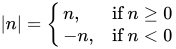
[edit]Obtaining the absolute value of a number is a unary operation. This function is defined as where is the absolute value of .


Negation
[edit]Negation is used to find the negative value of a single number. Here are some examples:


Factorial
[edit]For any positive integer n, the product of the integers less than or equal to n is a unary operation called factorial. In the context of complex numbers, the gamma function is a unary operation extension of factorial.
Trigonometry
[edit]In trigonometry, the trigonometric functions, such as , , and , can be seen as unary operations. This is because it is possible to provide only one term as input for these functions and retrieve a result. By contrast, binary operations, such as addition, require two different terms to compute a result.


Examples from programming languages
[edit]Below is a table summarizing common unary operators along with their symbols, description, and examples:[3]
| Operator | Symbol | Description | Example |
|---|---|---|---|
| Increment | ++ | Increases the value of a variable by 1 | x = 2; ++x; // x is now 3 |
| Decrement | -- | Decreases the value of a variable by 1 | y = 10; --y; // y is now 9 |
| Unary Plus | + | Indicates a positive value | a = -5; b = +a; // b is -5 |
| Unary Minus | - | Indicates a negative value | c = 4; d = -c; // d is -4 |
| Logical NOT | ! | Negates the truth value of a Boolean expression | flag = true; result = !flag; // result is false |
| Bitwise NOT | ~ | Bitwise negation, flips the bits of an integer | num = 5; result = ~num; // result is -6 |
JavaScript
[edit]In JavaScript, these operators are unary:[4]
- Increment:
++x,x++ - Decrement:
--x,x-- - Positive:
+x - Negative:
-x - Ones' complement:
~x - Logical negation:
!x
Python
[edit]In Python, there are no increment or decrement operators, but the following unary operators are available:[3]
- Positive:
+x - Negative:
-x - Ones' complement:
~x - Logical negation:
not x
C family of languages
[edit]In the C family of languages, the following operators are unary:[5][6]
- Increment:
++x,x++ - Decrement:
--x,x-- - Address:
&x - Indirection:
*x - Positive:
+x - Negative:
-x - Ones' complement:
~x - Logical negation:
!x - Sizeof:
sizeof x, sizeof(type-name) - Cast:
(type-name) cast-expression
Unix shell (Bash)
[edit]In the Unix shell (Bash/Bourne Shell), e.g., the following operators are unary:[7][8]
- Pre and Post-Increment:
++$x,$x++ - Pre and Post-Decrement:
--$x,$x-- - Positive:
+$x - Negative:
-$x - Logical negation:
!$x - Simple expansion:
$x - Complex expansion:
${#x}
PowerShell
[edit]In the PowerShell, the following operators are unary:[9]
See also
[edit]References
[edit]- ↑ Weisstein, Eric W. "Unary Operation". mathworld.wolfram.com. Retrieved 2020-07-29.
- ↑ Weisstein, Eric W. "Binary Operation". mathworld.wolfram.com. Retrieved 2020-07-29.
- 1 2 "Unary Operators in Programming". GeeksforGeeks. 20 March 2024. Retrieved 24 April 2024.
- ↑ "Unary Operators".
- ↑ "5. Expressions and Operators". C/C++ Language Reference. Version 6.0. p. 109. Archived from the original on 2012-10-16.
- ↑ "Unary Operators - C Tutorials - Sanfoundry". www.sanfoundry.com. 2 March 2014. Archived from the original on 13 June 2018. Retrieved 15 May 2017.
- ↑ "Shell Arithmetic (Bash Reference Manual)". www.gnu.org. GNU Operating System. Retrieved 24 April 2024.
- ↑ Miran, Mohammad Shah (26 October 2023). "Unary Operators in Bash". LinuxSimply. Retrieved 24 April 2024.
- ↑ "Expressions - PowerShell". learn.microsoft.com. Microsoft. 3 September 2021. Retrieved 23 April 2024.
External links
[edit] Media related to Unary operations at Wikimedia Commons
