


// Workers AI · dad joke modeWhat did Quercus fusiformis say? "I'm a tree-mendous oak
| Escarpment live oak | |
|---|---|
 | |
| Matrimonial oak near San Saba, Texas | |
Scientific classification  | |
| Kingdom: | Plantae |
| Clade: | Tracheophytes |
| Clade: | Angiosperms |
| Clade: | Eudicots |
| Clade: | Rosids |
| Order: | Fagales |
| Family: | Fagaceae |
| Genus: | Quercus |
| Subgenus: | Quercus subg. Quercus |
| Section: | Quercus sect. Virentes |
| Species: | Q. fusiformis |
| Binomial name | |
| Quercus fusiformis | |
| Synonyms[2] | |
|
List
| |

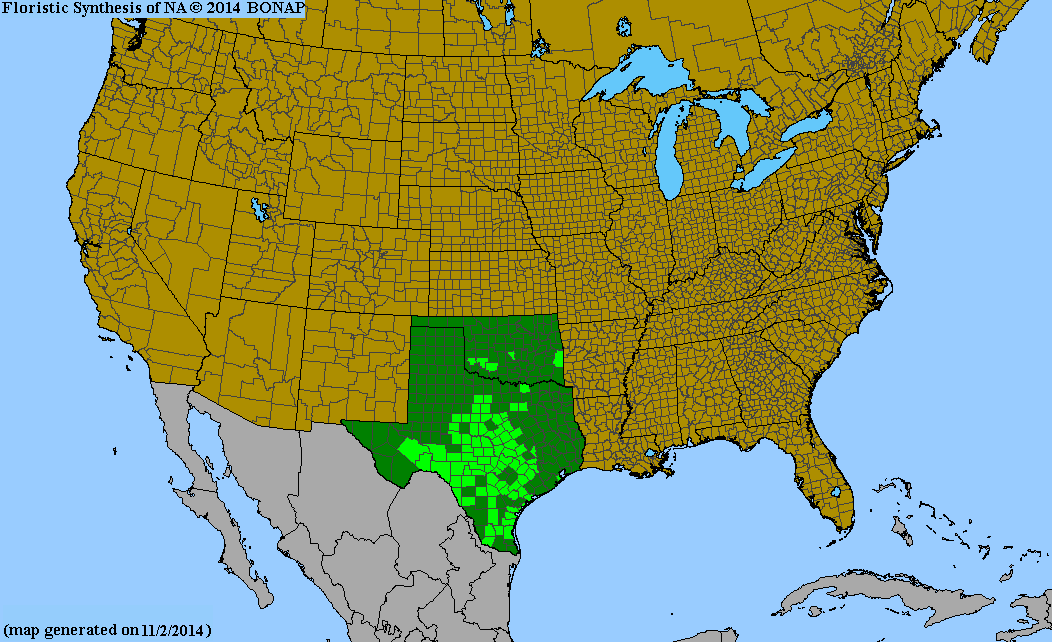
Quercus fusiformis (also often referred to as Q. virginiana var. fusiformis), commonly known as escarpment live oak, plateau live oak, plateau oak, or Texas live oak, is an semi-evergreen/tardily deciduous tree.[3] Its native range includes the Quartz Mountains and Wichita Mountains in southwestern Oklahoma,[4] through Texas (approximately from the Brazos River west up to the Pecos River and the southern Llano Estacado), to the Mexican states of Coahuila, Tamaulipas, and Nuevo León.[5][6]
Quercus fusiformis is an evergreen tree in the southern live oaks section of the genus Quercus (section Virentes).[7] It is distinguished from Quercus virginiana (southern live oak) most easily by the acorns, which are slightly larger and with a more pointed apex. It is also a smaller tree, not exceeding 1 metre (40 inches) in trunk diameter – compared to 2.5 m (75 in) in diameter in southern live oak – with more erect branching and a less wide crown.[6] Like Q. virginiana, its magnificent, stately form and unparalleled longevity has endeared it to generations of residents throughout its native range. Its low hanging branches are a favorite for local children to climb and play in.
Escarpment live oak is typically found on dry sites, unlike southern live oak, which prefers moister conditions. The tree, especially the Quartz Mountains variety, is generally accepted to be the hardiest evergreen oak, able to withstand very cold winters with minimal leaf burn in areas as cold as USDA zone 6a. For this reason the tree has become popular within the landscape industry for its beauty, ability to endure urban conditions, and general hardiness. It is prevalently used for these purposes in Texas and southern Oklahoma but use is becoming more widespread in the Western US.
The largest recorded individual tree of Q. fusiformis in the state of Texas is found in Bosque County[8][9] (not to be confused with the "Election Oak" or Bosque County Oak). It has a circumference of 870 centimetres (342 in), which is actually larger than the largest recorded Q. virginiana in the state, listed at 860 cm (338 in).
References
[edit]- ↑ Kenny, L.; Jerome, D. (2017). "Quercus fusiformis". IUCN Red List of Threatened Species. 2017 e.T194130A2302046. doi:10.2305/IUCN.UK.2017-2.RLTS.T194130A2302046.en. Retrieved 7 July 2026.
- ↑ "Quercus fusiformis Small". Plants of the World Online. Royal Botanic Gardens, Kew. Retrieved 7 July 2026.
- ↑ "Texas Big Tree Registry".
- ↑ Bruce Hoagland. "Quercus fusiformis". Oklahoma Biological Survey. Retrieved October 10, 2012.
- ↑ Kartesz, John T. (2014). "Quercus fusiformis". County-level distribution map from the North American Plant Atlas (NAPA). Biota of North America Program (BONAP).
- 1 2 Nixon, Kevin C. (1997). "Quercus fusiformis". In Flora of North America Editorial Committee (ed.). Flora of North America North of Mexico (FNA). Vol. 3. New York and Oxford: Oxford University Press – via eFloras.org, Missouri Botanical Garden, St. Louis, Missouri and Harvard University Herbaria, Cambridge, Massachusetts. "Archived copy". Archived from the original on 2025-02-16. Retrieved 2004-09-18.
{{cite web}}: CS1 maint: archived copy as title (link) CS1 maint: bot: original URL status unknown (link) - ↑ Denk, Thomas; Grimm, Guido W.; Manos, Paul S.; Deng, Min & Hipp, Andrew L. (2017). "Appendix 2.1: An updated infrageneric classification of the oaks" (xls). figshare. doi:10.6084/m9.figshare.5547622.v1. Retrieved 2023-02-18.
- ↑ "Texas Big Tree Registry". texasforestinfo.tamu.edu. Retrieved 2021-04-26.
- ↑ "Texas live Oak (Quercus fusiformis)". American Forests. 2016-09-17. Retrieved 2021-04-26.[dead link]
External links
[edit] Media related to Quercus fusiformis at Wikimedia Commons
- Texas Native Plants Database, Texas A&M University: Quercus fusiformis — horticultural/ornamental tree description.
- Native Plant Database profile, Lady Bird Johnson Wildflower Center, University of Texas at Austin
- photo of herbarium specimen collected in Nuevo León in 2003

 | This article about plants in the genus Quercus is a stub. You can help Wikipedia by adding missing information. |
- IUCN Red List least concern species
- Quercus
- Flora of the Great Plains (North America)
- Flora of Northeastern Mexico
- Flora of Oklahoma
- Flora of the Sierra Madre Oriental
- Flora of Texas
- Least concern flora of Mexico
- Least concern flora of the United States
- Trees of Northern America
- Plants described in 1901
- Taxa named by John Kunkel Small
- Quercus stubs