Abstract definition
[edit]Let  be a field of characteristic zero, such as
  or
or  .
Let
.
Let  be a finite-dimensional vector space over , and let
  be an order-d simple tensor, i.e., there exist some vectors
  such that
  . If we are given a collection of linear maps
  , then the multilinear multiplication of
  with
with  is defined[1] as the action on of the tensor product of these linear maps,[2] namely

Since the tensor product of linear maps is itself a linear map,[2] and because every tensor admits a tensor rank decomposition,[1] the above expression extends linearly to all tensors. That is, for a general tensor , the multilinear multiplication is
![{\displaystyle {\begin{aligned}&{\mathcal {B}}:=(A_{1}\otimes A_{2}\otimes \cdots \otimes A_{d})({\mathcal {A}})\\[4pt]={}&(A_{1}\otimes A_{2}\otimes \cdots \otimes A_{d})\left(\sum _{i=1}^{r}\mathbf {a} _{i}^{1}\otimes \mathbf {a} _{i}^{2}\otimes \cdots \otimes \mathbf {a} _{i}^{d}\right)\\[5pt]={}&\sum _{i=1}^{r}A_{1}(\mathbf {a} _{i}^{1})\otimes A_{2}(\mathbf {a} _{i}^{2})\otimes \cdots \otimes A_{d}(\mathbf {a} _{i}^{d})\end{aligned}}}](https://wikimedia.org/api/rest_v1/media/math/render/svg/578131c96c802126b32a930136da435d8de2f7a3)
where  with
with  is one of 's tensor rank decompositions. The validity of the above expression is not limited to a tensor rank decomposition; in fact, it is valid for any expression of as a linear combination of pure tensors, which follows from the universal property of the tensor product.
It is standard to use the following shorthand notations in the literature for multilinear multiplications: and
and where
where  is the identity operator.
Definition in coordinates
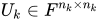
[edit]In computational multilinear algebra it is conventional to work in coordinates. Assume that an inner product is fixed on and let  denote the dual vector space of . Let
 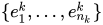 be a basis for , let
  be the dual basis, and let
 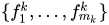 be a basis for
  . The linear map
  is then represented by the matrix
 ![{\displaystyle {\widehat {M}}_{k}=[m_{i,j}^{(k)}]\in F^{m_{k}\times n_{k}}}](https://wikimedia.org/api/rest_v1/media/math/render/svg/e40e7abf70005fe2b6848a76da0837bd374cbdba) . Likewise, with respect to the standard tensor product basis
. Likewise, with respect to the standard tensor product basis  , the abstract tensor
 is represented by the multidimensional array
 ![{\displaystyle {\widehat {\mathcal {A}}}=[a_{j_{1},j_{2},\ldots ,j_{d}}]\in F^{n_{1}\times n_{2}\times \cdots \times n_{d}}}](https://wikimedia.org/api/rest_v1/media/math/render/svg/7a39d34160d0f6db294f09c923100419af8a14df) . Observe that
. Observe that 
where  is the jth standard basis vector of
  and the tensor product of vectors is the affine Segre map :(\mathbf {v} ^{(1)},\mathbf {v} ^{(2)},\ldots ,\mathbf {v} ^{(d)})\mapsto [v_{i_{1}}^{(1)}v_{i_{2}}^{(2)}\cdots v_{i_{d}}^{(d)}]_{i_{1},i_{2},\ldots ,i_{d}}}
![{\displaystyle \otimes :(\mathbf {v} ^{(1)},\mathbf {v} ^{(2)},\ldots ,\mathbf {v} ^{(d)})\mapsto [v_{i_{1}}^{(1)}v_{i_{2}}^{(2)}\cdots v_{i_{d}}^{(d)}]_{i_{1},i_{2},\ldots ,i_{d}}}](https://wikimedia.org/api/rest_v1/media/math/render/svg/69adb55d53319166d9f59c902210694dc0b5903b) . It follows from the above choices of bases that the multilinear multiplication
. It follows from the above choices of bases that the multilinear multiplication  becomes
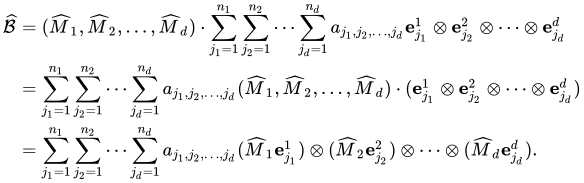
The resulting tensor  lives in
  .
.
Element-wise definition
[edit]From the above expression, an element-wise definition of the multilinear multiplication is obtained. Indeed, since is a multidimensional array, it may be expressed as  where
where 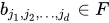 are the coefficients. Then it follows from the above formulae that
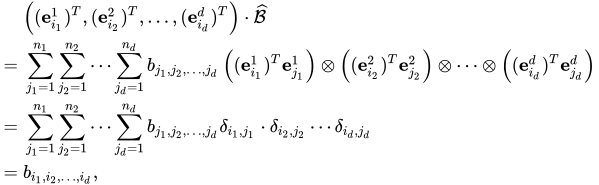
where  is the Kronecker delta. Hence, if , then
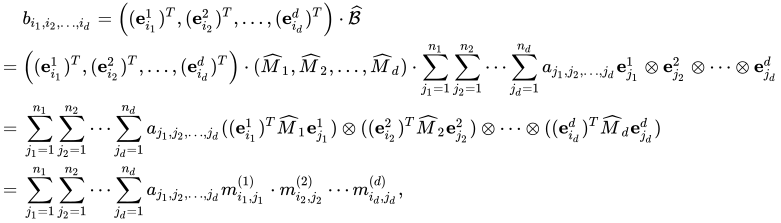
where the  are the elements of
  as defined above.
Let be an order-d tensor over the tensor product of -vector spaces.
Since a multilinear multiplication is the tensor product of linear maps, we have the following multilinearity property (in the construction of the map):[1][2]

Multilinear multiplication is a linear map:[1][2] 
It follows from the definition that the composition of two multilinear multiplications is also a multilinear multiplication:[1][2]

where  and
and  are linear maps.
Observe specifically that multilinear multiplications in different factors commute,

if 
The factor-k multilinear multiplication  can be computed in coordinates as follows. Observe first that

Next, since

there is a bijective map, called the factor-k standard flattening,[1] denoted by  , that identifies with an element from the latter space, namely

where  is the jth standard basis vector of
  ,
,  , and
, and  is the factor-k flattening matrix of whose columns are the factor-k vectors
 ![{\displaystyle [a_{j_{1},\ldots ,j_{k-1},i,j_{k+1},\ldots ,j_{d}}]_{i=1}^{n_{k}}}](https://wikimedia.org/api/rest_v1/media/math/render/svg/69ab38a528ff9bc9c3e399924aa3644fb7aae219) in some order, determined by the particular choice of the bijective map
in some order, determined by the particular choice of the bijective map
![{\displaystyle \mu _{k}:[1,n_{1}]\times \cdots \times [1,n_{k-1}]\times [1,n_{k+1}]\times \cdots \times [1,n_{d}]\to [1,N_{k}].}](https://wikimedia.org/api/rest_v1/media/math/render/svg/a3e1d65c6facfa5698a4fcd5230bfa093c2ff272)
In other words, the multilinear multiplication  can be computed as a sequence of d factor-k multilinear multiplications, which themselves can be implemented efficiently as classic matrix multiplications.