


Talk:Fermat's Last Theorem
Add topic| This is the talk page for discussing improvements to the Fermat's Last Theorem article. This is not a forum for general discussion of the subject of the article. |
Article policies
|
| Find sources: Google (books · news · scholar · free images · WP refs) · FENS · JSTOR · TWL |
Archives: 1, 2, 3, 4, 5, 6, 7, 8Auto-archiving period: 12 months  |
 | This article is written in British English, which has its own spelling conventions (colour, travelled, centre, defence, artefact, analyse) and some terms may be different or absent from other varieties of English. According to the relevant style guide, this should not be changed without broad consensus. |
 | This  level-4 vital article is rated C-class on Wikipedia's content assessment scale. level-4 vital article is rated C-class on Wikipedia's content assessment scale.It is of interest to the following WikiProjects: | |||||||||||||
| ||||||||||||||


"It is impossible to separate a cube into two cubes" versus Banach-Tarski paradox?
[edit]> "It is impossible to separate a cube into two cubes - Fermat"
The article should clarify for layman readers how that 1670 statement by Fermat can co-exist / reconcile with the Banach-Tarski paradox from 1924? I mean, one may use B-T-P as a workaround: transform the cube into a ball, split that ball up into as few as 5 pieces and re-combine them in a different way, which yields TWO identical copies of the original ball (or abritrarily many copies, per Churkin 2010). Transform those balls into cubes and finished, or not if the logic is broken somewhere? 94.21.229.113 (talk) 23:12, 22 June 2024 (UTC)
- One is about integers and the other is about continuous shapes (or, if you prefer, real numbers). They are not very closely related. —David Eppstein (talk) 23:24, 22 June 2024 (UTC)
Is Fermat's copy still around?
[edit]I'm finding several different claims that the book was lost right after his death, and all we have a transcripts made by his son, but I also heard claims that the Bibliothèque nationale de France has the original copy with his notes. Any source on either? 2A02:3035:66D:C24F:5D30:1812:F787:BA5B (talk) 16:14, 29 August 2024 (UTC)
Should "Fermat's Last Theorem" be renamed to "Fermat's last theorem" for consistency?
[edit]The disambiguation page Fermat's theorem shows that only this article has all words initially capitalized. For example Fermat's little theorem isn't titled Fermat's Little Theorem, and neither is Fermat's theorem on sums of two squares called Fermat's Theorem on Sums of Two Squares. Should this article be renamed to Fermat's last theorem for Wikipedia consistency? GregariousMadness (talk to me!) 16:05, 27 December 2024 (UTC)
- This has been heavily discussed, most recently Talk:Fermat's Last Theorem/Archive 8#Requested move 2 August 2021. Have you read those discussions and do you have something different to add than what was already discussed there? But to be brief: This is not actually the last theorem of Fermat, so it does not make sense to use a capitalization suggesting that the phrase is a description. It is not a description; it is a name. In contrast, for the theorem on sums of two squares, the title actually is an accurate description of the theorem rather than its name. —David Eppstein (talk) 16:52, 27 December 2024 (UTC)
- Ah I see, I didn't see those discussions. Thank you! GregariousMadness (talk to me!) 14:39, 28 December 2024 (UTC)
- Followup for the record: (a) It was, of course, only a "theorem" in the sense that Fermat said he had a proof (though he almost certainly did not). And (b) it wasn't called "last" because Fermat never did anything again -- he did -- but because by the early 19th c it was the last of Fermat's many propositions to remain unresolved. EEng 02:48, 12 July 2025 (UTC)
preprint-fermat's last theorem
[edit]|
https://www.techrxiv.org/users/717330/articles/702287-on-fermat-s-last-theorem 2600:1012:A023:1293:F83E:21A9:FD4F:E4DF (talk) 19:47, 21 January 2025 (UTC)
|


Reverted alleged Gerber's proof
[edit]I agree with this revert. Nevertheless, it may be useful to know why Gerber's proof and the supposed Fermat's proof are wrong. I an unable to source what follows, since this results from what I remember from a course by Pierre Samuel.
The reverted text mention heavily Fermat's method of infinite descent. The reason for which one cannot prove the theorem with infinite descent only is that the method supposes that the rings of integers of cyclotomic fields satisfy the unique factorization property. It has been discovered during the 19th century (by Gauss, Kummer or someone else?) that this is wrong, and thus that the teorem cannot be proved with infinite descent. Most wrong proofs, included Gerber's one, result from the ignorance of the existence of non-unique factorization. The non-unique factorization is a subtle property that Fermat could certainly not know; this explains why Fermat could not have a correct proof.
If someone can source the above assertions, it would be useful to add them to the article. D.Lazard (talk) 21:43, 11 July 2025 (UTC)
- I believe Mathematics: The New Golden Age by Keith Devlin discusses this, although I'll defer to someone with far more math background than I to draft the language for the article. Newyorkbrad (talk) 02:54, 12 July 2025 (UTC)
- The current article goes into this somewhat in the Ernst Kummer and the theory of ideals subsection. Stepwise Continuous Dysfunction (talk) 01:58, 22 July 2025 (UTC)
- I'm confused -- why would the article give any attention at all to yet another faulty proof of no apparently significance? EEng 22:47, 23 July 2025 (UTC)
- Not to the purported proof, but to why this kind of descent argument fails more generally. —David Eppstein (talk) 22:55, 23 July 2025 (UTC)
- Ah, I see. Well, good thing we've got you on the team for stuff like that. EEng 01:15, 24 July 2025 (UTC)
- Not to the purported proof, but to why this kind of descent argument fails more generally. —David Eppstein (talk) 22:55, 23 July 2025 (UTC)
Recent removal of sourced content
[edit]After lengthy discussion about Khazin's works, page 15 of this source says:[1]
It was also in this tradition that the study of the representation of an integer as the sum of squares started: in fact, al-Khāzin devotes several propositions in his dissertation to this study. These tenth century mathematicians were the first to address the question of impossible problems, such as the first case of Fermat's theorem.
The book is authored by Roshdi Rashed who is a historian of Mathematics. This source is reliable in context WP:CONTEXTMATTERS, yet @David Eppstein is removing my edit, falsely accusing me of misquoting Roshdi. https://en.wikipedia.org/w/index.php?title=Fermat%27s_Last_Theorem&diff=prev&oldid=1356960655 Hu741f4 (talk) 00:24, 31 May 2026 (UTC)
- I did not accuse you of misquoting Rashed. I stated that the assertion you added, that "the study of the representation of an integer as the sum of squares started" in Islamic mathematics, is clearly blatantly false: integer solutions of the Pythagorean theorem were obviously studied for much longer in Greek and Babylonian mathematics. And "the first case of Fermat's theorem" usually means the full formulation of Fermat's last theorem, in the case where the exponent does not divide the other numbers (the second case being the case where it does divide at least one of them), but without seeing the full text of your source it is impossible to tell whether that is the intended meaning here, whether "first case" means only something special like the case of cubes, or even whether "Fermat's theorem" really refers to Fermat's last theorem. The wording you supplied is too vague to tell what it means. For that matter it is not even clear from the wording whether it is intended to mean that the mathematicians of this period specifically studied Fermat's theorem, or whether they studied unrelated "impossible problems" and that Fermat is merely an example of an impossible problem but not one that they studied. As for misquoting, the alternatives I gave were that the material from Rashed was mistaken or that it was quoted out of context (i.e. misquoted). I am not accusing you of anything but the way you have added this material, and defended it by an argument to authority rather than any elaboration of what is meant, make it impossible for me to determine the true meaning and validity of this source. —David Eppstein (talk) 00:55, 31 May 2026 (UTC)
- This is quoted from a different source which you can access:
Khuğandī tried to prove the following theorem: «the sum of two cubes cannot be a cube»...Al-Khāzin tried however to prove that: The sum of two squares cannot be a square and a cube cannot be divided in the sum of two cubes. A square can however be divided into a sum of two squares
- In the last page:
[2]One of the consequences of the result settled by al-Zanğānī is that: «The surface of a right-angled (With whole numbers sides) triangle can never be a square», which is a result that Fermat have quoted in the XVIth century and after him Frenicle in XVII one. To finish, we may note that another important result, which represents a special case of the famous Fermat Theorem, was proved by al-Khayyam in the XIth century is: The equation has no integer solutions». This same problem will be revisited in Europe by Fermat, Legendre and Euler.
- Hu741f4 (talk) 06:39, 31 May 2026 (UTC)

- PS it is also impossible to tell from your wording whether representation as sum of squares refers to the Pythagorean theorem (two squares) or to Waring's problem (more squares than two) but our Waring's problem article dates it to Diophantus, again long before the medieval Islamic period. —David Eppstein (talk) 01:47, 31 May 2026 (UTC)
- I quoted the exact text from the book here. The source clearly says "Fermat's theorem". Just because you are unable to browse that source doesn't mean you should remove that. Hu741f4 (talk) 06:07, 31 May 2026 (UTC)
- "Fermat's theorem" could easily mean Fermat's little theorem or something else. When you quote something that says only "Fermat's theorem" you are not being informative. —David Eppstein (talk) 07:31, 31 May 2026 (UTC)
- I quoted the exact text from the book here. The source clearly says "Fermat's theorem". Just because you are unable to browse that source doesn't mean you should remove that. Hu741f4 (talk) 06:07, 31 May 2026 (UTC)
- Not to mention that the Ancients had also considered "impossible problems" e.g. angle trisection. Of course, they didn't know they were impossible, but then neither did "these tenth-c mathematicians" know that Fermat's equation is impossible -- otherwise there'd have been nothing left for Andrew Wiles to do. So what exactly Rashed means is impossible to discern without more context. EEng 05:40, 31 May 2026 (UTC)
- No, they didn't. That is why Rashed is writing "These tenth century mathematicians were the first to address the question of impossible problems, such as the first case of Fermat's theorem." Hu741f4 (talk) 06:08, 31 May 2026 (UTC)
- Who didn't what? EEng 10:15, 31 May 2026 (UTC)
- This is quoted from a different source which you can access:
[3]Khuğandī tried to prove the following theorem: «the sum of two cubes cannot be a cube»...Al-Khāzin tried however to prove that: The sum of two squares cannot be a square and a cube cannot be divided in the sum of two cubes. A square can however be divided into a sum of two squares
- In the last page:
[4]One of the consequences of the result settled by al-Zanğānī is that: «The surface of a right-angled (With whole numbers sides) triangle can never be a square», which is a result that Fermat have quoted in the XVIth century and after him Frenicle in XVII one. To finish, we may note that another important result, which represents a special case of the famous Fermat Theorem, was proved by al-Khayyam in the XIth century is: « The equation has no integer solutions». This same problem will be revisited in Europe by Fermat, Legendre and Euler.
- Hu741f4 (talk) 06:46, 31 May 2026 (UTC)
- "The sum of two squares cannot be a square" ??? 3^2 + 4^2 = 5^2. Something is missing in the context of your quotes; either the way you are quoting them, devoid of context, or the way Rashed is writing them, makes them come across as nonsensical. I have been unable to find any reviews of this book or this chapter in it to determine whether other scholars than Rashed are as baffled by it as I am by what I have seen of it here. It was indexed in MathSciNet and zbMATH but not reviewed by either. Does it claim to be peer reviewed?
- At least the additional quote on sums of cubes makes it clear that what you are calling "the first case" is not what is standardly called the first case, but rather the case of exponent 3. —David Eppstein (talk) 07:33, 31 May 2026 (UTC)
- i edited my response while you were replying. Re read that Hu741f4 (talk) 07:39, 31 May 2026 (UTC)
- It still contains the baffling text "The sum of two squares cannot be a square". The wrong word "threw" in the abstract of the link does not fill me with confidence in the care with which it was written and edited. —David Eppstein (talk) 07:56, 31 May 2026 (UTC)
- but one thing is clear from the the cited sources: The 10th- and 11th-century mathematicians were the first to address the insolubility of these equations, proving the theorem for the cases and . This is why Rashed writes: "These tenth century mathematicians were the first to address the question of impossible problems, such as the first case of Fermat's theorem." Hu741f4 (talk) 08:00, 31 May 2026 (UTC)
- It is clear that these sources assert that those mathematicians looked at those equations, and that Khuğandī either proved or "tried to prove" the impossibility of the first (the same source says both things). What is unclear is how reliable these sources are in saying this. Kchir et al is in very bad English, in a journal of unclear reliability, with reference to Rashed but no direct reference to where Rashed found these things. And I still have not been able to read much of Rashed to see whether his provenance is more clearly laid out. —David Eppstein (talk) 08:07, 31 May 2026 (UTC)
- I have given you the source. Access it. Hu741f4 (talk) 08:11, 31 May 2026 (UTC)
- Rashed is obviously reliable https://hal.science/hal-01653436/document Here's a review affirming the fact that the first attempts to prove the unsolvability of the so-called Fermat equation occured in work of Arab mathematicians Hu741f4 (talk) 08:26, 31 May 2026 (UTC)
- It is possibly interesting that the bio of Rashed that you link, writing about Rashed's work connecting Descartes and Fermat to mathematics from the medieval Islamic period, calls his work "fascinating connections with Arabic mathematics, some of which are found difficult by many to accept, on account of certain stereotypical beliefs." Later in the same piece we find that Rashed "insisted on seeing there the
- notion of 'impossible and inaccessible Diophantine problems,' a notion which posed
- tremendous logical and philosophical questions", with phrasing that suggests the author of the piece to be skeptical of this notion.
- Regardless of what might motivate this lack of acceptance, we are constrained here to report on what is the mainstream scientific belief. If Rashed's work is not generally accepted, we might still be able to report it, but only with wording that makes clear that it is not generally accepted.
- We do at least have a mention in this piece (without skeptical wording) that the Islamic mathematicians considered the equation , closely related to the exponent-4 case of Fermat. It might be reasonable to also state that they considered the exponent-3 equation , using Rashed as a source. The overblown claims that they were the first to consider representations as sums of squares (whether that means Pythagoras or Diophantos/Waring) is entirely another thing. —David Eppstein (talk) 21:05, 31 May 2026 (UTC)
- The review is positive and didn't refute or point out any mistakes in the work of Rashed. Rather the author supports many points made by Rashed including the one which we are discussing by stating We also find there the first attempts to prove the unsolvability of the so-called Fermat equation. By saying "some of which are found difficult by many to accept, on account of certain stereotypical beliefs" the reviewer doesn't mean that (some of) his points have been rejected or turned out to be false. If Rashed's claim isn't accepted then prove so. Bring a review refuting or contesting his fundings regarding the occurrence of first case of Fermat's theorem in the 10th century. The fact that there are other reliable sources repeating Rashed's finding regarding Fermat's theorem (this citation, for example) [5], including this review which we are discussing, the Mc tutor article, the other peer reviewed journal paper which I cited are enough. Hu741f4 (talk) 15:45, 1 June 2026 (UTC)
- Nobody challenges Rashed's assertion. THe problem is that you changed it into "Mathematicians of this era were also among the first to systematically investigate impossible problems", which has a completely different meaning. This change is blatantly WP:OR D.Lazard (talk) 16:14, 1 June 2026 (UTC)
- Rashed wrote: "These tenth century mathematicians were the first to address the question of impossible problems, such as the first case of Fermat's theorem."
- I paraphrased it like this: "Mathematicians of this era were also among the first to systematically investigate impossible problems, including the first case of what later became known as Fermat's Last Theorem".
- But I agree that Rashed's wording was bit awkward here. Hu741f4 (talk) 16:42, 1 June 2026 (UTC)
- "insisted on seeing ... a notion which posed tremendous logical and philosophical questions" is very far from being positive wording, and suggests that the reviewer does not agree with these positions. —David Eppstein (talk) 17:41, 1 June 2026 (UTC)
- The reviewer used the word "insisted" but this can't be cited as a proof for your claim that it means "reviewer does not agree with these positions." If this was the case the reviewer would have mentioned or stated that clearly. You are focusing on one word, but you aren't reading the entire review where the reviewer is praising almost every work of Rashed. Anyway, that part isn't about what we are discussing. let's stick to the topic of Fermat's theorem. Hu741f4 (talk) 19:33, 1 June 2026 (UTC)
- It could alternatively mean that Rashed insisted on taking this position despite opposition from other researchers. Regardless, it means that the position was not uniformly accepted. And this is highly relevant because the position in question is exactly the one you are trying to push here, that the Islamic mathematicians were the first to consider "impossible problems". —David Eppstein (talk) 20:17, 1 June 2026 (UTC)
- "It could alternatively mean...". This means you are uncertain. Then show me a reliable source refuting Rashed's finding regarding first occurrence of insolubility of Fermat's equation in the 10th century work by Persian mathematicians, or show me who did this earlier than them. Why has Rashed's claim been repeated in multiple sources[6][7].??? Hu741f4 (talk) 20:56, 1 June 2026 (UTC)
- It could alternatively mean that Rashed insisted on taking this position despite opposition from other researchers. Regardless, it means that the position was not uniformly accepted. And this is highly relevant because the position in question is exactly the one you are trying to push here, that the Islamic mathematicians were the first to consider "impossible problems". —David Eppstein (talk) 20:17, 1 June 2026 (UTC)
- The reviewer used the word "insisted" but this can't be cited as a proof for your claim that it means "reviewer does not agree with these positions." If this was the case the reviewer would have mentioned or stated that clearly. You are focusing on one word, but you aren't reading the entire review where the reviewer is praising almost every work of Rashed. Anyway, that part isn't about what we are discussing. let's stick to the topic of Fermat's theorem. Hu741f4 (talk) 19:33, 1 June 2026 (UTC)
- "insisted on seeing ... a notion which posed tremendous logical and philosophical questions" is very far from being positive wording, and suggests that the reviewer does not agree with these positions. —David Eppstein (talk) 17:41, 1 June 2026 (UTC)
- Nobody challenges Rashed's assertion. THe problem is that you changed it into "Mathematicians of this era were also among the first to systematically investigate impossible problems", which has a completely different meaning. This change is blatantly WP:OR D.Lazard (talk) 16:14, 1 June 2026 (UTC)
- The review is positive and didn't refute or point out any mistakes in the work of Rashed. Rather the author supports many points made by Rashed including the one which we are discussing by stating We also find there the first attempts to prove the unsolvability of the so-called Fermat equation. By saying "some of which are found difficult by many to accept, on account of certain stereotypical beliefs" the reviewer doesn't mean that (some of) his points have been rejected or turned out to be false. If Rashed's claim isn't accepted then prove so. Bring a review refuting or contesting his fundings regarding the occurrence of first case of Fermat's theorem in the 10th century. The fact that there are other reliable sources repeating Rashed's finding regarding Fermat's theorem (this citation, for example) [5], including this review which we are discussing, the Mc tutor article, the other peer reviewed journal paper which I cited are enough. Hu741f4 (talk) 15:45, 1 June 2026 (UTC)
- In mactutor article of Al-Khazin it is clearly mentioned that
- It is clear that these sources assert that those mathematicians looked at those equations, and that Khuğandī either proved or "tried to prove" the impossibility of the first (the same source says both things). What is unclear is how reliable these sources are in saying this. Kchir et al is in very bad English, in a journal of unclear reliability, with reference to Rashed but no direct reference to where Rashed found these things. And I still have not been able to read much of Rashed to see whether his provenance is more clearly laid out. —David Eppstein (talk) 08:07, 31 May 2026 (UTC)
- but one thing is clear from the the cited sources: The 10th- and 11th-century mathematicians were the first to address the insolubility of these equations, proving the theorem for the cases and . This is why Rashed writes: "These tenth century mathematicians were the first to address the question of impossible problems, such as the first case of Fermat's theorem." Hu741f4 (talk) 08:00, 31 May 2026 (UTC)
- It still contains the baffling text "The sum of two squares cannot be a square". The wrong word "threw" in the abstract of the link does not fill me with confidence in the care with which it was written and edited. —David Eppstein (talk) 07:56, 31 May 2026 (UTC)
- i edited my response while you were replying. Re read that Hu741f4 (talk) 07:39, 31 May 2026 (UTC)
- No, they didn't. That is why Rashed is writing "These tenth century mathematicians were the first to address the question of impossible problems, such as the first case of Fermat's theorem." Hu741f4 (talk) 06:08, 31 May 2026 (UTC)


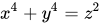
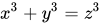
Al-Khujandi claimed to have proved that x3+y3=z3 is impossible for whole numbers x,y,z which of course is the n=3 case of Fermat's Last Theorem.
- So it's clearly states that he discovered a special case of fermat last theorem for n = 3 which is a whole number,not the general one nor a numerical proof. Myuoh kaka roi (talk) 10:04, 31 May 2026 (UTC)
- This isn't my argument, and this isn't what I seek to add. I never claimed that they either stated or proved it for general case. Hu741f4 (talk) 11:28, 31 May 2026 (UTC)
- but thanks for this new source. Hu741f4 (talk) 11:29, 31 May 2026 (UTC)
- I gave one of the new source for the statement and if you have other reliable sources other than roshdid rashed for your argument then we can discuss about it Myuoh kaka roi (talk) 12:40, 31 May 2026 (UTC)
- 2 sources (one by Roshdi Rashed, another a review of Roshdi Rashed's work) + A new source that you just provided are enough to confirm that these 10th- and 11th-century Persian mathematicians were the first to address the insolubility of these equations, stating the case for n=3 and n=4 Hu741f4 (talk) 13:16, 31 May 2026 (UTC)
- lets see if other editors agree with your changes but try to find any other source apart from himMyuoh kaka roi (talk) 13:49, 31 May 2026 (UTC)
- The other two sources aren't Rashed Roshdi, but Athanase Papadopoulos and J J O'Connor and E F Robertson Hu741f4 (talk) 15:14, 31 May 2026 (UTC)
- lets see if other editors agree with your changes but try to find any other source apart from himMyuoh kaka roi (talk) 13:49, 31 May 2026 (UTC)
- 2 sources (one by Roshdi Rashed, another a review of Roshdi Rashed's work) + A new source that you just provided are enough to confirm that these 10th- and 11th-century Persian mathematicians were the first to address the insolubility of these equations, stating the case for n=3 and n=4 Hu741f4 (talk) 13:16, 31 May 2026 (UTC)
- I gave one of the new source for the statement and if you have other reliable sources other than roshdid rashed for your argument then we can discuss about it Myuoh kaka roi (talk) 12:40, 31 May 2026 (UTC)
- RIST is also a peer reviewed journal. Hu741f4 (talk) 15:28, 31 May 2026 (UTC)
- So it's clearly states that he discovered a special case of fermat last theorem for n = 3 which is a whole number,not the general one nor a numerical proof. Myuoh kaka roi (talk) 10:04, 31 May 2026 (UTC)
- I agree withe the Epstein's revert: the first sentence ("The study of representing integers as the sum of squares originated in the medieval Islamic world") is blatantly wrong, since the Pythagorean theorem and the study of Pythagorean triples are much earlier and consist of the representation of a square as a sum of two squares. The second sentence ("In the 10th century, the mathematician al-Khāzin dedicated several propositions in his dissertation to this topic") is off-topic, since this article is not about sums of squares. The beginning of the third sentence ("Mathematicians of this era were also among the first to systematically investigate impossible problems") is too vague to be acceptable, because the vagueness of "impossible problems". If one interprets "impossible problems" as "equations without integer solutions", the sentence becomes wrong, since equations such as , , doubling the cube and angle trisection were widely studied by the ancient Greeks (they failed to solve the three latter problems, which where not solved before the 18th century). As blatantly wrong assertions cannot be reliably sourced, it does not matter whether there are sources for these assertions.
- The only thing that could be salvaged in this section is that some mathematician from the medieval Islamic world could have proved Fermat's Last Theorem for the exponent 3 (or 3 and 4). However, for including this, one must know which mathematician, and have a source discussing whether this proof is correct. This does not result clearly from the above discussion. D.Lazard (talk) 14:02, 31 May 2026 (UTC)
- By saying
, Roshdi means that these 10th and 11th century Persian mathematicians were the first to state impossibility of solving equations of form , and stated it for and . Fermat's last theorem states that there are no positive integers with such that . The Babylonian and Greek mathematicians didn't discuss this impossibility. The The casesThese tenth century mathematicians were the first to address the question of impossible problems, such as the first case of Fermat's theorem.
- of and which have been known since antiquity to have infinitely many solutions, aren't related to impossibility.
- Stop discussing your own opinion here and don't rely on WP:OR. If Rashed Roshdi is wrong then how come there are reviews supporting his claim instead of rejecting it?? Here is a review by Athanase Papadopoulos, Directeur de Recherche at the French Centre National de la Recherche Scientifique, affirming this:
We also find there the first attempts to prove the unsolvability of the so-called Fermat equation.[8]
- As the other editor pointed out: In MacTutor History of Mathematics Archive article of Al-Khazin it is clearly mentioned that
Al-Khujandi claimed to have proved that is impossible for whole numbers which of course is the case of Fermat's Last Theorem.
- Here's the third one–RIST, which is a peer reviewed journal:
[9]To finish, we may note that another important result, which represents a special case of the famous Fermat Theorem, was proved by al-Khayyam in the XIth century is: « The equation has no integer solutions». This same problem will be revisited in Europe by Fermat, Legendre and Euler.
- By saying


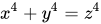
Hu741f4 (talk) 15:13, 31 May 2026 (UTC)
- The article already says, with sources, that Khojandi claimed to have proved Fermat's Last Theorem for the exponent 3, and that his proof was flawed. No more details are needed. The assertion that the exponent 4 was proved by al-Khayyam requires a more reliable source that a single unsourced sentence in a badly written article. It is possible that Islamic mathematicians conjectured the theorem for the exponent 4, but this seems not sufficient for adding a new section to the article. D.Lazard (talk) 18:16, 31 May 2026 (UTC)
- He stated it. As for the proof, his proof was flawed not according to historians of mathematics, but according to Al-Khazin. According to Rashed Roshdi, Al-Khazin was himself offtrack and didn't provide enough justifiable reason to disprove Khojandi. (see The Development of Arabic Mathematics: Between Arithmetic and Algebra, R. Rashed.(2013). The second source is also a reliable source that hasn't been contradicted by any other reliable source. There is no reason why it shouldn't be included. Hu741f4 (talk) 18:29, 31 May 2026 (UTC)
- I see no reason to regard RIST as a reliable source. That item appears to be a conference proceeding, for a conference that was not devoted to mathematics or mathematics history, published in a journal that is not devoted to mathematics or mathematics history. Its self-description is that it publishes
research papers on any topic related to information processing at the digital age which includes but is not limited to: digital Libraries, Digital Humanities and Heritage, Artificial Intelligence, Natural Language Processing, Semantic Web Technologies, Linked Data, Databases, big data, Machine Learning, deep learning, computer vision, ... and other issues related to information access, ethics, and privacy.
The "OCTA International Multi-Conference" has a similar purview: so broad it seems like a WASET-style junk conference, yet still not encompassing mathematics history, meaning that we have no reason to expect that they actually evaluate papers in that area. Stepwise Continuous Dysfunction (talk) 20:17, 1 June 2026 (UTC)- what about the other sources. RIST is supplementary Hu741f4 (talk) 20:40, 1 June 2026 (UTC)
- In the article, there are two sources asserting that Khojandi claimed to have proved Fermat's Last Theorem for the exponent 3, and that his proof was flawed (references 85 and 86). These sources are much older that Rashed's writings (one was published before Rashed's birth). Nothing else, in your edits, belongs to this article. D.Lazard (talk) 11:46, 2 June 2026 (UTC)
- That still doesn't change the fact they were the first to state the impossibility and stated the theorem for the case n=3 and n=4. They were also the first who attempted to prove, even though the proof is now lost or false. (Even Fermat was unable to prove the theorem). Source 86 attributes the falsification of his attempt to Al Khazin (as I pointed out). What does source 85 says? As per WP:AGE MATTERS older sources may be inaccurate because new information has been brought to light Hu741f4 (talk) 12:54, 2 June 2026 (UTC)
- In the article, there are two sources asserting that Khojandi claimed to have proved Fermat's Last Theorem for the exponent 3, and that his proof was flawed (references 85 and 86). These sources are much older that Rashed's writings (one was published before Rashed's birth). Nothing else, in your edits, belongs to this article. D.Lazard (talk) 11:46, 2 June 2026 (UTC)
- what about the other sources. RIST is supplementary Hu741f4 (talk) 20:40, 1 June 2026 (UTC)
Arbor-treeish break
[edit]Let's go back to the question of text for the article. Hu741f4, you originally added:
The study of representing integers as the sum of squares originated in the medieval Islamic world. In the 10th century, the mathematician al-Khāzin dedicated several propositions in his dissertation to this topic. Mathematicians of this era were also among the first to systematically investigate "impossible problems," including the first case of what later became known as Fermat's Last Theorem.
Let's go sentence by sentence. Are you still proposing that the first sentence belongs in the article? EEng 17:02, 31 May 2026 (UTC)
- No! I am not reinstating this edit. But I'll keep the part that the 10th century Persian mathematicians were the first to state unsolvability of such equations (The last sentence of the edit). Hu741f4 (talk) 17:06, 31 May 2026 (UTC)
- No that's obviously not ok because "such equations" is far too vague (as has already been pointed out above several times). --JBL (talk) 19:03, 31 May 2026 (UTC)
- "Among the first" is also vague and raises the question, "OK, why not just say who was the first?" Moreover, grouping different questions together as "impossible problems" is WP:SYNTH if that grouping is not already attested in WP:RS. And on top of that, the phrasing "systematically investigate" suggests that these problems were being studied together, i.e., that mathematicians were trying to find a theory of insolvability, a common explanation for why multiple problems were each insolvable. To my knowledge, this did not happen before the modern period.
- (This is Stepwise Continuous Dysfunction, editing from a computer where I do not have my regular login info.) ~2026-32294-86 (talk) 19:18, 31 May 2026 (UTC)
- "To my knowledge", keep your knowledge and your original research to yourself. I have explicitly cited exact quotes. Citing exact quotes directly from the source isn't WP:OR. Citing two or three sources saying the same thing isn't WP:SYNTH. All the sources that I have cited are reliable no one in this discussion has proven that any of my source is unreliable as per Wikipedia guidelines.
- 1)https://en.wikipedia.org/w/index.php?title=Talk:Fermat%27s_Last_Theorem&diff=prev&oldid=1357064430
- 2)https://en.wikipedia.org/w/index.php?title=Talk:Fermat%27s_Last_Theorem&diff=prev&oldid=1357065914 Hu741f4 (talk) 19:46, 31 May 2026 (UTC)
- This kind of hyper-aggressive personalized remark is uncalled for; it is reminiscent of some of the behavior that prominently featured in Wikipedia:Arbitration/Requests/Case/Maghreb. Please desist immediately and completely, and focus your comments in this discussion on content only. There is no need to respond to this message; thanks in advance for adhering to appropriate behavioral norms going forward. --JBL (talk) 20:48, 31 May 2026 (UTC)
- And for the record, BTW, while OR is verboten in articles, editors are not only allowed, but compelled to use their general knowledge, common sense, and research into the subject at hand in order to evaluate sources. EEng 23:39, 31 May 2026 (UTC)
- They should bring a reliable source. Hu741f4 (talk) 15:51, 1 June 2026 (UTC)
- Any reliable source about the development of abstract algebra will say the same thing, as far as the issue here is concerned. The extraordinary claim that requires extraordinary support would be that a unifying theory of impossibility like Galois theory existed centuries before Galois. Stepwise Continuous Dysfunction (talk) 20:26, 1 June 2026 (UTC)
- Then show me a reliable source refuting Rashed's finding regarding first occurrence of insolubility of Fermat's equation in the 10th century work by Persian mathematicians, or show me who did this earlier than them. Why has Rashed's claim been repeated in multiple sources[10][11].??? Note that insolubility arises only when Hu741f4 (talk) 20:59, 1 June 2026 (UTC)
- You are repeatedly citing the same few sources in response to things that people are not saying. Stepwise Continuous Dysfunction (talk) 21:06, 1 June 2026 (UTC)
- But those who disagree with these same few sources are unable to refute them either by citing a reliable source saying otherwise or by showing why those sources are unreliable. Hu741f4 (talk) 21:11, 1 June 2026 (UTC)
- We have more than once pointed out how Rashed's general claim ("These tenth century mathematicians were the first to address the question of impossible problems") cannot be true as written. More specific statements about individual mathematicians studying what would in retrospect be seen as individual cases of a theorem are not the same thing. Stepwise Continuous Dysfunction (talk) 21:15, 1 June 2026 (UTC)
- This isn't just Rashed. What about Athanase Papadopoulos who writes "We also find there the first attempts to prove the unsolvability of the so-called Fermat equation" Hu741f4 (talk) 21:27, 1 June 2026 (UTC)
- We have more than once pointed out how Rashed's general claim ("These tenth century mathematicians were the first to address the question of impossible problems") cannot be true as written. More specific statements about individual mathematicians studying what would in retrospect be seen as individual cases of a theorem are not the same thing. Stepwise Continuous Dysfunction (talk) 21:15, 1 June 2026 (UTC)
- But those who disagree with these same few sources are unable to refute them either by citing a reliable source saying otherwise or by showing why those sources are unreliable. Hu741f4 (talk) 21:11, 1 June 2026 (UTC)
- You are repeatedly citing the same few sources in response to things that people are not saying. Stepwise Continuous Dysfunction (talk) 21:06, 1 June 2026 (UTC)
- Then show me a reliable source refuting Rashed's finding regarding first occurrence of insolubility of Fermat's equation in the 10th century work by Persian mathematicians, or show me who did this earlier than them. Why has Rashed's claim been repeated in multiple sources[10][11].??? Note that insolubility arises only when Hu741f4 (talk) 20:59, 1 June 2026 (UTC)
- Any reliable source about the development of abstract algebra will say the same thing, as far as the issue here is concerned. The extraordinary claim that requires extraordinary support would be that a unifying theory of impossibility like Galois theory existed centuries before Galois. Stepwise Continuous Dysfunction (talk) 20:26, 1 June 2026 (UTC)
- They should bring a reliable source. Hu741f4 (talk) 15:51, 1 June 2026 (UTC)
- "This kind of hyper-aggressive personalized remark"... Asking editors not to bring their original research here on Wikipedia isn't "personalized remark". Feel free to report that remark if you think it was "personal" and "problematic" Hu741f4 (talk) 15:13, 1 June 2026 (UTC)
- And for the record, BTW, while OR is verboten in articles, editors are not only allowed, but compelled to use their general knowledge, common sense, and research into the subject at hand in order to evaluate sources. EEng 23:39, 31 May 2026 (UTC)
- This kind of hyper-aggressive personalized remark is uncalled for; it is reminiscent of some of the behavior that prominently featured in Wikipedia:Arbitration/Requests/Case/Maghreb. Please desist immediately and completely, and focus your comments in this discussion on content only. There is no need to respond to this message; thanks in advance for adhering to appropriate behavioral norms going forward. --JBL (talk) 20:48, 31 May 2026 (UTC)
- That vagueness can be fixed by explicitly writing the equation of the fermat's last theorem (because all the source that I have quoted mention either fermat's last theorem or fermat's equation.) Hu741f4 (talk) 19:39, 31 May 2026 (UTC)
- Ok, it sounds like everyone agrees that none of the sentences from your original attempt are going into the article. I invite you to propose alternate additions; I (and I'm sure everyone else) would be happy to consider it on the merits. --JBL (talk) 20:52, 31 May 2026 (UTC)
- But they are unable to prove how my sources are unreliable, either by showing a reliable source contesting the claim or simply proving that the sources that I am citing are unreliable Hu741f4 (talk) 15:53, 1 June 2026 (UTC)
- Nobody said that Rached's source is unreliable. The problem is that you aded to the article assertions that are not in Rashed's writings and are not sourced at all. D.Lazard (talk) 16:23, 1 June 2026 (UTC)
- which part of my edit wasn't in Rashed's writing? Please write that down. This is a serious accusation. Hu741f4 (talk) 16:37, 1 June 2026 (UTC)
- D.Lazard put the point rather well:
As blatantly wrong assertions cannot be reliably sourced, it does not matter whether there are sources for these assertions.
The claim, as written in Roshdi, is blatantly wrong if taken at face value. The Pythagoreansaddress[ed] the question of impossible problems
so long ago that the details have slipped into legend. (Roshdi's book may well be fine for other purposes. Perhaps that line was just badly phrased. Even Homer nods, and all that.) You turned Roshdi's claim into a different claim, also indefensible but for the opposite reason. By inserting "systematically investigate", you made a stronger claim than Roshdi. Stepwise Continuous Dysfunction (talk) 20:38, 1 June 2026 (UTC)- Show me one reliable source claiming that Pythagoreans stated the theorem for the case of , because impossibility arises only when . I can't copy paste the exact word of Rashed as per copyright violation guidelines, but he used similar wording. Hu741f4 (talk) 20:43, 1 June 2026 (UTC)
- The question is not whether the Pythagoreans stated a case of Fermat's Last Theorem. No one here is saying that they did. What we are saying, because it is true, is that they studied "impossible problems". Stepwise Continuous Dysfunction (talk) 21:04, 1 June 2026 (UTC)
- "Impossible problems" is vast term. Let's focus only on impossibility in context of Fermat's last theorem. Hu741f4 (talk) 21:13, 1 June 2026 (UTC)
- But the sentence in dispute does not focus like that. It says,
Mathematicians of this era were also among the first to systematically investigate "impossible problems," including the first case of what later became known as Fermat's Last Theorem.
Stepwise Continuous Dysfunction (talk) 21:17, 1 June 2026 (UTC)- I can't directly copy Rashed's exact wording. That'll constitute copyright violation. This is what he writes: These tenth century mathematicians were the first to address the question of impossible problems, such as the first case of Fermat's theorem. I replaced 'addressed' with 'investigate'. But I agree that I should have not included 'systematically'. Hu741f4 (talk) 21:23, 1 June 2026 (UTC)
- Of course you can copy his words here; it's called "fair use". Geesh, you make everything 5X more difficult for yourself. EEng 02:38, 2 June 2026 (UTC)
- I can't directly copy Rashed's exact wording. That'll constitute copyright violation. This is what he writes: These tenth century mathematicians were the first to address the question of impossible problems, such as the first case of Fermat's theorem. I replaced 'addressed' with 'investigate'. But I agree that I should have not included 'systematically'. Hu741f4 (talk) 21:23, 1 June 2026 (UTC)
- But the sentence in dispute does not focus like that. It says,
- "Impossible problems" is vast term. Let's focus only on impossibility in context of Fermat's last theorem. Hu741f4 (talk) 21:13, 1 June 2026 (UTC)
- The question is not whether the Pythagoreans stated a case of Fermat's Last Theorem. No one here is saying that they did. What we are saying, because it is true, is that they studied "impossible problems". Stepwise Continuous Dysfunction (talk) 21:04, 1 June 2026 (UTC)
- Show me one reliable source claiming that Pythagoreans stated the theorem for the case of , because impossibility arises only when . I can't copy paste the exact word of Rashed as per copyright violation guidelines, but he used similar wording. Hu741f4 (talk) 20:43, 1 June 2026 (UTC)
- D.Lazard put the point rather well:
- which part of my edit wasn't in Rashed's writing? Please write that down. This is a serious accusation. Hu741f4 (talk) 16:37, 1 June 2026 (UTC)
- Nobody said that Rached's source is unreliable. The problem is that you aded to the article assertions that are not in Rashed's writings and are not sourced at all. D.Lazard (talk) 16:23, 1 June 2026 (UTC)
- But they are unable to prove how my sources are unreliable, either by showing a reliable source contesting the claim or simply proving that the sources that I am citing are unreliable Hu741f4 (talk) 15:53, 1 June 2026 (UTC)
- Ok, it sounds like everyone agrees that none of the sentences from your original attempt are going into the article. I invite you to propose alternate additions; I (and I'm sure everyone else) would be happy to consider it on the merits. --JBL (talk) 20:52, 31 May 2026 (UTC)
- No that's obviously not ok because "such equations" is far too vague (as has already been pointed out above several times). --JBL (talk) 19:03, 31 May 2026 (UTC)
Final Statement
[edit]Since the editors disagreed with my changes, I decided to conclude this discussion. Nonetheless, it has helped me reflect on the edit. I appreciate everyone's feedback and thank you @D.Lazard@EEng@JayBeeEll@Stepwise Continuous Dysfunction@David Eppstein for highlighting the problematic aspects of the edit. Hu741f4 (talk) 15:03, 2 June 2026 (UTC)
- Despite the heated thread your comments here have highlighted what was a gap in our history: there does indeed appear to be scholarly acceptance that the cubic Fermat equation, at least, was studied by Khujandi (with a faulty proof of its impossibility). I added this to the history section, with a source in a general-audience mathematics book. If we can find clarify the early history of the quartic equation we can add it there too. I did not add any claims about being the first to study sums of squares or impossible problems, as those were the parts I found problematic above. —David Eppstein (talk) 16:19, 2 June 2026 (UTC)
- Rashed claims in a 1979 paper in French (and probably in later works) that the quartic case was claimed impossible without proof in the works of Al-Khawam or Al-Khawwam (12th century, of whom we have no article) and the commentaries on those works by Kamāl al-Dīn al-Fārisī. The 1979 paper, at least, does not provide any bibliographic detail that would make this claim verifiable. This claim has been repeated by others in some later sources such as but based on citations to Rashed so not independent of him. —David Eppstein (talk) 00:36, 3 June 2026 (UTC)
- I found another 1986 publication in French by Abdeljaouad and Hedfi that more thoroughly reviews the work of Al-Khawwan and explicitly notes both the cubic and quartic Fermat equations in his work. They cite Rashed but their work appears to be based directly on the work of Al-Khawwam rather than being transmitted through Rashed (whose discussion of Al-Khawwam was so brief and unreferenced as to be unverifiable). Also (I think not itself a reliable source) calls Abdeljaouad and Hedfi "to this day the most comprehensive attempt" at commentary on the mathematics of Al-Khawwam. I think based on this new reference I can add Al-Khawwam and the quartic to our article. —David Eppstein (talk) 21:32, 3 June 2026 (UTC)
- Rashed claims in a 1979 paper in French (and probably in later works) that the quartic case was claimed impossible without proof in the works of Al-Khawam or Al-Khawwam (12th century, of whom we have no article) and the commentaries on those works by Kamāl al-Dīn al-Fārisī. The 1979 paper, at least, does not provide any bibliographic detail that would make this claim verifiable. This claim has been repeated by others in some later sources such as but based on citations to Rashed so not independent of him. —David Eppstein (talk) 00:36, 3 June 2026 (UTC)
References
- ↑ Rashed, Roshdi (2022-05-16), Chapter 1 Science in Islam and Classical Modernity, Brill, retrieved 2026-05-30
- ↑ http://www.rist.cerist.dz/wp-content/uploads/2020/12/Chapter-7_Foued-NAFTI.pdf
- ↑ http://www.rist.cerist.dz/wp-content/uploads/2020/12/Chapter-7_Foued-NAFTI.pdf
- ↑ http://www.rist.cerist.dz/wp-content/uploads/2020/12/Chapter-7_Foued-NAFTI.pdf
- ↑ https://books.google.co.in/books?id=ZQdZEAAAQBAJ&pg=PT98&dq=fermat%27s+last+theorem+10th+century+persian&hl=en&newbks=1&newbks_redir=0&source=gb_mobile_search&sa=X&ved=2ahUKEwi62b6bruaUAxWRaHADHTFqH5IQ6AF6BAgQEAM#v=onepage&q=fermat's last theorem 10th century persian&f=false
- ↑ https://books.google.co.in/books?id=ZQdZEAAAQBAJ&pg=PT98&dq=fermat%27s+last+theorem+10th+century+persian&hl=en&newbks=1&newbks_redir=0&source=gb_mobile_search&sa=X&ved=2ahUKEwi62b6bruaUAxWRaHADHTFqH5IQ6AF6BAgQEAM#v=snippet&q=fermatbyover600years&f=false
- ↑ https://hal.science/hal-01653436/document
- ↑ https://hal.science/hal-01653436/document
- ↑ http://www.rist.cerist.dz/wp-content/uploads/2020/12/Chapter-7_Foued-NAFTI.pdf
- ↑ https://books.google.co.in/books?id=ZQdZEAAAQBAJ&pg=PT98&dq=fermat%27s+last+theorem+10th+century+persian&hl=en&newbks=1&newbks_redir=0&source=gb_mobile_search&sa=X&ved=2ahUKEwi62b6bruaUAxWRaHADHTFqH5IQ6AF6BAgQEAM#v=snippet&q=fermatbyover600years&f=false
- ↑ https://hal.science/hal-01653436/document
Additons to 'History' and 'In Popular Culture' section!
[edit]Hi! I would like to to add one or two line sentence for the following: Regarding Diophantine equations, Would like to add a mention of Indian mathematicians, starting with Aryabhata, who systematically solved these types of equations (see Encyclopædia Britannica's article on Diophantine equations).
Additionally, I think we should also include Srinivasa Ramanujan's relevance to the Popular Culture section which is missing . Several sources discuss his connection to the Fermat last theorem. (for reference, see Michael Hirschhorn's paper and Simon Singh's breakdown on Ramanujan and Fermat near-misses). ~2026-33363-23 (talk) 18:28, 5 June 2026 (UTC)
- Do you have reliably scholarly publications on links between Aryabhata or Ramanujan and, specifically, Fermat's last theorem rather than merely to more general topics in number theory? —David Eppstein (talk) 19:03, 5 June 2026 (UTC)
- Thanks for the reply!
- Regarding Srinivasa Ramanujan, The link is explicitly tied to hi s work on 'near-misses' to Fermat's Last Theorem for cubes (example, ), which are widely highlighted in FLT-specific literature. For instance, Simon Singh explicitly devotes a section of his breakdown to Ramanujan's taxi cab numbers and near-misses specifically within the context of FLT's cultural history. Michael Hirschhorn's paper also formally explores these approximations.
- ~2026-33363-23 (talk) 20:41, 5 June 2026 (UTC)
- Other than that, Number Theorist Krishnaswami Alladi also connects them in his book 'Ramanujan's Place in the World of Mathematics' (Springer, p. 154). He notes how the Ramanujan taxi-cab equation directly yields Fermat's equation for cubes when . ~2026-33363-23 (talk) 20:52, 5 June 2026 (UTC)
- We have a separate article Taxicab number where this material more properly belongs. —David Eppstein (talk) 21:01, 5 June 2026 (UTC)
- That's good!
- But I mean these are relevant to this page too, as the authors explicitly analyzes this link in Ramanujan's Place in the World of Mathematics who explicitly contrasts the two structural behaviors, noting the elegant mathematical tension that the taxi-cab equation yields an infinite number of non-trivial positive integer solutions, whereas Fermat's equation inherently has none.
- Shouldn't this be mentioned since this is direct structural relationship in some way. ~2026-33363-23 (talk) 21:08, 5 June 2026 (UTC)
- Not really. It's just saying that different math problems are different. Stepwise Continuous Dysfunction (talk) 21:12, 5 June 2026 (UTC)
- Yes but My goal is to add this in "Popular Culture" section -It deserves a mention indeed!
- Mainstream popular accounts—like Simon Singh's 'Fermat's Enigma', Michael Hirschhorn or Alladi source frequently bring up Ramanujan's taxicab numbers when discussing the mathematical landscape around exponent 3 and furthermre they, provides the baseline linking the taxicab identity structurally to Fermat's cubic equation. Since these mainstream sources explicitly uses the Fermat equation to introduce and define the behavior of Ramanujan's taxicab work, a brief single-sentence mention of this "near-misses" relationship under the "In Popular Culture" or a dedicated "Near-misses" section is entirely within the article's scope. ~2026-33363-23 (talk) 21:47, 5 June 2026 (UTC). ~2026-33363-23 (talk) 21:20, 5 June 2026 (UTC)
- also see chapter 5 (Pages 27–30), titled "Fermat and Ramanujan: A Comparison ~2026-33363-23 (talk) 21:26, 5 June 2026 (UTC)
- That chapter is entirely about a comparison of the mathematical styles of Fermat and Ramanujan. It does not make any direct mathematical connection between the works of Ramanujan and Fermat's last theorem. —David Eppstein (talk) 22:07, 5 June 2026 (UTC)
- Yes this chapter more discuss about cmparison of the mathematics styles, but what off the formerly given sources that dirctly talks off the link between Ramanujan and Fermat near misses. ~2026-33363-23 (talk) 09:49, 6 June 2026 (UTC)
- That chapter is entirely about a comparison of the mathematical styles of Fermat and Ramanujan. It does not make any direct mathematical connection between the works of Ramanujan and Fermat's last theorem. —David Eppstein (talk) 22:07, 5 June 2026 (UTC)
- I don't see how a few brief mentions in the vein of "this famous math problem looks a bit like this other famous math problem" actually merit inclusion here. Nor does it seem in scope for the "In popular culture" section, since we have no examples of popular-culture works that themselves make a connection between FLT and taxicab numbers. Futurama made jokes about taxicab numbers, P versus NP and permutation theory, but that doesn't mean it connected them. Stepwise Continuous Dysfunction (talk) 22:28, 5 June 2026 (UTC)
- I hear your point that 'Futurama' makes independent jokes, but I think the distinction here is that the taxicab connection isn't just a random trivia drop. Sources deliberately use Ramanujan's 'near-misses' as a pedagogical tool to explain the mathematical landscape of the exponent 3 case.
- Since multiple mainstream authors use this specific structural contrast to explain the theorem to the public, it seems highly relevant to how FLT is culturally and/or educationally communicated. I think a brief mention in some section would be a reasonable things. ~2026-33363-23 (talk) 10:02, 6 June 2026 (UTC)
- This "structural contrast" sems to appear in pedagogical books only. It seems that there is no mathematical source mentioning it. This appears to be a further example of the attitude of some pedagogists who teach their own mathematics, different from mainstream mathematics, with the hope to make mathematics more understandable. This is generally misleading for students who want study the subject more deeply. D.Lazard (talk) 11:41, 6 June 2026 (UTC)
- I understand your concern about pedagogical oversimplification, but I respectfully disagree here that this is a non-mainstream mathematics. The structural proximity of the Ramanujan taxicab equation () to Fermat's equation for cubes (where ) is a factual algebraic property, not a pedagogical fiction.
- Furthermore, the sources explicitly connecting them are not just popularizers. Krishnaswami Alladi is a professional number theorist, and his book Ramanujan's Place in the World of Mathematics is published by Springer, a highly respected academic mathematical publisher. Michael Hirschhorn is also a professional mathematician whose published papers formally explore these identities.
- Given this, wouldn't a brief note about this verifiable mathematical connection be appropriate for the article? ~2026-33363-23 (talk) 11:49, 6 June 2026 (UTC)
- What connection? We have many articles about problems involving sums of powers; Fermat is only one of them. You are pointing to another topic about sums of powers, with its own article already, and saying we must talk about it because it is also about sums of powers. No, we do not. We have a link to sums of powers already; we do not need to replicate it within this article. —David Eppstein (talk) 17:01, 6 June 2026 (UTC)
- Exactly. There's no real connection here, only a juxtaposition. Studying the "near misses" doesn't actually give any insight into how FLT or individual cases thereof were proved. ("Almost" only counts in horseshoes and hand grenades.) ~2026-33597-12 (talk) 17:09, 6 June 2026 (UTC)
- Fair point regarding the mathematical hierarchy—I completely agree that structurally they both just roll up under the broader "sums of powers" umbrella, and we shouldn't replicate the rigorous math content here when that parent article already exists.
- My argument is less about the underlying number theory, and more about the cultural and pedagogical footprint of FLT. When the general public encounters FLT in popular media (like the near-miss blackboard gags in The Simpsons), mainstream sources specifically use Ramanujan's taxicab near-misses as the vehicle to explain the theorem to laypeople. It has become a notable part of how FLT's public lore is communicated.
- If a full sentence in this article's section stretches the article scope too much for would simply reccomend adding in Taxicab number . ~2026-33363-23 (talk) 17:13, 6 June 2026 (UTC)
- Anyway! Thank you for the Dicussions. ~2026-33363-23 (talk) 17:25, 6 June 2026 (UTC)
- What connection? We have many articles about problems involving sums of powers; Fermat is only one of them. You are pointing to another topic about sums of powers, with its own article already, and saying we must talk about it because it is also about sums of powers. No, we do not. We have a link to sums of powers already; we do not need to replicate it within this article. —David Eppstein (talk) 17:01, 6 June 2026 (UTC)
- This "structural contrast" sems to appear in pedagogical books only. It seems that there is no mathematical source mentioning it. This appears to be a further example of the attitude of some pedagogists who teach their own mathematics, different from mainstream mathematics, with the hope to make mathematics more understandable. This is generally misleading for students who want study the subject more deeply. D.Lazard (talk) 11:41, 6 June 2026 (UTC)
- also see chapter 5 (Pages 27–30), titled "Fermat and Ramanujan: A Comparison ~2026-33363-23 (talk) 21:26, 5 June 2026 (UTC)
- Not really. It's just saying that different math problems are different. Stepwise Continuous Dysfunction (talk) 21:12, 5 June 2026 (UTC)
- We have a separate article Taxicab number where this material more properly belongs. —David Eppstein (talk) 21:01, 5 June 2026 (UTC)
- Other than that, Number Theorist Krishnaswami Alladi also connects them in his book 'Ramanujan's Place in the World of Mathematics' (Springer, p. 154). He notes how the Ramanujan taxi-cab equation directly yields Fermat's equation for cubes when . ~2026-33363-23 (talk) 20:52, 5 June 2026 (UTC)
- Thanks for the reply!


Author name formatting
[edit]Is there a reason that half the author names are formatted in the Vancouver system where the first names are given only as initials glommed together without punctuation? This is a very nonstandard style for mathematics (it is more common in biology and medicine). I would prefer to see the names spelled out to match each author's preferred usage, or, if given as initials, then spaced and with periods.
In any case we are not using it consistently (many references are Vancouver style, many are not) nor correctly (we list a publication by "Dirichlet PGL" but the Vancouver system requires abbreviating to two initials like "Dirichlet PG"). Can we maybe agree on something more consistent? —David Eppstein (talk) 21:21, 5 June 2026 (UTC)
- I'd be happy with consolidating on a non-Vancouver style like "Dirichlet, P. G. L." or something like that. I don't have a strong preference for spelling out or not spelling out the names; if the sources being cited give the full names, I'd be inclined to follow that. (I'd be more concerned that we author-link appropriately in all the possible places.) Stepwise Continuous Dysfunction (talk) 22:34, 5 June 2026 (UTC)
Arithmetic progressions of three squares
[edit]In § General properties, above, a paper[1] by Nafti et al. was lengthy discussed. I have read this paper again. Except for dubious assertions in the introduction and the conclusion, the content of this article is devoted only to the study by Islamic mathemeticians of arithmetic progressions of three squares, presented as solutions of the system of equations . It is clear that they knew the strong relationship between this problem and Pythagorean triples, but it remains unclear whether they knew that arithmetic progressions of three squares are in one-to-one correspondence with Pythagorean triples. As I did not find this in Wikipedia, I created section Arithmetic progressions of three squares in article Pythagorean triples.

I leave two problems to others. Firstly, to find a correctly written modern source.
Secondly, to verify or disprove Nafti's assertion that Islamic mathematicians were the first to discover the relationship between arithmetic progressions of squares and Pythagorean triples. Indeed, in view of the strong interest of Ancient Greeks in both arithmetic progressions of squares and Pythagorean triples, it seems plausible that they discovered first this relationship. Ping Jacobolus.
D.Lazard (talk) 13:29, 10 June 2026 (UTC)
- You should perhaps use "congruum" as a keyword in hunting around. See also Fermat's right triangle theorem. –jacobolus (t) 16:46, 10 June 2026 (UTC)
- Thanks. It seems that the one-to-one correspondence between arithmetic progressions of squares and Pythagorean triples was known but not stated explicitly by Fibonacci and Fermat. So, I think that the new section that I added deserves to be kept, with a hatnote {{see also}} linking to these two articles. Also, Nafti's paper shows that the congruum problem was essentially solved by Islamic mathematicians of the 8th century. So the Congruum#History must be completed accordingly. I'll do these changes later. D.Lazard (talk) 20:55, 10 June 2026 (UTC)
- My understanding is that much of Fibonacci's work either copied or built on (uncited) previous works written in Arabic. It's nice that in recent decades there has been more effort to translate and describe some of the history. –jacobolus (t) 06:34, 11 June 2026 (UTC)
- Thanks. It seems that the one-to-one correspondence between arithmetic progressions of squares and Pythagorean triples was known but not stated explicitly by Fibonacci and Fermat. So, I think that the new section that I added deserves to be kept, with a hatnote {{see also}} linking to these two articles. Also, Nafti's paper shows that the congruum problem was essentially solved by Islamic mathematicians of the 8th century. So the Congruum#History must be completed accordingly. I'll do these changes later. D.Lazard (talk) 20:55, 10 June 2026 (UTC)
Fermat's Proof and should we quote it?
[edit]In the introduction the sentence "Fermat added that he had a proof that was too large to fit in the margin." I wonder whether we should quote his actual words - "I have a truly marvellous demonstration of his proposition which this margin is too narrow to contain". I also know that the quote can be found in Fermat's Conjecture section. Fishes3 (talk) 08:01, 21 July 2026 (UTC)