


Solidago auriculata
(Redirected from Solidago notabilis)
| Solidago auriculata | |
|---|---|
 | |
| Cumberland Escarpment in Tennessee | |
Scientific classification  | |
| Kingdom: | Plantae |
| Clade: | Tracheophytes |
| Clade: | Angiosperms |
| Clade: | Eudicots |
| Clade: | Asterids |
| Order: | Asterales |
| Family: | Asteraceae |
| Genus: | Solidago |
| Species: | S. auriculata |
| Binomial name | |
| Solidago auriculata Shuttleworth ex S.F.Blake 1931 | |
| Synonyms[1] | |
| |
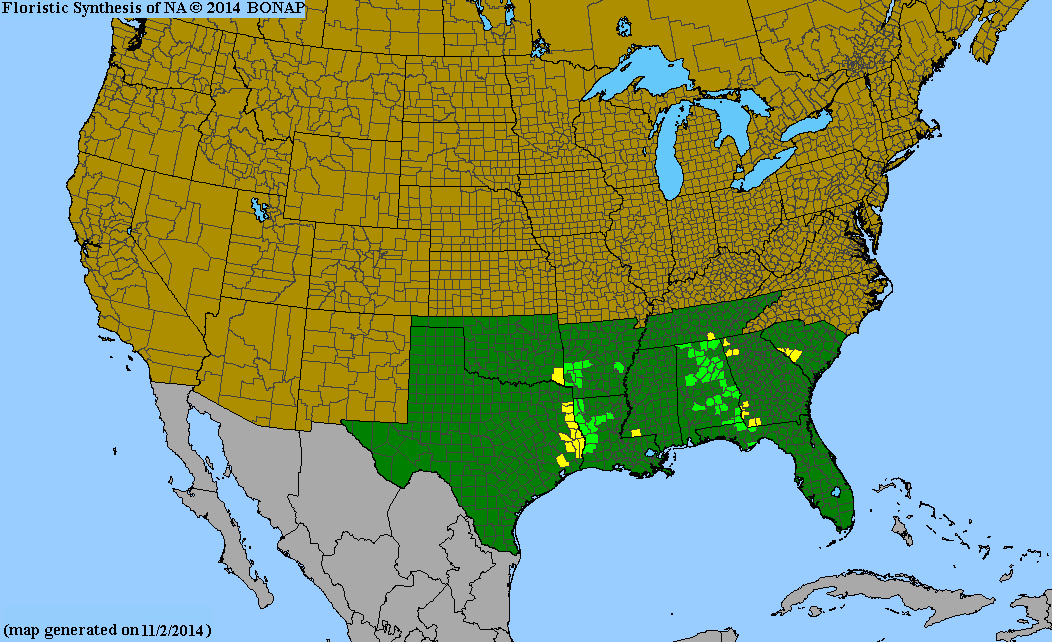
Solidago auriculata, commonly called clasping goldenrod[2] or eared goldenrod,[2][3] is a species of flowering plant native to the southeastern and south-central United States from South Carolina west as far as eastern Texas and southeastern Oklahoma.[4] It has a patchy distribution and is mostly found in rocky forests over calcareous rocks, although it can be along streams.
Solidago auriculata is a perennial plant up to 150 cm (5 feet) tall, spreading by means of underground rhizomes. One plant produces sometimes as many as 100 small yellow flower heads in late summer and fall.[2]
References
[edit]- ↑ The Plant List, Solidago auriculata Shuttlew. ex S.F.Blake
- 1 2 3 Flora of North America, Solidago auriculata Shuttleworth ex S. F. Blake, 1931. Eared or clasping goldenrod
- ↑ NRCS. "Solidago auriculata". PLANTS Database. United States Department of Agriculture (USDA). Retrieved 18 November 2015.
- ↑ Biota of North America Program 2014 county distribution map
_(8577495976)_inflorescence_transparent_background.png) | This Solidago article is a stub. You can help Wikipedia by adding missing information. |