


Generalized inverse Gaussian distribution
| Generalized inverse Gaussian | |||
|---|---|---|---|
|
Probability density function  | |||
| Parameters | a > 0, b > 0, p real | ||
| Support | x > 0 | ||
| Mean |
| ||
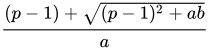
| Mode | |||
| Variance | |||
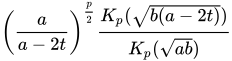
| MGF | |||
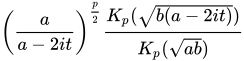
| CF | |||
![{\displaystyle \operatorname {E} [x]={\frac {{\sqrt {b}}\ K_{p+1}({\sqrt {ab}})}{{\sqrt {a}}\ K_{p}({\sqrt {ab}})}}}](https://wikimedia.org/api/rest_v1/media/math/render/svg/9eea374ea6d263f4dec6f737248ac6c7ee9edec4)
![{\displaystyle \operatorname {E} [x^{-1}]={\frac {{\sqrt {a}}\ K_{p+1}({\sqrt {ab}})}{{\sqrt {b}}\ K_{p}({\sqrt {ab}})}}-{\frac {2p}{b}}}](https://wikimedia.org/api/rest_v1/media/math/render/svg/4b8243064fe20b0eb33317bf58d29ad616bbd2ff)
![{\displaystyle \operatorname {E} [\ln x]=\ln {\frac {\sqrt {b}}{\sqrt {a}}}+{\frac {\partial }{\partial p}}\ln K_{p}({\sqrt {ab}})}](https://wikimedia.org/api/rest_v1/media/math/render/svg/f49d3a11593033dcb22f9bf4f12377957b4ecc5b)
![{\displaystyle \left({\frac {b}{a}}\right)\left[{\frac {K_{p+2}({\sqrt {ab}})}{K_{p}({\sqrt {ab}})}}-\left({\frac {K_{p+1}({\sqrt {ab}})}{K_{p}({\sqrt {ab}})}}\right)^{2}\right]}](https://wikimedia.org/api/rest_v1/media/math/render/svg/fb650b320e436e5cc35f33ed94c0794e9f4c58ea)
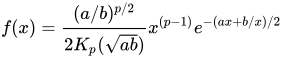
In probability theory and statistics, the generalized inverse Gaussian distribution (GIG) is a three-parameter family of continuous probability distributions with probability density function

where Kp is a modified Bessel function of the second kind, a > 0, b > 0 and p a real parameter. It is used extensively in geostatistics, statistical linguistics, finance, etc. This distribution was first proposed by Étienne Halphen.[1][2][3] It was rediscovered and popularised by Ole Barndorff-Nielsen, who called it the generalized inverse Gaussian distribution. Its statistical properties are discussed in Bent Jørgensen's lecture notes.[4]
Properties
[edit]Alternative parametrization
[edit]By setting and , we can alternatively express the GIG distribution as



where is the concentration parameter while is the scaling parameter.


Summation
[edit]Barndorff-Nielsen and Halgreen proved that the GIG distribution is infinitely divisible.[5]
Entropy
[edit]The entropy of the generalized inverse Gaussian distribution is given as[citation needed]
![{\displaystyle {\begin{aligned}H={\frac {1}{2}}\log \left({\frac {b}{a}}\right)&{}+\log \left(2K_{p}\left({\sqrt {ab}}\right)\right)-(p-1){\frac {\left[{\frac {d}{d\nu }}K_{\nu }\left({\sqrt {ab}}\right)\right]_{\nu =p}}{K_{p}\left({\sqrt {ab}}\right)}}\\&{}+{\frac {\sqrt {ab}}{2K_{p}\left({\sqrt {ab}}\right)}}\left(K_{p+1}\left({\sqrt {ab}}\right)+K_{p-1}\left({\sqrt {ab}}\right)\right)\end{aligned}}}](https://wikimedia.org/api/rest_v1/media/math/render/svg/4d663373bdf483797c0ce4ada0238439389242a3)
where is a derivative of the modified Bessel function of the second kind with respect to the order evaluated at
![{\displaystyle \left[{\frac {d}{d\nu }}K_{\nu }\left({\sqrt {ab}}\right)\right]_{\nu =p}}](https://wikimedia.org/api/rest_v1/media/math/render/svg/3838a857c40b56dee47ed55dade77403f6657cb8)


Characteristic Function
[edit]The characteristic of a random variable is given as[4]


for where denotes the imaginary unit.


Related distributions
[edit]Special cases
[edit]The inverse Gaussian and gamma distributions are special cases of the generalized inverse Gaussian distribution for p = −1/2 and b = 0, respectively.[6] Specifically, an inverse Gaussian distribution of the form
![{\displaystyle f(x;\mu ,\lambda )=\left[{\frac {\lambda }{2\pi x^{3}}}\right]^{1/2}\exp {\left({\frac {-\lambda (x-\mu )^{2}}{2\mu ^{2}x}}\right)}}](https://wikimedia.org/api/rest_v1/media/math/render/svg/430c36a80c0f4de08f8b56fe7019d79e5d8aea68)
is a GIG with , , and . A gamma distribution of the form


is a GIG with , , and .
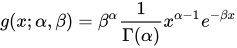


Other special cases include the inverse-gamma distribution, for a = 0.[6]
Conjugate prior for Gaussian
[edit]The GIG distribution is conjugate to the normal distribution when serving as the mixing distribution in a normal variance-mean mixture.[7][8] Let the prior distribution for some hidden variable, say , be GIG: and let there be observed data points, , with normal likelihood function, conditioned on





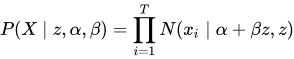
where is the normal distribution, with mean and variance . Then the posterior for , given the data is also GIG: where .[note 1]




Sichel distribution
[edit]The Sichel distribution results when the GIG is used as the mixing distribution for the Poisson parameter .[9][10]

Notes
[edit]- ↑ Due to the conjugacy, these details can be derived without solving integrals, by noting that . Omitting all factors independent of , the right-hand-side can be simplified to give an un-normalized GIG distribution, from which the posterior parameters can be identified.

References
[edit]- ↑ Seshadri, V. (1997). "Halphen's laws". In Kotz, S.; Read, C. B.; Banks, D. L. (eds.). Encyclopedia of Statistical Sciences, Update Volume 1. New York: Wiley. pp. 302–306.
- ↑ Perreault, L.; Bobée, B.; Rasmussen, P. F. (1999). "Halphen Distribution System. I: Mathematical and Statistical Properties". Journal of Hydrologic Engineering. 4 (3): 189. doi:10.1061/(ASCE)1084-0699(1999)4:3(189).
- ↑ Étienne Halphen was the grandson of the mathematician Georges Henri Halphen.
- 1 2 Jørgensen, Bent (1982). Statistical Properties of the Generalized Inverse Gaussian Distribution. Lecture Notes in Statistics. Vol. 9. New York–Berlin: Springer-Verlag. ISBN 0-387-90665-7. MR 0648107.
- ↑ Barndorff-Nielsen, O.; Halgreen, Christian (1977). "Infinite Divisibility of the Hyperbolic and Generalized Inverse Gaussian Distributions". Zeitschrift für Wahrscheinlichkeitstheorie und verwandte Gebiete. 38: 309–311. doi:10.1007/BF00533162.
- 1 2 Johnson, Norman L.; Kotz, Samuel; Balakrishnan, N. (1994), Continuous univariate distributions. Vol. 1, Wiley Series in Probability and Mathematical Statistics: Applied Probability and Statistics (2nd ed.), New York: John Wiley & Sons, pp. 284–285, ISBN 978-0-471-58495-7, MR 1299979
- ↑ Karlis, Dimitris (2002). "An EM type algorithm for maximum likelihood estimation of the normal–inverse Gaussian distribution". Statistics & Probability Letters. 57 (1): 43–52. doi:10.1016/S0167-7152(02)00040-8.
- ↑ Barndorf-Nielsen, O. E. (1997). "Normal Inverse Gaussian Distributions and stochastic volatility modelling". Scand. J. Statist. 24 (1): 1–13. doi:10.1111/1467-9469.00045.
- ↑ Sichel, Herbert S. (1975). "On a distribution law for word frequencies". Journal of the American Statistical Association. 70 (351a): 542–547. doi:10.1080/01621459.1975.10482469.
- ↑ Stein, Gillian Z.; Zucchini, Walter; Juritz, June M. (1987). "Parameter estimation for the Sichel distribution and its multivariate extension". Journal of the American Statistical Association. 82 (399): 938–944. doi:10.1080/01621459.1987.10478520.
See also
[edit]

