


Shish kebab

Shish kebab or shish kebap is a popular dish of skewered and grilled cubes of meat, originating in the Middle East.[1]
It is one of the many types of kebab, a range of meat dishes originating in the Middle East. In North American English, the word kebab alone often refers to shish kebab, though outside of North America, kebab may also mean doner kebab.
It is traditionally made of lamb[2] but there are also versions with various kinds of meat, poultry, or fish.[3]
Etymology
[edit]Two etymologies have been suggested for shish kabob in the Persian dictionary of Dehkhoda: shish being the Persian word "shish" for the number six, which refers to the original six pieces of meat of a standard kabob skewer, or "shish" being derived from Late Middle Persian "Sich" meaning skewer. The word "kabob" is most probably driven from the Arhameic word kbābā (to roast).[4]
The word kebab alone was already present in English by the late 17th century, from the Arabic: كَبَاب (kabāb), partly via Urdu, Persian and Turkish.[5] Etymologist Sevan Nişanyan states that the word has the equivalent meaning of "frying / burning" with kabābu in the old Akkadian language, and kbabā (כבבא) in Aramaic.[6]
According to the Oxford English Dictionary, its earliest known publication in English is in the 1914 novel Our Mr. Wrenn by Sinclair Lewis.[7][8]
History
[edit]Greece
[edit]Kebabs existed as far back as the 17th century BC Minoan civilization.[9] In Homer's Odyssey, there are descriptions of skewering strips of meat for broiling. Clifford A. Wright considers these an early version of shish kebab.[10] In Classical Greece and Hellenistic Greece, kebabs were prepared in ancient Athenian taverna sites. They were grilled on an eschara.[11][12]
Kebabs were also staples in the Byzantine Empire;[13] there is iconographical evidence of Byzantine Greeks preparing them.[10]
Egypt
[edit]Several varieties of shish kebab are popular in Egyptian cuisine. Skewers of grilled seasoned ground meat are called kofta. Shish taouk, which are skewers of grilled marinated chicken chunks, are another popular variety of kebab in Egypt.[14]
Gallery
[edit] Shish kebab
 Shish kebab in Ankara
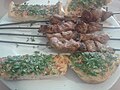 Lamb shish


See also
[edit]

References
[edit]- ↑ John Ayto (18 October 2012). The Diner's Dictionary: Word Origins of Food and Drink. OUP Oxford. pp. 192–. ISBN 978-0-19-964024-9.
- ↑ Ozcan Ozan (13 December 2013). The Sultan's Kitchen: A Turkish Cookbook. Tuttle Publishing. pp. 146–. ISBN 978-1-4629-0639-0.
- ↑ Mimi Sheraton (13 January 2015). 1,000 Foods To Eat Before You Die: A Food Lover's Life List. Workman Publishing Company. pp. 1090–. ISBN 978-0-7611-8306-8.
- ↑ "Kabob – Dehkhoda". Vajehyab (in Persian). Retrieved 4 August 2023.
- ↑ "kebab - definition of kebab in English". Oxford Dictionaries. Oxford University Press. Archived from the original on August 3, 2017. Retrieved August 3, 2017.
- ↑ Nişanyan Sevan, Sözlerin Soyağacı, Çağdaş Türkçenin Etimolojik Sözlüğü, Online, Book Archived 2013-07-03 at the Wayback Machine
- ↑ "shish kebab". Oxford English Dictionary (2nd ed.). Oxford University Press. 1989.
- ↑ Lewis, Sinclair (11 March 2015). Our Mr. Wrenn – The Romantic Adventures of a Gentle Man. Read Books Ltd. ISBN 9781473372498 – via Google Books.
- ↑ Tassoula Eptakili (2015-10-09). "Prehistoric Gastronomy". Greece Is. Retrieved 21 February 2016.
- 1 2 Wright, Clifford A. (1999). A Mediterranean feast. Internet Archive. Morrow. p. 333. ISBN 978-0-688-15305-2.
- ↑ Kelly-Blazeby, C. (2001). Tavernas in ancient Greece c. 475-146 BC: An archaeological perspective. Assemblage 6
- ↑ Sparkes, B. A. (1962). "The Greek Kitchen". The Journal of Hellenic Studies. 82: 121–137. doi:10.2307/628548. ISSN 0075-4269.
- ↑ Ash, John (1995). A Byzantine Journey. Random House. p. 223. ISBN 978-0-679-40934-2.
- ↑ Marks, Gil (2010). Encyclopedia of Jewish Food. Houghton Mifflin Harcourt. ISBN 978-0-544-18631-6.


| Ingredients |
| ||||||||
|---|---|---|---|---|---|---|---|---|---|
| Breads and nans | |||||||||
| Salads |
| ||||||||
| Cheeses | |||||||||
| Soups and āshes |
| ||||||||
| Dishes |
| ||||||||
| Sauces | |||||||||
| Hors d'oeuvre | |||||||||
| Sweets and desserts | |||||||||
| Beverages | |||||||||
| Instruments | |||||||||
| Related cuisines | |||||||||


| Beverages |
|
|---|---|
| Breads | |
| Appetizers and salads | |
| Dairy products |
|
| Soups and stews | |
| Pastries | |
| Dishes |
|
| Grilled meats | |
| Desserts |
|
| Unique instruments | |
| Related cuisines | |
| Cooking styles | |
|---|---|
| Regional variations | |
| Cookers and related | |
| Foods and dishes |
|
| Societies and festivals | |
| Misc. | |
