Cloudflare fetched the original article and streamed it through HTMLRewriter to apply an entirely new visual system without rebuilding the source page.
// request.cf · coarse context
A page that knows where it met you.
Only coarse request metadata is shown. This demo does not display or persist visitor IP addresses.
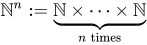
The Schwartz space or space of rapidly decreasing functions on is the function space where is the function space of smooth functions from into , and Here, denotes the supremum, and we used multi-index notation, i.e. and .
To put common language to this definition, one could consider a rapidly decreasing function as essentially a function such that , , , ... all exist everywhere on and go to zero as faster than any reciprocal power of . In particular, is a subspace of .
If is a multi-index, and a is a positive real number, then .
Any smooth function with compact support is in . This is clear since any derivative of is continuous and supported in the support of , so has a maximum in by the extreme value theorem.
Because the Schwartz space is a vector space, any polynomial can be multiplied by a factor for a real constant, to give an element of the Schwartz space. In particular, there is an embedding of polynomials into a Schwartz space.
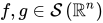
From Leibniz's rule, it follows that is also closed under pointwise multiplication: implies . In particular, this implies that is an -algebra. More generally, if and is a bounded smooth function with bounded derivatives of all orders, then .
Hörmander, L. (1990). The Analysis of Linear Partial Differential Operators I, (Distribution theory and Fourier Analysis) (2nded.). Berlin: Springer-Verlag. ISBN3-540-52343-X.
Reed, M.; Simon, B. (1980). Methods of Modern Mathematical Physics: Functional Analysis I (Revised and enlargeded.). San Diego: Academic Press. ISBN0-12-585050-6.
Stein, Elias M.; Shakarchi, Rami (2003). Fourier Analysis: An Introduction (Princeton Lectures in Analysis I). Princeton: Princeton University Press. ISBN0-691-11384-X.