Quercus inopina
(Redirected from Sandhill oak)
| Quercus inopina | |
|---|---|
 | |
Scientific classification  | |
| Kingdom: | Plantae |
| Clade: | Tracheophytes |
| Clade: | Angiosperms |
| Clade: | Eudicots |
| Clade: | Rosids |
| Order: | Fagales |
| Family: | Fagaceae |
| Genus: | Quercus |
| Subgenus: | Quercus subg. Quercus |
| Section: | Quercus sect. Lobatae |
| Species: | Q. inopina |
| Binomial name | |
| Quercus inopina Ashe 1929 | |
 | |
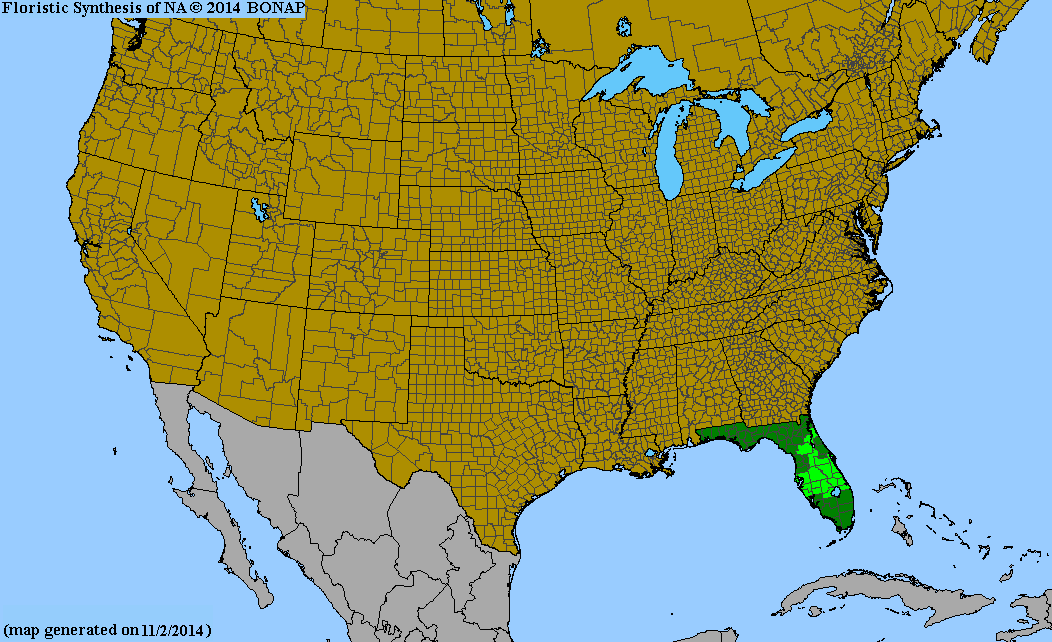
| Natural range | |


Quercus inopina, the sandhill oak,[3] is an uncommon North American species of oak shrub. It has been found only in the state of Florida in the southeastern United States.[4][5]
It is a branching shrub up to 5 meters (17 feet) in height. The bark is gray, twigs purplish brown. The leaves are broad, up to 85 millimeters (3+3⁄8 inches) long, usually hairless, with no teeth or lobes.[6][7][8]
References
[edit]- ↑ Wenzell, K.; Kenny, L. (2015). "Quercus inopina". IUCN Red List of Threatened Species. 2015. Retrieved January 6, 2023.
- ↑ "Quercus inopina". NatureServe Explorer. Retrieved 5 September 2025.
- ↑ NRCS. "Quercus inopina". PLANTS Database. United States Department of Agriculture (USDA). Retrieved 15 September 2015.
- ↑ Biota of North America Program 2014 county distribution map
- ↑ Atlas of Florida Vascular Plants
- ↑ Flora of North America, Quercus inopina Ashe, 1929
- ↑ Ashe, William Willard 1929. Rhodora 31(364): 79–80
- ↑ Ann F. Johnson and Warren G. Abrahamson 1982. Quercus inopina: A Species to be Recognized from South-Central Florida. Bulletin of the Torrey Botanical Club 190:392-395