Edge Rewrite
// HTMLRewriter · presentation

This page was redesigned at the edge.

Cloudflare fetched the original article and streamed it through HTMLRewriter to apply an entirely new visual system without rebuilding the source page.

// request.cf · coarse context

A page that knows where it met you.

Only coarse request metadata is shown. This demo does not display or persist visitor IP addresses.

Country
US
Cloudflare location
CMH
Connection
HTTP/2
Language
Not provided

Ray ID: a25f9fbc4f1fde81

Jump to content

// Workers AI · dad joke modeWhat did Bab Tuma say to his friend? Gate expectations.

(Redirected from Saint Thomas's Gate)
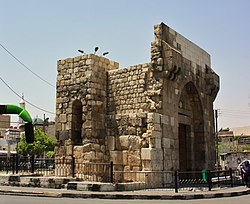
Bab Tuma
باب توما
Map
Interactive map of Bab Tuma
باب توما
LocationOld Damascus, Syria
Coordinates33°30′48″N 36°18′54″E / 33.51333°N 36.31500°E / 33.51333; 36.31500

Bab Tuma (Arabic: بَابُ تُومَا, romanized: Bāb Tūmā, meaning: "Gate of Thomas") is a neighborhood located in the old city of Damascus in Syria.[1] It is one of the seven gates of Damascus, a geographic landmark of Christianity.

Etymology

The gate was named by the Byzantines to commemorate Thomas the Apostle, one of the Twelve Apostles of Jesus Christ.[2]

History

Late modern period

Wilhelm II and Augusta Victoria of Schleswig-Holstein visiting Bab tuma, 1898

The Damascus affair happened in 1840, near Bab Tuma, when an Italian monk & his servant disappeared. The Christians accused the Jews of their disappearance, saying they extracted their blood to bake matzo.

The neighborhood was the site of the 1860 massacre of Christians by a local interfaith mob, during the larger conflict between the Druze and Christians in Mount Lebanon.

French noble Alphonse de Lamartine visited Bab Tuma in 1832. It was also visited by German emperor Wilhelm II and his wife, Augusta Victoria of Schleswig-Holstein, in 1898.

Tourism

It is a famous geographic landmark in Damascus. It has a hotel in the area called "Bab Touma Hotel".

Geography

It is located in Old Damascus, near Bab Sharqi and the Umayyad Mosque. Beit Shameea is located there; it was converted to Besançon school. Patriarch Dimitrios I opened the St. Paul school in 1925.

Notable people

Religion and culture

In the 16th century, it was entirely Syriac Catholic and Greek Orthodox. Easter and Christmas are celebrated every year in the area. Kahk is prepared every year on Easter.

References

  1. Ahmad, Balsam (2012). Syria's contrasting neighbourhoods : gentrification and informal settlements juxtaposed. Fife, Scotland: University of St Andrews Centre for Syrian Studies. p. 31. ISBN 9780955968785.
  2. "Chapitre III. Portes et tours". books.openedition.org. Retrieved 2026-08-02.