


// Workers AI · dad joke modeWhat did signal-to-quantization-noise ratio say? "I'm ratio-nal.
 | This article includes a list of references, related reading, or external links, but its sources remain unclear because it lacks inline citations. (September 2011) |
Signal-to-quantization-noise ratio (SQNR or SNqR) is widely used quality measure in analysing digitizing schemes such as pulse-code modulation (PCM). The SQNR reflects the relationship between the maximum nominal signal strength and the quantization error (also known as quantization noise) introduced in the analog-to-digital conversion.
As SQNR applies to quantized signals, the formulae for SQNR refer to discrete-time digital signals. Instead of the value- and time-continuous message signal , the digitized signal will be used. For quantization steps, each sample, requires bits. The probability distribution function (PDF) represents the distribution of values in and can be denoted as . The maximum magnitude value of any is denoted by .


As SQNR, like SNR, is a ratio of signal power to some noise power, it can be calculated as:
![{\displaystyle \mathrm {SQNR} ={\frac {P_{signal}}{P_{noise}}}={\frac {E[x^{2}]}{E[{\tilde {x}}^{2}]}}}](https://wikimedia.org/api/rest_v1/media/math/render/svg/fca151b382158ecc0800856ef0744b057aa65a7c)
The signal power is:
![{\displaystyle {\overline {x^{2}}}=E[x^{2}]=P_{x^{\nu }}=\int _{}^{}x^{2}f(x)dx}](https://wikimedia.org/api/rest_v1/media/math/render/svg/5498cbfb53e94e7fbfa8d4d5d0d8b5e0cc2751c0)
The quantization noise power can be expressed as:
![{\displaystyle E[{\tilde {x}}^{2}]={\frac {x_{max}^{2}}{3\times 4^{\nu }}}}](https://wikimedia.org/api/rest_v1/media/math/render/svg/350238dbf7837dd72d0237c032c82637a538b6f3)
Giving:
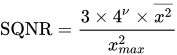
When the SQNR is desired in terms of decibels (dB), a useful approximation to SQNR is:

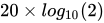
where is the number of bits in a quantized sample, and is the signal power calculated above. Note that for each bit added to a sample, the SQNR goes up by approximately 6 dB ().


References
[edit]- B. P. Lathi, Modern Digital and Analog Communication Systems (3rd edition), Oxford University Press, 1998
External links
[edit]- Signal to quantization noise in quantized sinusoidal - Analysis of quantization error on a sine wave