


Aria rupicola
(Redirected from Rock whitebeam)
| Aria rupicola | |
|---|---|
 | |
| Rock whitebeam at the Trondheimsfjord, Norway | |
Scientific classification  | |
| Kingdom: | Plantae |
| Clade: | Embryophytes |
| Clade: | Tracheophytes |
| Clade: | Angiosperms |
| Clade: | Eudicots |
| Clade: | Rosids |
| Order: | Rosales |
| Family: | Rosaceae |
| Genus: | Aria |
| Species: | A. rupicola |
| Binomial name | |
| Aria rupicola (Syme) Mezhenskyj | |
| Synonyms | |
|
List
| |

Aria rupicola, commonly known as rock whitebeam,[2] is a rare species of shrub or small tree best known from the British Isles but also reported from Norway, Sweden, and the Baltic States.[3]
Reaching heights of 10 m,[4] it grows in rocky woodland, scrub and cliffs, usually on limestone.[4]
The species reproduces apomictically (asexually via cloned seeds) and was presumably created by autopolyploidysation of the common whitebeam proper (Sorbus aria s.str.). It contains a tetraploidal set of chromosomes (2n=4x=68).
Stace gives Aria rupicola the following characteristics:[4]
- Leaves unlobed or lobed ≤1/20 of the way to the midrib.
- Leaves with a single style of teeth or, weakly, two styles of teeth.
- Leaves with 6 to 9 (rarely 4 to 10) pairs of lateral veins.
- Leaves mostly 1.6 to 2.4 times longer than wide.
- Leaves mostly widest in that half of the leaf furthest from the stalk.
- Leaves usually obtuse (rarely acute) at apex.
- Leaves have dense white hairs on lower surface.
- Fruits 10-15mm across, warty.
 A young specimen
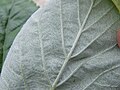 Back of a leaf
 Upper surface of a leaf
 Upper surface of a leaf
 Twig and part of a leaf


References
[edit]- ↑ Beech, E.; Rivers, M.C. (2017). "Sorbus rupicola". IUCN Red List of Threatened Species. 2017 e.T79749428A79749432. doi:10.2305/IUCN.UK.2017-2.RLTS.T79749428A79749432.en. Retrieved 31 July 2026.
- ↑ BSBI List 2007 (xls). Botanical Society of Britain and Ireland. Archived from the original (xls) on 2015-06-26. Retrieved 2014-10-17.
- ↑ "Ecological flora of the British Isles: Sorbus rupicola". Retrieved 2010-07-17.
- 1 2 3 New Flora of the British Isles; Clive Stace; Third edition; 2011 printing
Further reading
[edit]- Ennos, R. A.; G. C. French; P. M. Hollingsworth (2005). "Conserving taxonomic complexity". Trends in Ecology and Evolution. 20 (4): 164–168. doi:10.1016/j.tree.2005.01.012. PMID 16701363.
- Robertson, A.; A. C. Newton; R. A. Ennos (2004). "Multiple hybrid origins, genetic diversity and population genetic structure of two endemic Sorbus taxa on the Isle of Arran, Scotland". Molecular Ecology. 13 (1): 123–134. Bibcode:2004MolEc..13..123R. doi:10.1046/j.1365-294X.2003.02025.x. PMID 14653794. S2CID 38956138.
