


Ramanujan tau function


In mathematics, the Ramanujan tau function, studied by Srinivasa Ramanujan,[1] is the function defined by


where is the Euler function, is the Dedekind eta function, is the modular discriminant, and with .


Values
[edit]The first few values of the tau function are given in the following table (sequence A000594 in the OEIS):
| 1 | 2 | 3 | 4 | 5 | 6 | 7 | 8 | 9 | 10 | 11 | 12 | 13 | 14 | 15 | 16 | |
| 1 | −24 | 252 | −1472 | 4830 | −6048 | −16744 | 84480 | −113643 | −115920 | 534612 | −370944 | −577738 | 401856 | 1217160 | 987136 |

Calculating this function on an odd square number yields an odd number, whereas for any other number the function yields an even number.[2]
Main properties
[edit]Ramanujan conjectured two properties of ,[1] which can be rephrased equivalently as:
- if and are coprime (that is, is a multiplicative function)
- for prime and .


Together, these two properties are equivalent to the identity

They were proved by Louis Mordell using what is now understood as the theory of Hecke operators.[3] Ramanujan also conjectured the third propertyfor all primes , which is called the Ramanujan conjecture. Assuming the first two properties, Ramanujan noted that his conjecture is equivalent to the inequality
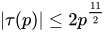
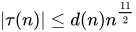
for all , where is the number-of-divisors function. Note that the weaker estimate is much easier to show. Ramanujan's conjecture was proved by Pierre Deligne in 1974 as a consequence of his proof of the Weil conjectures.


Ramanujan's L-function
[edit]Because the modular discriminant is a cusp form of weight 12, it gives rise to an -function, called Ramanujan's -function. It is defined for via the Dirichlet series


and due to the first two properties of above, it has an Euler product

valid for . It satisfies the functional equation

which enables the analytic continuation of to all complex numbers , making it an entire function. Ramanujan conjectured that all nontrivial zeros of have real part equal to .[citation needed] This is a special case of the Grand Riemann hypothesis. Robert Rankin showed that has no zeros on the line .[citation needed]


Congruences for the tau function
[edit]For and , the divisor function is the sum of the th powers of the divisors of . The tau function satisfies several congruence relations; many of them can be expressed in terms of . Here are some:[4]


- if is of the form [12]


Explicit formulas
[edit]In 1972, Ian G. Macdonald proved an explicit formula for the Ramanujan tau function[13]In 1975, Douglas Niebur proved the formula[14]


where is the sum-of-divisor function.

Conjectures on the tau function
[edit]Suppose that is a weight- integer newform whose Fourier coefficients are integers. Consider the problem:


- Given that does not have complex multiplication, do almost all primes have the property that ?

Indeed, most primes should have this property, and hence they are called ordinary. Despite the big advances by Deligne and Serre on Galois representations, which determine for coprime to , it is unclear how to compute . The only theorem in this regard is Elkies' famous result for modular elliptic curves, which guarantees that there are infinitely many primes such that , which thus are congruent to 0 modulo . There are no known examples of non-CM with weight greater than 2 for which for infinitely many primes (although it should be true for almost all . There are also no known examples with for infinitely many . Some researchers had begun to doubt whether for infinitely many . As evidence, many provided Ramanujan's (case of weight 12). The only solutions up to to the equation are 2, 3, 5, 7, 2411, and 7758337633 (sequence A007659 in the OEIS).[15]



Lehmer (1947) conjectured that for all , an assertion sometimes known as Lehmer's conjecture. Lehmer verified the conjecture for up to 214928639999 (Apostol 1997, p. 22). The following table summarizes progress on finding successively larger values of for which this condition holds for all .


| reference | |
|---|---|
| 3316799 | Lehmer (1947) |
| 214928639999 | Lehmer (1949) |
| 1000000000000000 | Serre (1973, p. 98), Serre (1985) |
| 1213229187071998 | Jennings (1993) |
| 22689242781695999 | Jordan and Kelly (1999) |
| 22798241520242687999 | Bosman (2007) |
| 982149821766199295999 | Zeng and Yin (2013) |
| 816212624008487344127999 | Derickx, van Hoeij, and Zeng (2013) |
Notes
[edit]- 1 2 Ramanujan (1916).
- ↑ Sloane, N. J. A. (ed.). "Sequence A016754 (Odd squares: (2n-1)^2. Also centered octagonal numbers.)". The On-Line Encyclopedia of Integer Sequences. OEIS Foundation.
- ↑ Mordell (1917).
- ↑ Swinnerton-Dyer (1973), p. 4.
- 1 2 3 4 Due to Kolberg 1962
- 1 2 Due to Ashworth 1968
- ↑ Due to Lahivi
- 1 2 Due to D. H. Lehmer
- ↑ Due to Ramanujan 1916
- ↑ Swinnerton-Dyer (1973).
- ↑ Wilton (1930).
- ↑ Due to J.-P. Serre 1968, Section 4.5
- ↑ Dyson, Freeman J. (1972). "Missed opportunities". Bulletin of the American Mathematical Society. 78 (5): 635–652. doi:10.1090/S0002-9904-1972-12971-9.
- ↑ Niebur, Douglas (1975). "A formula for Ramanujan's -function". Illinois Journal of Mathematics. 19 (3): 448–449. doi:10.1215/ijm/1256050746.
- ↑ N. Lygeros and O. Rozier (2010). "A new solution for the equation " (PDF). Journal of Integer Sequences. 13: Article 10.7.4.

References
[edit]- Apostol, Tom M. (1990) [1976]. Modular Functions and Dirichlet Series in Number Theory. Graduate Texts in Mathematics. Vol. 41 (2nd ed.). Springer New York. ISBN 978-0-387-97127-8.
- Ashworth, M. H. (1968), Congruence and identical properties of modular forms (D. Phil. Thesis, Oxford)
- Kolberg, O. (1962). "Congruences for Ramanujan's function ". Årbok for Universitetet i Bergen. Matematisk-Naturvitenskapelig Serie (11). ISSN 0522-9189. MR 0158873. Zbl 0148.02302.
- Lehmer, D. H. (1947). "The vanishing of Ramanujan's function ". Duke Mathematical Journal. 14 (2): 429–433. doi:10.1215/s0012-7094-47-01436-1. Zbl 0029.34502.
- Lygeros, N. (2010), "A New Solution to the Equation τ(p) ≡ 0 (mod p)" (PDF), Journal of Integer Sequences, 13: Article 10.7.4
- Mordell, Louis J. (1917), "On Mr. Ramanujan's empirical expansions of modular functions.", Proceedings of the Cambridge Philosophical Society, 19: 117–124, JFM 46.0605.01
- Newman, M. (1972), A table of τ (p) modulo p, p prime, 3 ≤ p ≤ 16067, National Bureau of Standards
- Rankin, Robert A. (1988), "Ramanujan's tau-function and its generalizations", in Andrews, George E. (ed.), Ramanujan revisited (Urbana-Champaign, Ill., 1987), Boston, MA: Academic Press, pp. 245–268, ISBN 978-0-12-058560-1, MR 0938968
- Ramanujan, S. (1916). "On certain arithmetical functions". Transactions of the Cambridge Philosophical Society. 22 (9): 159–184. MR 2280861.
- Serre, J-P. (1968), "Une interprétation des congruences relatives à la fonction de Ramanujan", Séminaire Delange-Pisot-Poitou, 14
- Swinnerton-Dyer, H. P. F. (1973). "On -adic representations and congruences for coefficients of modular forms". In Kuyk, Willem; Serre, Jean-Pierre (eds.). Modular Functions of One Variable III. Lecture Notes in Mathematics. Vol. 350. Springer Berlin, Heidelberg. pp. 1–55. doi:10.1007/978-3-540-37802-0_1. ISBN 978-3-540-06483-1. MR 0406931.

- Wilton, J. R. (1930). "Congruence properties of Ramanujan's function ". Proceedings of the London Mathematical Society. 31: 1–10. doi:10.1112/plms/s2-31.1.1.