Eurovision Song Contest 1979
| Eurovision Song Contest 1979 | |
|---|---|
 | |
| Date and venue | |
| Final |
|
| Venue | International Convention Center Jerusalem, Israel |
| Organisation | |
| Organiser | European Broadcasting Union (EBU) |
| Scrutineer | Frank Naef |
| Production | |
| Host broadcaster | Israel Broadcasting Authority (IBA) |
| Director | Yossi Zemach |
| Executive producer | Alex Gilady |
| Musical director | Izhak Graziani |
| Presenters | |
| Participants | |
| Number of entries | 19 |
| Non-returning countries |  Turkey Turkey |
| |
| Vote | |
| Voting system | Each country awarded 12, 10, 8–1 point(s) to their 10 favourite songs |
| Winning song |  Israel Israel"Hallelujah" |


The Eurovision Song Contest 1979 was the 24th edition of the Eurovision Song Contest, held on 31 March 1979 at the Menachem Ussishkin auditorium of the International Convention Centre in Jerusalem, Israel, and presented by Daniel Pe'er and Yardena Arazi. It was organised by the European Broadcasting Union (EBU) and host broadcaster the Israel Broadcasting Authority (IBA), who staged the event after winning the 1978 contest for Israel with the song "A-Ba-Ni-Bi" by Izhar Cohen and the Alphabeta. This was the first time that the Eurovision Song Contest was held outside Europe.
Broadcasters from nineteen countries participated in the contest, with Turkey deciding not to participate after Arab countries had pressured it into not participating in a contest held in Israel.[1] Yugoslavia, which had missed the 1977 and 1978 contests, also did not take part in or broadcast the contest this year for political reasons,[2] despite an earlier public poll in which almost 100,000 people supported a Yugoslav return to the contest.[3]
The winner was Israel, with the song "Hallelujah", composed by Kobi Oshrat, written by Shimrit Orr, and performed by the group Milk and Honey featuring Gali Atari. It was the second victory for Israel and the third time any country had won the contest two consecutive time; Spain did so in 1969 (in a four-way tie) and Luxembourg did so in 1973. Spain, France, Germany and Ireland rounded out the top five.
Location
[edit]
The 1979 contest took place in Jerusalem, Israel, following the win of Israel Broadcasting Authority (IBA) at the 1978 edition with the song "A-Ba-Ni-Bi" performed by Izhar Cohen and Alphabeta. IBA staged the contest at the Menachem Ussishkin auditorium of the International Convention Centre, also called Binyenei HaUma. The venue, inside the largest convention center in the Middle East, seats an audience of 3,104 and traditionally hosts other musical events.[4][5]
Participants
[edit]Initially, Türkiye Radyo ve Televizyon Kurumu (TRT) intended to participate in the contest. Turkey would have appeared 11th on stage (between Israel and France), represented by the song "Seviyorum" performed by Maria Rita Epik and 21. Peron. However TRT later ended up withdrawing from the contest following pressure from Arab states, who objected to a predominantly Muslim country taking part in a contest held in Israel.[6][7]
Several of the performing artists had previously competed as lead artists representing the same country in past editions: Peter, Sue and Marc had represented Switzerland in 1971 and in 1976; Xandra had represented the Netherlands in 1972 along with Andres Holten and in 1976 as Sandra Reemer; and Anita Skorgan had represented Norway in 1977. In addition, Anne-Marie David representing France, had won the contest for Luxembourg in 1973.
| Eurovision Song Contest 1979 – Participation summaries by country | |
|---|---|
Production
[edit]The contest was organised and broadcast by the Israel Broadcasting Authority (IBA) and the European Broadcasting Union (EBU). The event was produced by Alex Gilady, directed by Yossi Zemach, musically directed by Izhak Graziani who conducted the IBA Symphony Orchestra, and overseen by the EBU with scrutineer Frank Naef.[5] Since Israeli Television had yet to broadcast in colour at that point (except for a few special occasions), the production had to borrow cameras from the BBC – the same had happened when RTÉ had hosted the 1971 contest in Dublin. The 24th contest's logo featured a combination of a G-clef, the IBA logo, and the names of all participating countries in order of appearance. The IBA Symphony Orchestra played the music of each song, except for the Italian entry, which did not use the orchestra. This was the only contest where the orchestra was composed of 39 musicians.
The stage concept was designed by Dov Ben David. On stage there was a moving symbol which was based on the IBA logo (which was built like a lamp with 3 concentric rings) using a small projected model.[11] The event showcased stage decorations of several types of flora which represent the Land of Israel, and a film of Jerusalem's varied ancient, modern and religious scenery. The left side of the stage where the presentation was held, was decorated with prickly pear cactus, date, pomegranate, and orange plants. The film which opened the programme and repeated over its closing credits, screened Jerusalem's biblical and medieval monuments sacred to Judaism, Christianity, and Islam with residents and visitors who frequent them while its opening and concluding images showcased the city's cultural and governmental institutions along with different types of people outside the ancient walls.[5][12]
This year, the postcards between each song featured mime artists rather than the participating singers. The mime artists featured were the Yoram Boker Mime Group, and included some of Israel's leading mime artists, among them Ezra Dagan and Hanoch Rozen. The group performed on a background of illustrations created by Dudu Geva and Yochanan Lakitzevitz, that featured landmarks and typical landscapes of the respective countries.
Contest overview
[edit]The following tables reflect the confirmed, verified scores, which were adjusted after the live broadcast. During the voting announcement, mistakes kept appearing as some spokespersons gave multiple votes of the same amount to two countries. Importantantly, due to a misunderstanding by the presenter Yardena Arazi, Spain appeared to award 10 points to both Portugal and Israel and these scores were added to the scoreboard. After the programme, verification confirmed that Portugal should only have received six points, leaving the total Portuguese score reduced by four points to 64.
The intermission between the songs and the voting was presented by a performance of the Shalom '79 Dancing Ensemble, who performed a variety of Israeli folk dances. The performance was directed by the ensemble's manager and choreographer Gavri Levy.
Spokespersons
[edit]Each participating broadcaster appointed a spokesperson who was responsible for announcing the votes for its respective country via telephone. Known spokespersons at the 1979 contest are listed below.
 Finland – Kaarina Pönniö[14]
 Netherlands – Ivo Niehe[15]
 Sweden – Sven Lindahl[16]
 United Kingdom – Colin Berry[9]
Detailed voting results
[edit]Each participating broadcaster assembled a jury who awarded 12, 10, 8, 7, 6, 5, 4, 3, 2, 1 point(s) for their top ten songs. This was the last year in which the points were announced via order of appearance, as opposed to order of preference. From the next year's contest onwards, the points were announced in ascending order instead. This has remained in place ever since.
The voting was extremely close. Israel gained a good lead in the early stages of the voting, but Spain eventually caught up and took a good lead themselves. At the close of the penultimate jury's votes, Israel were one point behind Spain, and only the Spanish jury had yet to give their votes. Spain ended up giving Israel 10 points, thus giving the victory to the latter country for the second time in a row.
Total score |
Portugal |
Italy |
Denmark |
Ireland |
Finland |
Monaco |
Greece |
Switzerland |
Germany |
Israel |
France |
Belgium |
Luxembourg |
Netherlands |
Sweden |
Norway |
United Kingdom |
Austria |
Spain | ||
|---|---|---|---|---|---|---|---|---|---|---|---|---|---|---|---|---|---|---|---|---|---|
Contestants |
Portugal | 64 | 6 | 2 | 5 | 4 | 4 | 10 | 5 | 3 | 3 | 3 | 6 | 7 | 6 | ||||||
| Italy | 27 | 8 | 8 | 3 | 8 | ||||||||||||||||
| Denmark | 76 | 2 | 3 | 12 | 1 | 10 | 12 | 6 | 7 | 4 | 8 | 1 | 3 | 3 | 4 | ||||||
| Ireland | 80 | 5 | 5 | 5 | 6 | 10 | 6 | 6 | 3 | 10 | 7 | 8 | 5 | 4 | |||||||
| Finland | 38 | 7 | 7 | 8 | 5 | 5 | 6 | ||||||||||||||
| Monaco | 12 | 1 | 2 | 4 | 3 | 2 | |||||||||||||||
| Greece | 69 | 10 | 1 | 4 | 7 | 7 | 2 | 10 | 4 | 1 | 5 | 7 | 2 | 2 | 7 | ||||||
| Switzerland | 60 | 7 | 1 | 10 | 2 | 2 | 7 | 4 | 7 | 8 | 12 | ||||||||||
| Germany | 86 | 2 | 1 | 12 | 5 | 3 | 12 | 6 | 12 | 4 | 1 | 2 | 6 | 8 | 12 | ||||||
| Israel | 125 | 12 | 6 | 12 | 12 | 8 | 4 | 5 | 1 | 2 | 8 | 1 | 12 | 12 | 12 | 8 | 10 | ||||
| France | 106 | 6 | 10 | 1 | 10 | 8 | 10 | 5 | 6 | 12 | 12 | 5 | 7 | 6 | 5 | 3 | |||||
| Belgium | 5 | 2 | 1 | 2 | |||||||||||||||||
| Luxembourg | 44 | 7 | 3 | 4 | 4 | 5 | 3 | 2 | 4 | 2 | 10 | ||||||||||
| Netherlands | 51 | 8 | 10 | 5 | 3 | 3 | 7 | 3 | 4 | 4 | 4 | ||||||||||
| Sweden | 8 | 6 | 1 | 1 | |||||||||||||||||
| Norway | 57 | 3 | 3 | 8 | 6 | 2 | 8 | 2 | 6 | 10 | 7 | 1 | 1 | ||||||||
| United Kingdom | 73 | 4 | 8 | 10 | 7 | 7 | 1 | 2 | 8 | 5 | 10 | 6 | 5 | ||||||||
| Austria | 5 | 4 | 1 | ||||||||||||||||||
| Spain | 116 | 12 | 3 | 6 | 12 | 12 | 8 | 8 | 12 | 10 | 10 | 7 | 1 | 5 | 10 | ||||||
12 points
[edit]Below is a summary of all 12 points in the final:
| N. | Contestant | Nation(s) giving 12 points |
|---|---|---|
| 6 | Israel |
Finland,  Ireland, Ireland,  Norway, Norway,  Portugal, Sweden, United Kingdom Portugal, Sweden, United Kingdom |
| 4 |  Germany Germany |
 Denmark, Denmark,  France, France,  Monaco, Monaco,  Spain Spain |
| Spain |
 Belgium, Germany, Belgium, Germany,  Italy, Italy,  Switzerland Switzerland | |
| 2 | Denmark |
 Greece, Israel Greece, Israel |
| France |
 Luxembourg, Netherlands Luxembourg, Netherlands | |
| 1 | Switzerland |
 Austria Austria |
Broadcasts
[edit]Each participating broadcaster was required to relay the contest via its networks. Non-participating EBU member broadcasters were also able to relay the contest as "passive participants". Broadcasters were able to send commentators to provide coverage of the contest in their own native language and to relay information about the artists and songs to their television viewers.[19]
In addition to the participating countries, the contest was also reportedly broadcast in Hong Kong, Iceland, and Romania.[9][20] The contest was not broadcast in Yugoslavia for the first time since 1960, as the nation had no diplomatic ties with Israel.[9] Estimates ranged from 200 to 500 million viewers were reported prior to the contest.[21] Known details on the broadcasts in each country, including the specific broadcasting stations and commentators are shown in the tables below.
| Country | Broadcaster | Channel(s) | Commentator(s) | Ref(s) |
|---|---|---|---|---|
 Hong Kong Hong Kong |
TVB | TVB Jade[f] | Regina Hing Yue Tsang and Lee Chi-chung | [53][54] |
| TVB Pearl[f] | George Lam | |||
 Iceland Iceland |
RÚV | Sjónvarpið[g] | Björn Baldursson | [55] |
 Netherlands Antilles Netherlands Antilles |
ATM | TeleAruba[h] | [56] | |
| TeleCuraçao[i] | [57] |
See also
[edit]Notes
[edit]- ↑ On behalf of the German public broadcasting consortium ARD[10]
- ↑ Simulcast on RTBF 2[23]
- ↑ Deferred broadcast at 21:50 CET (20:50 UTC)[37]
- ↑ Broadcast through a second audio programme on TSR[29]
- ↑ Simulcast on BBC Radio 1 VHF[9]
- 1 2 Deferred broadcast on 1 April at 10:30 (HKT)[53][54]
- ↑ Delayed broadcast on 16 April 1979 at 21:20 WET (21:20 UTC)[55]
- ↑ Delayed broadcast on 18 June 1979 at 21:00 (ADT)[56]
- ↑ Delayed broadcast on 13 April 1979 at 21:11 (ADT)[57]
References
[edit]- ↑ "Jerusalem 1979". Eurovision.tv. Archived from the original on October 11, 2017.
- ↑ "Yugoslavya da Eurovision'a katılmama kararı verdi" [Yugoslavia also decided not to participate in Eurovision]. Milliyet (in Turkish). Istanbul, Turkey. 27 March 1979. Retrieved 16 July 2024.
- ↑ "Milionski žiri čitalaca domaćih TV magazina zahteva: Vratimo najzad Jugoslaviju na Pesmu Evrovizije". yugopapir.com.
- ↑ "International Convention Centre - Binyanei Ha'Ooma], WCities Destination Guide". eventseeker.
- 1 2 3 Waxman, Yosef (29 March 1979). "אירוויזיון השלום" [The Peace Eurovision]. Maariv (in Hebrew). p. 45.
- ↑ O'Connor, John Kennedy. The Eurovision Song Contest: The Official History. Carlton Books, UK. 2007 ISBN 978-1-84442-994-3
- ↑ "Türkiye, Eurovision Yarışması'ndan cekildi" [Turkey withdrew from the Eurovision Contest]. Milliyet (in Turkish). Istanbul, Turkey. 6 March 1979. Retrieved 16 July 2024.
- ↑ "Jerusalem 1979 – Participants". European Broadcasting Union. Archived from the original on 1 April 2023. Retrieved 5 July 2023.
- 1 2 3 4 5 6 Roxburgh, Gordon (2014). Songs for Europe: The United Kingdom at the Eurovision Song Contest. Volume Two: The 1970s. Prestatyn: Telos Publishing. pp. 352–365. ISBN 978-1-84583-093-9.
- ↑ "Alle deutschen ESC-Acts und ihre Titel" [All German ESC acts and their songs]. www.eurovision.de (in German). ARD. Archived from the original on 12 June 2023. Retrieved 12 June 2023.
- ↑ "An interview with Dov Ben David on the preparations for the Eurovision in Jerusalem". Retrieved June 17, 2020.
- ↑ "אירוויזיון 1979 בירושלים" [1979 Eurovision in Jerusalem]. Kan 11. 31 March 1979.
- ↑ "Jerusalem 1979 – Scoreboard". European Broadcasting Union. Archived from the original on 11 April 2021. Retrieved 11 April 2021.
- ↑ Murtomäki, Asko (2007). Finland 12 points! Suomen Euroviisut (in Finnish). Helsinki, Finland: Teos. pp. 102–105. ISBN 951-851-106-3.
- ↑ "Hallelujah: Het goede liedje op de goede plaats op de goede tijd". Leidse Courant (in Dutch). Leiden, Netherlands. 2 April 1979. p. 7. Retrieved 11 January 2023.
- ↑ Thorsson, Leif; Verhage, Martin (2006). Melodifestivalen genom tiderna : de svenska uttagningarna och internationella finalerna (in Swedish). Stockholm: Premium Publishing. pp. 140–141. ISBN 91-89136-29-2.
- ↑ "Jerusalem 1979 – Detailed voting results". European Broadcasting Union. Archived from the original on 11 April 2021. Retrieved 11 April 2021.
- ↑ "Eurovision Song Contest 1979 – Scoreboard". European Broadcasting Union. Archived from the original on 24 September 2015. Retrieved 23 July 2021.
- ↑ "The Rules of the Contest". European Broadcasting Union. 31 October 2018. Archived from the original on 4 October 2022. Retrieved 19 December 2022.
- ↑ "Hallelujah, Israel hat gewonnen" [Hallelujah, Israel has won]. Luxemburger Wort (in German). Luxembourg City, Luxembourg. 2 April 1979. p. 6. Retrieved 4 December 2024 – via National Library of Luxembourg.
- ↑ de Cocq, René (31 March 1979). "Halleluja en Black Lace" [Hallelujah and Black Lace]. Leidse Courant (in Dutch). Leiden, Netherlands. p. 4. Retrieved 15 December 2024.
- ↑ "TV". AZ (in German). Vienna, Austria. 31 March 1979. p. 13. Archived from the original on 28 July 2026. Retrieved 28 July 2026.
- 1 2 "tv". Het Laatste Nieuws (in Dutch). Brussels, Belgium. 31 March 1979. p. 45. Retrieved 5 June 2026 – via BelgicaPress.
- ↑ "Alle tiders programoversigter – Lørdag den 31. marts 1979" [All-time programme overviews – Saturday 31st March 1979] (in Danish). DR. Retrieved 20 May 2024.
- ↑ "Radio ja TV" [Radio and TV]. Helsingin Sanomat (in Finnish). 31 March 1979. p. 39. Retrieved 23 December 2022.
- ↑ "Euroviisut" [Eurovision]. Helsingin Sanomat (in Finnish). 31 March 1979. p. 39. Retrieved 23 December 2022.
- ↑ "Radio-Télévision – Samedi 31 mars" [Radio-Television – Saturday 31 March]. Le Monde. Paris, France. 31 March 1979. p. 30. Retrieved 18 June 2024 – via Internet Archive.
- 1 2 "TV – samedi 31 mars" [TV – Saturday 31 March]. Radio TV – Je vois tout (in French). No. 13. Lausanne, Switzerland. 29 March 1979. pp. 14–15. Retrieved 11 January 2023 – via Scriptorium.
- 1 2 3 "Tele-tip heute" [Tele-tip today]. Thuner Tagblatt (in German). Thun, Switzerland. 31 March 1979. p. 13. Retrieved 11 January 2023 – via E-newspaperarchives.ch.
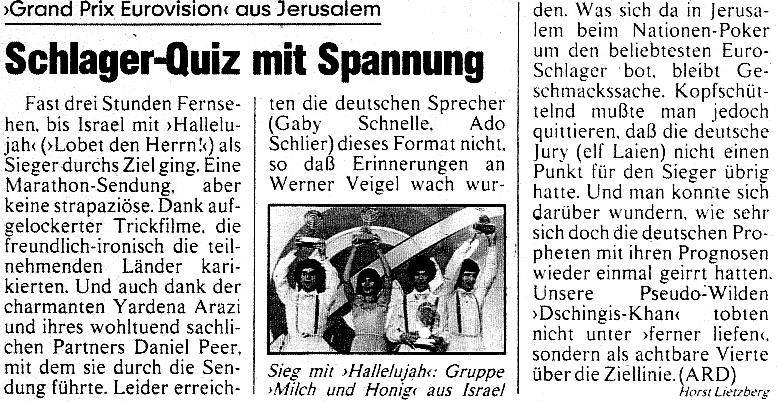
- ↑ Lietzberg, Horst. "Schlager-Quiz mit Spannung" [Bat quiz with excitement]. Hörzu (in German). Retrieved 18 January 2023.
- ↑ "Τηλεόραση" [TV]. Makedonia (in Greek). Thessaloniki, Greece. 31 March 1979. p. 3. Retrieved 21 September 2024 – via National Library of Greece.
- ↑ "Το ραδιοφωνο" [The radio]. Makedonia (in Greek). Thessaloniki, Greece. 31 March 1979. p. 3. Retrieved 21 September 2024 – via National Library of Greece.
- ↑ "Herald TV". Evening Herald. Dublin, Ireland. 31 March 1979. p. 15. Retrieved 18 July 2025 – via Newspapers.com.
- ↑ Clare, Mike (31 March 1979). "Mike Clare on tonight's Eurovision Song Contest: Okay Cathal, Now's Your Big Chance". Evening Herald. Dublin, Ireland. p. 7. Retrieved 15 June 2026 – via Newspapers.com.
- ↑ "he:שבת – 31.3.79 – טלוויזיה" [Saturday – 31.3.79 – TV]. Davar (in Hebrew). Tel Aviv, Israel. 30 March 1979. p. 60. Retrieved 11 January 2023 – via National Library of Israel.
- ↑ "שבת – 31.3.79 – רדיו" [Saturday – 31.3.79 – Radio]. Davar (in Hebrew). Tel Aviv, Israel. 30 March 1979. p. 60. Retrieved 11 January 2023 – via National Library of Israel.
- 1 2 "sabato 22 aprile" [Saturday 22 April]. Radiocorriere TV (in Italian). Vol. 56, no. 13. 25–31 March 1979. pp. 146–147. Retrieved 7 June 2024.
- ↑ "Télé hebdo – samedi 31 mars" [Weekly TV – Saturday March 31]. Luxemburger Wort (in German and French). Luxembourg City, Luxembourg. 30 March 1979. Retrieved 11 January 2023 – via National Library of Luxembourg.
- ↑ "RTL-ukw – Woch vum 31. März bis 6. Abrël 1979" [RTL-VHF – Week from 31 March to 6 April 1979]. Revue Agenda (in Luxembourgish and German). No. 13. 31 March – 6 April 1979. p. 24. Retrieved 4 December 2024 – via National Library of Luxembourg.
- ↑ "Radio en televisie dit weekend" [Radio and television this weekend]. Limburgs Dagblad (in Dutch). Heerlen, Netherlands. 31 March 1979. p. 7. Retrieved 11 January 2023 – via Delpher.
- ↑ "De volgorde van opkomst" [The order of emergence]. Algemeen Dagblad (in Dutch). Rotterdam, Netherlands. 31 March 1979. p. 11. Retrieved 11 January 2023 – via Delpher.
- ↑ "TV-radio programmene" [TV-radio programmes]. Oppland Arbeiderblad (in Norwegian). Gjøvik, Norway. 31 March 1979. p. 43. Retrieved 11 January 2023 – via National Library of Norway.
- ↑ "Televisão – Hoje" [Television – Today]. Diário de Lisboa (in Portuguese). 31 March 1979. p. 17. Retrieved 11 January 2023 – via Casa Comum.
- ↑ "Festival da Eurovisão: "Aleluia", venceu o balão de Israel" [Eurovision Contest: "Hallelujah", won the Israeli balloon]. Diário de Lisboa (in Portuguese). 2 April 1979. p. 24. Retrieved 11 January 2023 – via Casa Comum.
- ↑ "Rádio". Diário de Lisboa (in Portuguese). 31 March 1979. p. 22. Retrieved 11 January 2023 – via Casa Comum.
- ↑ "TVE : Canarias – programas para hoy" [TVE : Canaries – programmes for today]. El Eco de Canarias (in Spanish). Las Palmas, Canary Islands, Spain. 31 March 1979. p. 10. Retrieved 27 October 2024 – via University of Las Palmas de Gran Canaria.
- ↑ "tv-programmen" [tv-programmes]. Svenska Dagbladet (in Swedish). Stockholm, Sweden. 31 March 1979. p. 19.
- ↑ "radioprogrammen" [radio programmes]. Svenska Dagbladet (in Swedish). Stockholm, Sweden. 31 March 1979. p. 19.
- ↑ "Oggi e domani sul video". Popolo e Libertà (in Italian). Bellinzona, Switzerland. 31 March 1979. p. 11. Retrieved 15 June 2026 – via Sistema bibliotecario ticinese.
- ↑ "Radio – samedi 31 mars" [Radio – Saturday 31 March]. Radio TV – Je vois tout (in French). No. 13. Lausanne, Switzerland. 29 March 1979. p. 73. Retrieved 11 January 2023 – via Scriptorium.
- ↑ "Eurovision Song Contest 1979 – BBC1". Radio Times. 31 March 1979. Retrieved 11 January 2023 – via BBC Genome Project.
- ↑ "Eurovision Song Contest 1979 – BBC Radio 2". Radio Times. 31 March 1979. Retrieved 11 January 2023 – via BBC Genome Project.
- 1 2 "星期日 – Sunday, 1 April – 四月一日". Wah Kiu Yat Po Colour Weekly (in Traditional Chinese and English). Quarry Bay, Hong Kong. 1 April 1979. p. 13. Retrieved 3 November 2024 – via Internet Archive.
- 1 2 "本年度歐洲歌唱大賽 無線獲得獨家播映權 翡翠明珠台同時直播" [This year’s Eurovision Song Contest, TVB obtains exclusive broadcast rights, and TVB Pearl Channel broadcasts simultaneously]. Wah Kiu Yat Po (in Traditional Chinese). 31 March 1979. p. 7.4 – via Hong Kong Public Libraries.
- 1 2 "Mánudagur 16. apríl 1979" [Monday 16 April 1979]. Dagskrá sjónvarpsins (in Icelandic). Reykjavík, Iceland. 16 April 1979. Retrieved 26 June 2026 – via Timarit.is.
- 1 2 "Agenda Aruba | Telearuba". Amigoe (in Dutch). Willemstad, Curaçao. 18 June 1979. p. 5. Retrieved 16 July 2024 – via Delpher.
- 1 2 "Telecuraçao – Zaterdag" [Telecuraçao – Saturday]. Amigoe (in Dutch). Willemstad, Curaçao. 12 April 1979. p. 2. Retrieved 17 July 2024 – via Delpher.
External links
[edit]