


Projection (set theory)
(Redirected from Projection function)
In set theory, a projection is one of two closely related types of functions or operations, namely:
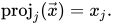
- A set-theoretic operation typified by the th projection map, written that takes an element of the Cartesian product to the value [1]
- A function that sends an element to its equivalence class under a specified equivalence relation [2] or, equivalently, a surjection from a set to another set.[3] The function from elements to equivalence classes is a surjection, and every surjection corresponds to an equivalence relation under which two elements are equivalent when they have the same image. The result of the mapping is written as when is understood, or written as when it is necessary to make explicit.





![{\displaystyle [x]}](https://wikimedia.org/api/rest_v1/media/math/render/svg/07548563c21e128890501e14eb7c80ee2d6fda4d)

![{\displaystyle [x]_{E}}](https://wikimedia.org/api/rest_v1/media/math/render/svg/d7135a51ea382628e332f61cec9cd6cedb22c580)
See also
[edit]- Cartesian product – Mathematical set formed from two given sets
- Projection (mathematics) – Mapping equal to its square under mapping composition
- Projection (measure theory)
- Projection (linear algebra) – Idempotent linear transformation from a vector space to itself
- Projection (relational algebra) – Operation that restricts a relation to a specified set of attributes
- Relation (mathematics) – Relationship between two sets, defined by a set of ordered pairs
References
[edit]- ↑ Halmos, P. R. (1960), Naive Set Theory, Undergraduate Texts in Mathematics, Springer, p. 32, ISBN 9780387900926
{{citation}}: ISBN / Date incompatibility (help). - ↑ Brown, Arlen; Pearcy, Carl M. (1995), An Introduction to Analysis, Graduate Texts in Mathematics, vol. 154, Springer, p. 8, ISBN 9780387943695.
- ↑ Jech, Thomas (2003), Set Theory: The Third Millennium Edition, Springer Monographs in Mathematics, Springer, p. 34, ISBN 9783540440857.
 | This set theory–related article is a stub. You can help Wikipedia by adding missing information. |