


Proca action
| Quantum field theory |
|---|
 |
| History |
In physics, specifically field theory and particle physics, the Proca action describes a massive spin-1 field of mass m in Minkowski spacetime. The corresponding equation is a relativistic wave equation called the Proca equation.[1] The Proca action and equation are named after Romanian physicist Alexandru Proca.
The Proca equation is involved in the Standard Model and describes there the three massive vector bosons, i.e. the Z and W bosons.
This article uses the (+−−−) metric signature and tensor index notation in the language of 4-vectors.
Lagrangian density
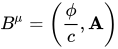
[edit]The field involved is a complex 4-potential , where is a kind of generalized electric potential and is a generalized magnetic potential. The field transforms like a complex four-vector.


The Lagrangian density is given by:[2]

where is the speed of light in vacuum, is the reduced Planck constant, and is the 4-gradient.


Equation
[edit]The Euler–Lagrange equation of motion for this case, also called the Proca equation, is:

which is conjugate equivalent to[3]
![{\displaystyle \left[\partial _{\mu }\partial ^{\mu }+\left({\frac {mc}{\hbar }}\right)^{2}\right]B^{\nu }=0}](https://wikimedia.org/api/rest_v1/media/math/render/svg/5a7c499bc518392bd0c6dd0229a25c281042fca1)
and for m ≠ 0 implies

equivalent to a generalized Lorenz gauge condition. For the massive case however, this is a physical constraint rather than an optional gauge condition. For non-zero sources, with all fundamental constants included, the field equation is:
![{\displaystyle c\mu _{0}j^{\nu }=\left[g^{\mu \nu }\left(\partial _{\sigma }\partial ^{\sigma }+{\frac {m^{2}c^{2}}{\hbar ^{2}}}\right)-\partial ^{\nu }\partial ^{\mu }\right]B_{\mu }}](https://wikimedia.org/api/rest_v1/media/math/render/svg/405fb449bcfa6c9c9fecdd45f4f670da359cfa7d)
When , the source-free equations reduce to Maxwell's equations without charge or current, and the above reduces to Maxwell's charge equation. This Proca field equation is closely related to the Klein–Gordon equation, because it is second order in space and time.

In the vector calculus notation, the source-free equations are:


and is the D'Alembert operator.

Gauge fixing
[edit]The Proca action is the gauge-fixed version of the Stueckelberg action via the Higgs mechanism. Quantizing the Proca action requires the use of second class constraints.
If , they are not invariant under the gauge transformations of electromagnetism


where is an arbitrary function.

See also
[edit]References
[edit]- ↑ B.R. Martin; G. Shaw (2008), Particle Physics (2nd ed.), John Wiley & Sons, ISBN 978-0-470-03294-7
- ↑ W. Greiner (2000), Relativistic quantum mechanics, Springer, p. 359, ISBN 3-540-67457-8
- ↑ Parker, C.B., ed. (1994). "conjugate equivalence". McGraw Hill Encyclopaedia of Physics (2nd ed.). New York, NY: McGraw Hill. ISBN 0-07-051400-3.
Further reading
[edit]- P. Labelle (2010), Supersymmetry Demystified, McGraw Hill (USA), ISBN 978-0-07-163641-4
- D. McMahon (2008), Quantum Field Theory, McGraw Hill (USA), ISBN 978-0-07-154382-8
- D. McMahon (2006), Quantum Mechanics Demystified, McGraw Hill (USA), ISBN 0-07-145546 9
| Theories | |||||||||||||||||
|---|---|---|---|---|---|---|---|---|---|---|---|---|---|---|---|---|---|
| Models |
| ||||||||||||||||
| Related |
| ||||||||||||||||
See also:  Template:Quantum mechanics topics Template:Quantum mechanics topics | |||||||||||||||||