


Portal:Mathematics


The Mathematics Portal

Mathematics is the study of representing and reasoning about abstract objects (such as numbers, points, spaces, sets, structures, and games). Mathematics is used throughout the world as an essential tool in many fields, including natural science, engineering, medicine, and the social sciences. Applied mathematics, the branch of mathematics concerned with application of mathematical knowledge to other fields, inspires and makes use of new mathematical discoveries and sometimes leads to the development of entirely new mathematical disciplines, such as statistics and game theory. Mathematicians also engage in pure mathematics, or mathematics for its own sake, without having any application in mind. There is no clear line separating pure and applied mathematics, and practical applications for what began as pure mathematics are often discovered. (Full article...)
Featured articles –
 Featured articles are displayed here, which represent some of the best content on English Wikipedia.
-


Figure 1: A solution (in purple) to Apollonius's problem. The given circles are shown in black.
In Euclidean plane geometry, Apollonius's problem is to construct circles that are tangent to three given circles in a plane (Figure 1). Apollonius of Perga (c. 262 BC – c. 190 BC) posed and solved this famous problem in his work Ἐπαφαί (Epaphaí, 'Tangencies'); this work has been lost, but a 4th-century AD report of his results by Pappus of Alexandria has survived. Three given circles generically have eight different circles that are tangent to them (Figure 2), a pair of solutions for each way to divide the three given circles in two subsets (there are 4 ways to divide a set of cardinality 3 in 2 parts).
In the 16th century, Adriaan van Roomen solved the problem using intersecting hyperbolas, but this solution uses methods not limited to straightedge and compass constructions. François Viète found a straightedge and compass solution by exploiting limiting cases: any of the three given circles can be shrunk to zero radius (a point) or expanded to infinite radius (a line). Viète's approach, which uses simpler limiting cases to solve more complicated ones, is considered a plausible reconstruction of Apollonius's method. The method of van Roomen was simplified by Isaac Newton, who showed that Apollonius's problem is equivalent to finding a position from the differences of its distances to three known points. This has applications in navigation and positioning systems such as LORAN. (Full article...) -
Algebra is a branch of mathematics that deals with abstract systems, known as algebraic structures, and the manipulation of expressions within those systems. It is a generalization of arithmetic that introduces variables and algebraic operations other than the standard arithmetic operations, such as addition and multiplication.
Elementary algebra is the main form of algebra taught in schools. It examines mathematical statements using variables for unspecified values and seeks to determine for which values the statements are true. To do so, it uses different methods of transforming equations to isolate variables. Linear algebra is a closely related field that investigates linear equations and combinations of them called systems of linear equations. It provides methods to find the values that solve all equations in the system at the same time, and to study the set of these solutions. (Full article...) -
The Quine–Putnam indispensability argument is an argument in the philosophy of mathematics for the existence of abstract mathematical objects such as numbers and sets, a position known as mathematical platonism. It was named after the philosophers Willard Van Orman Quine and Hilary Putnam, and is one of the most important arguments in the philosophy of mathematics.
Although elements of the indispensability argument may have originated with thinkers such as Gottlob Frege and Kurt Gödel, Quine's development of the argument was unique for introducing to it a number of his philosophical positions such as naturalism, confirmational holism, and the criterion of ontological commitment. Putnam gave Quine's argument its first detailed formulation in his 1971 book Philosophy of Logic. He later came to disagree with various aspects of Quine's thinking, however, and formulated his own indispensability argument based on the no miracles argument in the philosophy of science. A standard form of the argument in contemporary philosophy is credited to Mark Colyvan; whilst being influenced by both Quine and Putnam, it differs in important ways from their formulations. It is presented in the Stanford Encyclopedia of Philosophy: (Full article...) -
In classical mechanics, the Laplace–Runge–Lenz vector (LRL vector) is a vector used chiefly to describe the shape and orientation of the orbit of one astronomical body around another, such as a binary star or a planet revolving around a star. For two bodies interacting by Newtonian gravity, the LRL vector is a constant of motion, meaning that it is the same no matter where it is calculated on the orbit; equivalently, the LRL vector is said to be conserved. More generally, the LRL vector is conserved in all problems in which two bodies interact by a central force that varies as the inverse square of the distance between them; such problems are called Kepler problems.
Thus the hydrogen atom is a Kepler problem, since it comprises two charged particles interacting by Coulomb's law of electrostatics, another inverse-square central force. The LRL vector was essential in the first quantum mechanical derivation of the spectrum of the hydrogen atom, before the development of the Schrödinger equation. However, this approach is rarely used today. (Full article...) -
Leonhard Euler (/ˈɔɪlər/ OY-lər; 15 April 1707 – 18 September 1783) was a Swiss polymath who was active as a mathematician, physicist, astronomer, logician, geographer, music theorist and engineer. He founded the studies of graph theory and topology and made influential discoveries in many other branches of mathematics, such as analytic number theory, complex analysis, and infinitesimal calculus. He also introduced much of modern mathematical terminology and notation, including the notion of a mathematical function. He is known for his work in mechanics, fluid dynamics, optics, astronomy, and music theory. Euler has been called a "universal genius" who "was fully equipped with almost unlimited powers of imagination, intellectual gifts and extraordinary memory". He spent most of his adult life in Saint Petersburg, Russia, and in Berlin, then the capital of Prussia.
Euler is credited for popularizing the Greek letter (lowercase pi) to denote the ratio of a circle's circumference to its diameter, as well as first using the notation for the value of a function, the letter to express the imaginary unit , the Greek letter (capital sigma) to express summations, the Greek letter (capital delta) for finite differences, and lowercase letters to represent the sides of a triangle while representing the angles as capital letters. He gave the current definition of the constant , the base of the natural logarithm, now known as Euler's number. Euler made contributions to applied mathematics and engineering, such as his study of ships, which helped navigation; his three volumes on optics, which contributed to the design of microscopes and telescopes; and his studies of beam bending and column critical loads. (Full article...) -
In algebraic geometry and theoretical physics, mirror symmetry is a relationship between geometric objects called Calabi–Yau manifolds. The term refers to a situation where two Calabi–Yau manifolds look very different geometrically but are nevertheless equivalent when employed as extra dimensions of string theory.
Early cases of mirror symmetry were discovered by physicists. Mathematicians became interested in this relationship around 1990 when Philip Candelas, Xenia de la Ossa, Paul Green, and Linda Parkes showed that it could be used as a tool in enumerative geometry, a branch of mathematics concerned with counting the number of solutions to geometric questions. Candelas and his collaborators showed that mirror symmetry could be used to count rational curves on a Calabi–Yau manifold, thus solving a longstanding problem. Although the original approach to mirror symmetry was based on physical ideas that were not understood in a mathematically precise way, some of its mathematical predictions have since been proven rigorously. (Full article...) -

Plots of logarithm functions, with three commonly used bases. The special points logb b = 1 are indicated by dotted lines, and all curves intersect in logb 1 = 0.
In mathematics, the logarithm of a number is the exponent by which another fixed value, the base, must be raised to produce that number. For example, the logarithm of 1000 to base 10 is 3, because 1000 is 10 to the 3rd power: 1000 = 103 = 10 × 10 × 10. More generally, if x = by, then y is the logarithm of x to base b, written logb x = y, so log10 1000 = 3. As a single-variable function, the logarithm to base b is the inverse of exponentiation with base b.
The logarithm base 10 is called the decimal or common logarithm and is commonly used in science and engineering. The natural logarithm has the number e ≈ 2.718 as its base; its use is widespread in mathematics and physics because of its very simple derivative. The binary logarithm uses base 2 and is widely used in computer science, information theory, music theory, and photography. When the base is unambiguous from the context or irrelevant it is often omitted, and the logarithm is written log x. (Full article...) -

Euclid's method for finding the greatest common divisor (GCD) of two starting lengths BA and DC, both defined to be multiples of a common "unit" length. The length DC being shorter, it is used to "measure" BA, but only once because the remainder EA is less than DC. EA now measures (twice) the shorter length DC, with remainder FC shorter than EA. Then FC measures (three times) length EA. Because there is no remainder, the process ends with FC being the GCD. On the right Nicomachus's example with numbers 49 and 21 resulting in their GCD of 7 (derived from Heath 1908:300).
In mathematics, the Euclidean algorithm, or Euclid's algorithm, is an efficient method for computing the greatest common divisor (GCD) of two integers, the largest number that divides them both without a remainder. It is named after the ancient Greek mathematician Euclid, who first described it in his Elements (c. 300 BC).
It is an example of an algorithm, and is one of the oldest algorithms in common use. It can be used to reduce fractions to their simplest form, and is a part of many other number-theoretic and cryptographic calculations.
The Euclidean algorithm is based on the principle that the greatest common divisor of two numbers does not change if the larger number is replaced by its difference with the smaller number. For example, 21 is the GCD of 252 and 105 (as 252 = 21 × 12 and 105 = 21 × 5), and the same number 21 is also the GCD of 105 and 252 − 105 = 147. Since this replacement reduces the larger of the two numbers, repeating this process gives successively smaller pairs of numbers until the two numbers become equal. When that occurs, that number is the GCD of the original two numbers. By reversing the steps or using the extended Euclidean algorithm, the GCD can be expressed as a linear combination of the two original numbers, that is the sum of the two numbers, each multiplied by an integer (for example, 21 = 5 × 10⁵ + (−2) × 252). The fact that the GCD can always be expressed in this way is known as Bézout's identity. (Full article...) -
Theodore John Kaczynski (/kəˈzɪnski/ ⓘ kə-ZIN-skee; May 22, 1942 – June 10, 2023), also known as the Unabomber (/ˈjuːnəbɒmər/ ⓘ YOO-nə-bom-ər), was an American mathematician and domestic terrorist. A mathematics prodigy, he abandoned his academic career in 1969 to pursue a reclusive primitive lifestyle and lone wolf terrorism campaign.
Kaczynski murdered 3 people and injured 23 others between 1978 and 1995 in a nationwide mail bombing campaign against people he believed to be advancing modern technology and the destruction of the natural environment. He authored a roughly 35,000-word manifesto and social critique, Industrial Society and Its Future (1995), which opposes all forms of technology, rejects leftism, advocates cultural primitivism, and ultimately suggests violent revolution. (Full article...) -
An actuary is a professional with advanced mathematical skills who deals with the measurement and management of risk and uncertainty. These risks can affect both sides of the balance sheet and require asset management, liability management, and valuation skills. Actuaries provide assessments of financial security systems, with a focus on their complexity, their mathematics, and their mechanisms. The name of the corresponding academic discipline is actuarial science.
While the concept of insurance dates to antiquity, the concepts needed to scientifically measure and mitigate risks have their origins in 17th-century studies of probability and annuities. Actuaries in the 21st century require analytical skills, business knowledge, and an understanding of human behavior and information systems; actuaries use this knowledge to design programs that manage risk, by determining if the implementation of strategies proposed for mitigating potential risks does not exceed the expected cost of those risks actualized. The steps needed to become an actuary, including education and licensing, are specific to a given country, with various additional requirements applied by regional administrative units; however, almost all processes impart universal principles of risk assessment, statistical analysis, and risk mitigation, involving rigorously structured training and examination schedules, taking many years to complete. (Full article...) -
Emery Molyneux (/ˈɛməri ˈmɒlɪnoʊ/ EM-ər-ee MOL-in-oh; died June 1598) was an English Elizabethan maker of globes, mathematical instruments and ordnance. His terrestrial and celestial globes, first published in 1592, were the first to be made in England and the first to be made by an Englishman.
Molyneux was known as a mathematician and maker of mathematical instruments such as compasses and hourglasses. He became acquainted with many prominent men of the day, including the writer Richard Hakluyt and the mathematicians Robert Hues and Edward Wright. He also knew the explorers Thomas Cavendish, Francis Drake, Walter Raleigh and John Davis. Davis probably introduced Molyneux to his own patron, the London merchant William Sanderson, who largely financed the construction of the globes. When completed, the globes were presented to Elizabeth I. Larger globes were acquired by royalty, noblemen and academic institutions, while smaller ones were purchased as practical navigation aids for sailors and students. The globes were the first to be made in such a way that they were unaffected by the humidity at sea, and they came into general use on ships. (Full article...) -
Robert Hues (1553 – 24 May 1632) was an English mathematician and geographer. He attended St. Mary Hall at Oxford, and graduated in 1578. Hues became interested in geography and mathematics, and studied navigation at a school set up by Walter Raleigh. During a trip to Newfoundland, he made observations which caused him to doubt the accepted published values for variations of the compass. Between 1586 and 1588, Hues travelled with Thomas Cavendish on a circumnavigation of the globe, performing astronomical observations and taking the latitudes of places they visited. Beginning in August 1591, Hues and Cavendish again set out on another circumnavigation of the globe. During the voyage, Hues made astronomical observations in the South Atlantic, and continued his observations of the variation of the compass at various latitudes and at the Equator. Cavendish died on the journey in 1592, and Hues returned to England the following year.
In 1594, Hues published his discoveries in the Latin work Tractatus de globis et eorum usu (Treatise on Globes and Their Use) which was written to explain the use of the terrestrial and celestial globes that had been made and published by Emery Molyneux in late 1592 or early 1593, and to encourage English sailors to use practical astronomical navigation. Hues's work subsequently went into at least 12 other printings in Dutch, English, French and Latin. (Full article...) -
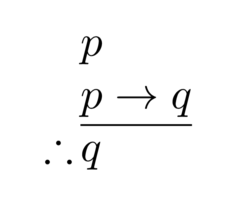
Logic studies valid forms of inference like modus ponens.
Logic is the study of correct reasoning. It includes both formal and informal logic. Formal logic is the study of deductively valid inferences or logical truths. It examines how conclusions follow from premises based on the structure of arguments alone, independent of their topic and content. Informal logic is associated with informal fallacies, critical thinking, and argumentation theory. Informal logic examines arguments expressed in natural language whereas formal logic uses formal language. When used as a countable noun, the term "a logic" refers to a specific logical formal system that articulates a proof system. Logic plays a central role in many fields, such as philosophy, mathematics, computer science, and linguistics.
Logic studies arguments, which consist of a set of premises that leads to a conclusion. An example is the argument from the premises "it's Sunday" and "if it's Sunday then I don't have to work" leading to the conclusion "I don't have to work." Premises and conclusions express propositions or claims that can be true or false. An important feature of propositions is their internal structure. For example, complex propositions are made up of simpler propositions linked by logical vocabulary like (and) or (if...then). Simple propositions also have parts, like "Sunday" or "work" in the example. The truth of a proposition usually depends on the meanings of all of its parts. However, this is not the case for logically true propositions. They are true only because of their logical structure independent of the specific meanings of the individual parts. (Full article...) -

The first 15,000 partial sums of 0 + 1 − 2 + 3 − 4 + ... The graph is situated with positive integers to the right and negative integers to the left.
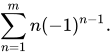
In mathematics, 1 − 2 + 3 − 4 + ··· is an infinite series whose terms are the successive positive integers, given alternating signs. Using sigma summation notation the sum of the first m terms of the series can be expressed as
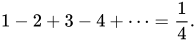
The infinite series diverges, meaning that its sequence of partial sums, (1, −1, 2, −2, 3, ...), does not tend towards any finite limit. Nonetheless, in the mid-18th century, Leonhard Euler wrote what he admitted to be a paradoxical equation:
(Full article...) -
Archimedes of Syracuse (/ˌɑːrkɪˈmiːdiːz/ AR-kih-MEE-deez; c. 287 – c. 212 BC) was an Ancient Greek mathematician, physicist, engineer, astronomer, and inventor from the city of Syracuse in Sicily. Although few details of his life are known, based on his surviving work, he is considered one of the leading scientists in classical antiquity, and one of the greatest mathematicians of all time. Archimedes anticipated modern calculus and analysis by applying the concept of the infinitesimals and the method of exhaustion to derive and rigorously prove many geometrical theorems, including the area of a circle, the surface area and volume of a sphere, the area of an ellipse, the area under a parabola, the volume of a segment of a paraboloid of revolution, the volume of a segment of a hyperboloid of revolution, and the area of a spiral.
Archimedes' other mathematical achievements include deriving an approximation of pi (π), defining and investigating the Archimedean spiral, and devising a system using exponentiation for expressing very large numbers. He was also one of the first to apply mathematics to physical phenomena, working on statics and hydrostatics. Archimedes' achievements in this area include a proof of the law of the lever, the widespread use of the concept of center of gravity, and the enunciation of the law of buoyancy known as Archimedes' principle. In astronomy, he made measurements of the apparent diameter of the Sun and the size of the universe. He is also said to have built a planetarium device that demonstrated the movements of the known celestial bodies, and may have been a precursor to the Antikythera mechanism. He is also credited with designing innovative machines, such as his screw pump, compound pulleys, and defensive war machines to protect his native Syracuse from invasion. (Full article...)


.jpg)


.jpg)



Selected image –

Good articles –
 These are Good articles, which meet a core set of high editorial standards.
-
In geometry, an isosceles triangle (/aɪˈsɒsəliːz/) is a triangle that has two sides of equal length and two angles of equal measure. Sometimes it is specified as having exactly two sides of equal length, and sometimes as having at least two sides of equal length, the latter version thus including the equilateral triangle as a special case.
Examples of isosceles triangles include the isosceles right triangle, the golden triangle, and the faces of bipyramids and certain Catalan solids.
The mathematical study of isosceles triangles dates back to ancient Egyptian mathematics and Babylonian mathematics. Isosceles triangles have been used as decoration from even earlier times, and appear frequently in architecture and design, for instance in the pediments and gables of buildings. (Full article...) -

Four opaque sets for a unit square. Upper left: its boundary, length 4. Upper right: Three sides, length 3. Lower left: a Steiner tree of the vertices, length . Lower right: the conjectured optimal solution, length .
In discrete geometry, an opaque set is a system of curves or other set in the plane that blocks all lines of sight across a polygon, circle, or other shape. Opaque sets have also been called barriers, beam detectors, opaque covers, or (in cases where they have the form of a forest of line segments or other curves) opaque forests. Opaque sets were introduced by Stefan Mazurkiewicz in 1916, and the problem of minimizing their total length was posed by Frederick Bagemihl in 1959.
For instance, visibility through a unit square can be blocked by its four boundary edges, with length 4, but a shorter opaque forest blocks visibility across the square with length . It is unproven whether this is the shortest possible opaque set for the square, and for most other shapes this problem similarly remains unsolved. The shortest opaque set for any bounded convex set in the plane has length at most the perimeter of the set, and at least half the perimeter. For the square, a slightly stronger lower bound than half the perimeter is known. Another convex set whose opaque sets are commonly studied is the unit circle, for which the shortest connected opaque set has length . Without the assumption of connectivity, the shortest opaque set for the circle has length at least and at most . (Full article...) -
Ri Jong-yol (Korean: 리정렬; born 1998) is a North Korean defector and child prodigy of mathematics. After winning silver at the 2016 International Mathematical Olympiad in Hong Kong, he made his way to the South Korean consulate general, where he took refuge for two months. Chinese authorities eventually allowed him to leave Hong Kong on a flight to Seoul. He legally changed his name to Lee Jung-ho (이정호) after receiving South Korean citizenship. (Full article...)
-
Hugo Dyonizy Steinhaus (English: /ˈhjuːɡoʊ ˈstaɪnˌhaʊs/ HYOO-goh STYNE-howss, Polish: [ˈxuɡɔ ˈʂtajnxaws]; 14 January 1887 – 25 February 1972) was a Polish mathematician and educator. Steinhaus obtained his PhD under David Hilbert at Göttingen University in 1911 and later became a professor at the Jan Kazimierz University in Lwów (now Lviv, Ukraine), where he helped establish what later became known as the Lwów School of Mathematics. He is credited with "discovering" mathematician Stefan Banach, with whom he gave a notable contribution to functional analysis through the Banach–Steinhaus theorem. After World War II Steinhaus played an important part in the establishment of the mathematics department at Wrocław University and in the revival of Polish mathematics from the destruction of the war.
Author of around 170 scientific articles and books, Steinhaus has left his legacy and contribution in many branches of mathematics, such as functional analysis, geometry, mathematical logic, and trigonometry. Notably he is regarded as one of the early founders of game theory and probability theory, which led to later development of more comprehensive approaches by other scholars. (Full article...) -
James Clerk Maxwell FRS FRSE (13 June 1831 – 5 November 1879) was a Scottish physicist and mathematician who was responsible for the classical theory of electromagnetic radiation, which was the first theory to describe electricity, magnetism and light as different manifestations of the same phenomenon. Maxwell's equations for electromagnetism achieved the second great unification in physics, where the first one had been realised by Isaac Newton. Maxwell was also key in the creation of statistical mechanics.
Maxwell graduated from Trinity College, Cambridge, in 1854, where he earned distinction in mathematics and the Smith's Prize. He remained at Cambridge briefly, publishing early mathematical work and investigations into optics, particularly the principles of colour combination and colour-blindness. He later held the Chair of Natural Philosophy at Marischal College in Aberdeen, where he studied the rings of Saturn and correctly proposed that they were composed of numerous small particles, work that earned him the Adams Prize in 1859. During this time he married Katherine Mary Dewar, who assisted him in his laboratory work. From 1860 to 1865, he served as the Professor of Natural Philosophy at King's College London, where he developed his theory of electromagnetic fields. His publication of "A Dynamical Theory of the Electromagnetic Field" in 1865 demonstrated that electric and magnetic fields travel through space as waves moving at the speed of light, proposing that light is an undulation in the same medium that is the cause of electric and magnetic phenomena. His unification of light and electrical phenomena led to his prediction of the existence of radio waves. (Full article...) -
In geometry, the Beckman–Quarles theorem states that if a transformation of the Euclidean plane or a higher-dimensional Euclidean space preserves unit distances, then it preserves all Euclidean distances. Equivalently, every homomorphism from the unit distance graph of the plane to itself must be an isometry of the plane. The theorem is named after Frank S. Beckman and Donald A. Quarles Jr., who published this result in 1953; it was later rediscovered by other authors and re-proved in multiple ways. Analogous theorems for rational subsets of Euclidean spaces, or for non-Euclidean geometry, are also known. (Full article...)
-

A cube is a three-dimensional solid object in geometry. It has eight vertices and twelve straight edges of the same length, so that these edges form six square faces of the same size. It is an example of a polyhedron. It is a special case of a cuboid, a parallelepiped, and a rhombohedron in which all six quadrilateral faces are squares. It is a three-dimensional hypercube, a family of polytopes that also includes the two-dimensional square and four-dimensional tesseract.
The cube is found in many popular cultures, including toys and games, the arts, optical illusions, and architectural buildings. Cubes can be found in crystal structures, science, and technological devices. It is also found in ancient texts, such as Plato's work Timaeus, which described a set of solids now called Platonic solids, associating a cube with the classical element of earth. A cube with unit length is the canonical unit of volume in three-dimensional space, relative to which other solid objects are measured. (Full article...) -
Eratosthenes of Cyrene (/ɛrəˈtɒsθəˌniːz/ err-ə-TOSS-thə-NEEZ; Ancient Greek: Ἐρατοσθένης [eratostʰénɛːs]; c. 276 BC – c. 195/194 BC) was an Ancient Greek polymath: a philosopher, scholar, mathematician, geographer, poet, astronomer, and music theorist. Eratosthenes eventually became the chief librarian at the Library of Alexandria. His work was the precursor to the modern discipline of geography, and he introduced some of its terminology, coining the terms geography and geographer.
He is best remembered as the first known person to calculate the Earth's circumference. He was also the first to calculate Earth's axial tilt, which similarly proved to have remarkable accuracy. He created the first global projection of the world incorporating parallels and meridians based on the geographic knowledge of his era. Eratosthenes was the founder of scientific chronology; he used Egyptian and Persian records to estimate the dates of the main events of the Trojan War, dating the sack of Troy to 1184 BC. In number theory, he introduced the sieve of Eratosthenes, an efficient method of identifying prime numbers and composite numbers. (Full article...) -
In graph theory, a branch of mathematics, the Herschel graph is a bipartite undirected graph with 11 vertices and 18 edges. It is a polyhedral graph (the graph of a convex polyhedron), and is the smallest polyhedral graph that does not have a Hamiltonian cycle, a cycle passing through all its vertices. The polyhedron whose vertices and edges form this graph is sometimes called the Herschel enneahedron; it is an enneahedron because it has nine faces.
Both the graph and the polyhedron are named after British astronomer Alexander Stewart Herschel, because of Herschel's studies of Hamiltonian cycles in polyhedral graphs (but not of this graph). (Full article...) -
Aristotle (Ancient Greek: Ἀριστοτέλης, romanized: Aristotélēs; 384–322 BC) was an ancient Greek philosopher and polymath. His writings span the natural sciences, philosophy, linguistics, economics, politics, psychology, and the arts. As the founder of the Peripatetic school of philosophy in the Lyceum in Athens, he began the wider Aristotelian tradition that followed, which set the groundwork for the development of modern science.
Little is known about Aristotle's life. He was born in the city of Stagira in Chalkidiki (northern Greece) during the Classical period. His father, Nicomachus, died when Aristotle was a child, and he was brought up by a guardian. At around eighteen years old, he joined Plato's Academy in Athens and remained there until the age of thirty seven (c. 347 BC). Shortly after Plato died, Aristotle left Athens and, at the request of Philip II of Macedon, tutored his son Alexander the Great beginning in 343 BC. He established a library in the Lyceum, which helped him to produce many of his hundreds of books on papyrus scrolls. (Full article...) -

Fig. 1: A binary search tree of size 9 and depth 3, with 8 at the root.
In computer science, a binary search tree (BST), also called an ordered or sorted binary tree, is a rooted binary tree data structure with the key of each internal node being greater than all the keys in the respective node's left subtree and less than the ones in its right subtree. The time complexity of operations on the binary search tree is linear with respect to the height of the tree.
Binary search trees allow binary search for fast lookup, addition, and removal of data items. Since the nodes in a BST are laid out so that each comparison skips about half of the remaining tree, the lookup performance is proportional to that of binary logarithm. BSTs were devised in the 1960s for the problem of efficient storage of labeled data and are attributed to Conway Berners-Lee and David Wheeler. (Full article...) -

The hypotenuse c of a right triangle with sides a and b is the Pythagorean sum of a and b.
In mathematics, Pythagorean addition is a binary operation on the real numbers that computes the length of the hypotenuse of a right triangle, given its two sides. Like the more familiar addition and multiplication operations of arithmetic, it is both associative and commutative.
This operation can be used in the conversion of Cartesian coordinates to polar coordinates, and in the calculation of Euclidean distance. It also provides a simple notation and terminology for the diameter of a cuboid, the energy-momentum relation in physics, and the overall noise from independent sources of noise. In its applications to signal processing and propagation of measurement uncertainty, the same operation is also called addition in quadrature. A scaled version of this operation gives the quadratic mean or root mean square. (Full article...)






Did you know (auto-generated) –

- ... that the symbol for equality in mathematics was not used for 61 years after its introduction, and was later popularized by Isaac Newton?
- ... that Hannah Fry used mathematics to compare Elizabeth II's Christmas messages with the lyrics of Snoop Dogg?
- ... that the identity of Cleo, who provided online answers to complex mathematics problems without showing any work, was revealed over a decade later in 2025?
- ... that formal semantics uses logic and mathematics to study language?
- ... that the first volume of Felix Klein's books on the history of mathematics does not mention the three women who originally transcribed his lectures?
- ... that Livingstone Luboobi claimed that he chose to teach himself double mathematics at A-level because there was no teacher available?
- ... that Pamela Ball was prouder of her mathematics degrees than of being the first Jamaican woman to be a fellow of the Royal College of Surgeons of England?
- ... that in 1940 Xu Ruiyun became the first Chinese woman to receive a PhD in mathematics?
More did you know –
- ...that it is not possible to configure two mutually inscribed quadrilaterals in the Euclidean plane, but the Möbius–Kantor graph describes a solution in the complex projective plane?
- ...that the six permutations of the vector (1,2,3) form a hexagon in 3D space, the 24 permutations of (1,2,3,4) form a truncated octahedron in four dimensions, and both are examples of permutohedra?
- ...that the Rule 184 cellular automaton can simultaneously model the behavior of cars moving in traffic, the accumulation of particles on a surface, and particle-antiparticle annihilation reactions?
- ...that a cyclic cellular automaton is a system of simple mathematical rules that can generate complex patterns mixing random chaos, blocks of color, and spirals?
- ...that a nonconvex polygon with three convex vertices is called a pseudotriangle?
- ...that the axiom of choice is logically independent of the other axioms of Zermelo–Fraenkel set theory?
- ...that the Pythagorean Theorem generalizes to any three similar shapes on the three sides of a right-angled triangle?
Selected article –
 |
Image credit: User:Fropuff |
Knot theory is the branch of topology that studies mathematical knots, which are defined as embeddings of a circle S1 in 3-dimensional Euclidean space, R3. This is basically equivalent to a conventional knotted string with the ends of the string joined together to prevent it from becoming undone. Two mathematical knots are considered equivalent if one can be transformed into the other via continuous deformations (known as ambient isotopies); these transformations correspond to manipulations of a knotted string that do not involve cutting the string or passing the string through itself.
Knots can be described in various ways, but the most common method is by planar diagrams (known as knot projections or knot diagrams). Given a method of description, a knot will have many descriptions, e.g., many diagrams, representing it. A fundamental problem in knot theory is determining when two descriptions represent the same knot. One way of distinguishing knots is by using a knot invariant, a "quantity" which remains the same even with different descriptions of a knot.
Research in knot theory began with the creation of knot tables and the systematic tabulation of knots. While tabulation remains an important task, today's researchers have a wide variety of backgrounds and goals. Classical knot theory, as initiated by Max Dehn, J. W. Alexander, and others, is primarily concerned with the knot group and invariants from homology theory such as the Alexander polynomial.
The discovery of the Jones polynomial by Vaughan Jones in 1984, and subsequent contributions from Edward Witten, Maxim Kontsevich, and others, revealed deep connections between knot theory and mathematical methods in statistical mechanics and quantum field theory. A plethora of knot invariants have been invented since then, utilizing sophisticated tools as quantum groups and Floer homology. (Full article...)
| View all selected articles |
Subcategories

Algebra | Arithmetic | Analysis | Complex analysis | Applied mathematics | Calculus | Category theory | Chaos theory | Combinatorics | Dynamical systems | Fractals | Game theory | Geometry | Algebraic geometry | Graph theory | Group theory | Linear algebra | Mathematical logic | Model theory | Multi-dimensional geometry | Number theory | Numerical analysis | Optimization | Order theory | Probability and statistics | Set theory | Statistics | Topology | Algebraic topology | Trigonometry | Linear programming
Mathematics | History of mathematics | Mathematicians | Awards | Education | Literature | Notation | Organizations | Theorems | Proofs | Unsolved problems
Topics in mathematics
 General
 Foundations
 Number theory
 Discrete mathematics
 Algebra
 Analysis
 Geometry and topology

Index of mathematics articles
| ARTICLE INDEX: | |
| MATHEMATICIANS: |
Related portals


WikiProjects
 The Mathematics WikiProject is the center for mathematics-related editing on Wikipedia. Join the discussion on the project's talk page.
|
Project pages Essays Subprojects Related projects
|
Things you can do
|
In other Wikimedia projects
The following Wikimedia Foundation sister projects provide more on this subject:
-
 Commons
Free media repository -
 Wikidata
Free knowledge base -
 Wikiquote
Collection of quotations -
 Wikisource
Free-content library -
 Wikiversity
Free learning tools -
 Wiktionary
Dictionary and thesaurus


