


Inequation
 | This article needs more citations. (March 2010) |
In mathematics, an inequation is a statement relating two values, that is either an strict inequality ("greater than", <, or "less than", >) or a relation "not equal to" (≠).[1][2] It is usually written in the form of a pair of expressions denoting the values in question, with a relational sign between the two sides, indicating the specific inequality relation. Some examples of inequations are:


Sometimes, the term "inequation" is restricted to the relaton "not equal to",[2][3] or is enlarged for including the relations "less than or equal to", ≤, and "greater than or equal to", ≥.[citation needed]
Chains of inequations
[edit]A shorthand notation is used for the conjunction of several inequations involving common expressions, by chaining them together. For example, the chain

is shorthand for

which also implies that and .


In rare cases, chains without such implications about distant terms are used. For example is shorthand for , which does not imply [citation needed] Similarly, is shorthand for , which does not imply any order of and .[4]





Solving inequations
[edit]
Similar to equation solving, inequation solving means finding what values (numbers, functions, sets, etc.) fulfill a condition stated in the form of an inequation or a conjunction of several inequations. These expressions contain one or more unknowns, which are free variables for which values are sought that cause the condition to be fulfilled. To be precise, what is sought are often not necessarily actual values, but, more in general, expressions. A solution of the inequation is an assignment of expressions to the unknowns that satisfies the inequation(s); in other words, expressions such that, when they are substituted for the unknowns, make the inequations true propositions. Often, an additional objective expression (i.e., an optimization equation) is given, that is to be minimized or maximized by an optimal solution.[5]
For example,

is a conjunction of inequations, partly written as chains (where can be read as "and"); the set of its solutions is shown in blue in the picture (the red, green, and orange line corresponding to the 1st, 2nd, and 3rd conjunct, respectively). For a larger example. see Linear programming#Example.

Computer support in solving inequations is described in constraint programming; in particular, the simplex algorithm finds optimal solutions of linear inequations.[6] The programming language Prolog III also supports solving algorithms for particular classes of inequalities (and other relations) as a basic language feature. For more, see constraint logic programming.
Combinations of meanings
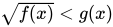
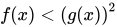
[edit]Usually because of the properties of certain functions (like square roots), some inequations are equivalent to a combination of multiple others. For example, the inequation is logically equivalent to the following three inequations combined:


See also
[edit]
- Apartness relation — a form of inequality in constructive mathematics
- Equation
- Equals sign
- Inequality (mathematics)
- Relational operator
References
[edit]- ↑ Thomas H. Sidebotham (2002). The A to Z of Mathematics: A Basic Guide. John Wiley and Sons. p. 252. ISBN 0-471-15045-2.
- 1 2 Weisstein, Eric W. "Inequation". mathworld.wolfram.com. Retrieved 2019-12-03.
- ↑ "BestMaths". bestmaths.net. Archived from the original on 2023-10-03. Retrieved 2019-12-03.
- ↑ Brian A. Davey; Hilary Ann Priestley (1990). Introduction to Lattices and Order. Cambridge Mathematical Textbooks. Cambridge University Press. definition of a fence in exercise 1.11, p.23. ISBN 0-521-36766-2. LCCN 89009753.
- ↑ Stapel, Elizabeth. "Linear Programming: Introduction". Purplemath. Retrieved 2019-12-03.
- ↑ "Optimization - The simplex method". Encyclopedia Britannica. Retrieved 2019-12-03.
| Authority control databases: National |
|---|
