


// Workers AI · dad joke modeWhat did Vaccinium uliginosum say? "I'm a little blue.
 | You can help expand this article with text translated from the corresponding article in Chinese. (July 2026) Click [show] for important translation instructions.
|
| Vaccinium uliginosum | |
|---|---|
 | |
 | |
Scientific classification  | |
| Kingdom: | Plantae |
| Clade: | Tracheophytes |
| Clade: | Angiosperms |
| Clade: | Eudicots |
| Clade: | Asterids |
| Order: | Ericales |
| Family: | Ericaceae |
| Genus: | Vaccinium |
| Species: | V. uliginosum |
| Binomial name | |
| Vaccinium uliginosum | |
| Synonyms[2] | |
| |

Vaccinium uliginosum (bog bilberry,[3] bog blueberry,[4] alpine blueberry or western blueberry) is a Eurasian and North American flowering plant in the heath family.[5][6] The berries are edible.
Description
[edit]Vaccinium uliginosum is a small deciduous shrub growing to 10–75 centimetres (4–30 in) tall, rarely 1 metre (3 feet) tall, with brown stems (unlike the green stems of the closely related bilberry). The leaves are oval, 4–30 millimetres (1⁄8–1+1⁄8 in) long and 2–15 mm (1⁄16–9⁄16 in) wide, blue-green with pale net-like veins, with a smooth margin and rounded apex.[7]
The flowers are pendulous, urn-shaped, pale pink, 4–6 mm (3⁄16–1⁄4 in) long, produced in mid-spring. The fruit is a dark blue-black berry 5–8 mm (3⁄16–5⁄16 in) in diameter, with sweet white flesh, ripe in late summer.[7] Cytology is 2n = 24.[8] Its fruit persists for an average of 26.1 days, and bears an average of 24.7 seeds per fruit. The fruit averages 86.8% water, with the dry weight including 38.4% carbohydrates and 3.9% lipids.[9]
Subspecies
[edit]Three subspecies and one variety are accepted by the Plants of the World Online (POWO) database,[10] but not all authorities distinguish them. Only the nominate subspecies of V. uliginosum subsp. uliginosum is relatively widely accepted.[7]
- Vaccinium uliginosum var. japonicum T.Yamaz. — Japan
- Vaccinium uliginosum subsp. nanum (Boiss.) Rivas Mart., A.Asensi, Molero Mesa & F.Valle — Spain (Sierra Nevada)
- Vaccinium uliginosum subsp. uliginosum — throughout most of the range of the species
- Vaccinium uliginosum subsp. vulcanorum (Kom.) Alsos & Elven — northeast Asia
A fourth subspecies Vaccinium uliginosum subsp. microphyllum Lange is sometimes accepted for Arctic plants; POWO treat it as a synonym of the nominate subspecies.[11]
Distribution and habitat
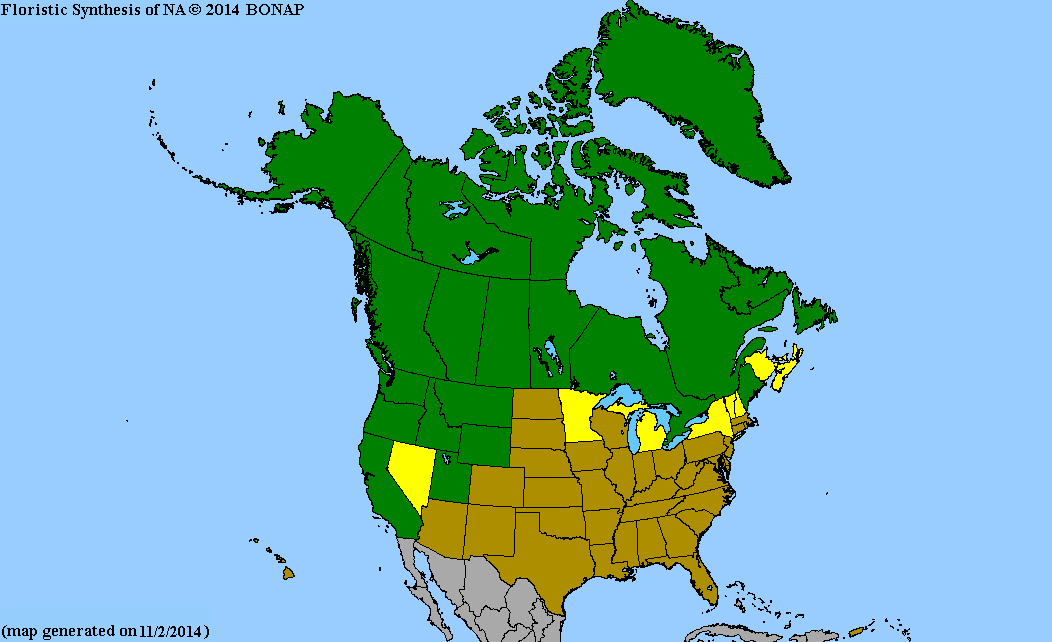
[edit]The plant is native to cool temperate regions of the Northern Hemisphere, at low altitudes in the Arctic, Baltics, and at high altitudes south to the Pyrenees, the Alps, and the Caucasus in Europe, the mountains of Mongolia, northern China, the Korean Peninsula and central Japan in Asia, and the Sierra Nevada in California and the Rocky Mountains in Utah in North America.[7][12][13][14]
It grows on wet acidic soils on heathland, moorland, tundra,[15] and in the understory of coniferous forests, from sea level in the Arctic, up to 3,400 m (11,200 ft) altitude in the south of the range. It is also occasionally found on calcareous soils on mountain ledges.[3]
V. uliginosum can survive long, severe climatic oscillations.[16][17]
Uses
[edit]The berries can be eaten raw or cooked, used to make jelly or pies, or dried to make pemmican.[18]
In Korean cuisine, bog bilberry is used to make infused liquor (Deuljjuk-sul).
Gallery
[edit] Bog bilberries on branches
 Close-up of bog bilberries in Eastern Siberia
 Bog bilberry liquor (left) produced in North Korea


References
[edit]- ↑ NatureServe (6 December 2024). "Vaccinium uliginosum | NatureServe Explorer". NatureServe Explorer. Arlington, Virginia. Retrieved 27 December 2024.
- ↑ "Vaccinium uliginosum". World Checklist of Selected Plant Families. Royal Botanic Gardens, Kew – via The Plant List. Note that this website has been superseded by World Flora Online
- 1 2 "Bog Bilberry Vaccinium uliginosum L." PlantAtlas. Retrieved 2026-07-29.
- ↑ NRCS. "Vaccinium uliginosum". PLANTS Database. United States Department of Agriculture (USDA). Retrieved 28 July 2015.
- ↑ Wallace, Gary D. (2017). "Vaccinium uliginosum subsp. occidentale". In Jepson Flora Project (ed.). Jepson eFlora. The Jepson Herbarium, University of California, Berkeley. Retrieved 18 July 2018.
- ↑ "Vaccinium uliginosum — alpine blueberry". Native Plant Trust. 2026. Retrieved 17 January 2026.
- 1 2 3 4 Vander Kloet, Sam P. (2009). "Vaccinium uliginosum". In Flora of North America Editorial Committee (ed.). Flora of North America North of Mexico (FNA). Vol. 8. New York and Oxford: Oxford University Press – via eFloras.org, Missouri Botanical Garden, St. Louis, MO & Harvard University Herbaria, Cambridge, MA.
- ↑ Redpath, Lauren E.; Aryal, Rishi; Lynch, Nathan; Spencer, Jessica A.; Hulse-Kemp, Amanda M.; Ballington, James R.; Green, Jaimie; Bassil, Nahla; Hummer, Kim; Ranney, Thomas; Ashrafi, Hamid (2022). "Nuclear DNA contents and ploidy levels of North American Vaccinium species and interspecific hybrids". Scientia Horticulturae. 297 110955. Elsevier BV. doi:10.1016/j.scienta.2022.110955. ISSN 0304-4238.
- ↑ Ehrlén & Eriksson 1991.
- ↑ "Vaccinium uliginosum L." Plants of the World Online. Retrieved 2026-07-29.
- ↑ "Vaccinium uliginosum subsp. uliginosum". Plants of the World Online, Royal Botanic Gardens, Kew. 2023. Retrieved 8 November 2025.
- ↑ Fang, Ruizheng; Steven, Peter F. "Vaccinium uliginosum". Flora of China. Vol. 14 – via eFloras.org, Missouri Botanical Garden, St. Louis, MO & Harvard University Herbaria, Cambridge, MA.
- ↑ Altervista Flora Italiana, Falso mirtillo, Vaccinium uliginosum L.
- ↑ Kartesz, John T. (2014). "Vaccinium uliginosum". State-level distribution map from the North American Plant Atlas (NAPA). Biota of North America Program (BONAP).
- ↑ Turner, Mark; Kuhlmann, Ellen (2014). Trees & Shrubs of the Pacific Northwest (1st ed.). Portland, OR: Timber Press. p. 183. ISBN 978-1-60469-263-1.
- ↑ Alexander, Jake M.; Chalmandrier, Loïc; Lenoir, Jonathan; et al. (2017-11-27). "Lags in the response of mountain plant communities to climate change". Global Change Biology. 24 (2): 563–579. doi:10.1111/gcb.13976. ISSN 1354-1013. PMC 5813787. PMID 29112781.
- ↑ De Witte, LC; Armbruster, GFJ; Gielly, L; Taberlet, P; Stocklin, J (2011-11-10). "AFLP markers reveal high clonal diversity and extreme longevity in four key arctic-alpine species". Molecular Ecology. 21 (5): 1081–1097. doi:10.1111/j.1365-294x.2011.05326.x. ISSN 0962-1083. PMID 22070158.
- ↑ Nyerges, Christopher (2017). Foraging Washington: Finding, Identifying, and Preparing Edible Wild Foods. Guilford, CT: Falcon Guides. ISBN 978-1-4930-2534-3. OCLC 965922681.
Further reading
[edit]- Blamey, M.; Grey-Wilson, C. (1989). Flora of Britain and Northern Europe. Hodder & Stoughton.
- Ehrlén, Johan; Eriksson, Ove (1991). "Phenological variation in fruit characteristics in vertebrate-dispersed plants". Oecologia. 86 (4): 463–470. doi:10.1007/BF00318311. ISSN 0029-8549.
External links
[edit]- Calflora
- Jepson Manual treatment of Vaccinium uliginosum – flora of California.
- Flora Europaea: Vaccinium uliginosum
- Plants of British Columbia: Vaccinium uliginosum Archived 2016-03-03 at the Wayback Machine
- Vaccinium uliginosum in the CalPhotos photo database, University of California, Berkeley
 Media related to Vaccinium uliginosum at Wikimedia Commons

- NatureServe secure species
- Vaccinium
- Berries
- Alpine flora
- Flora of the Arctic
- Flora of the Alps
- Flora of Europe
- Flora of temperate Asia
- Flora of Canada
- Flora of Greenland
- Flora of the Northeastern United States
- Flora of the Western United States
- Flora of the Sierra Nevada (United States)
- Bird food plants
- Japanese fruit
- Plants described in 1753
- Botanical taxa named by Carl Linnaeus