


// Workers AI · dad joke modeIs Newtonian limit a party pooper? It's always limiting the new tons.
In physics, the Newtonian limit is a mathematical approximation applicable to physical systems exhibiting (1) weak gravitation, (2) objects moving slowly compared to the speed of light, and (3) slowly changing (or completely static) gravitational fields.[1] Under these conditions, Newton's law of universal gravitation may be used to obtain values that are accurate. In general, and in the presence of significant gravitation, the general theory of relativity must be used.
In the Newtonian limit, spacetime is approximately flat[1] and the Minkowski metric may be used over finite distances. In this case 'approximately flat' is defined as space in which gravitational effect approaches 0, mathematically actual spacetime and Minkowski space are not identical, Minkowski space is an idealized model.
Special relativity
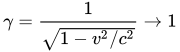
[edit]In special relativity, Newtonian behaviour can in most cases be obtained by performing the limit . In this limit, the often appearing gamma factor becomes 1 and the Lorentz transformations between reference frames turn into Galileo transformations


General relativity
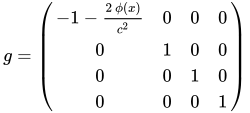
[edit]The geodesic equation for a free particle on curved spacetime with metric can be derived from the action If the spacetime-metric is then, ignoring all contributions of order the action becomes which is the action that reproduces the Newtonian equations of motion of a particle in a gravitational potential [2]

![{\displaystyle {\begin{aligned}S[x,{\dot {x}}]&=-m\,c\,\int dt\,{\sqrt {-g_{\mu \nu }\,{\dot {x}}^{\mu }\,{\dot {x}}^{\nu }}}\end{aligned}}}](https://wikimedia.org/api/rest_v1/media/math/render/svg/e8543883648ff9b4297c4a6b0c3ec1e85e1af12f)

![{\displaystyle {\begin{aligned}S[x,{\dot {x}}]&=-m\,c\,\int dt\,{\sqrt {c^{2}+2\,\phi (x)-{\dot {\mathbf {x} }}^{2}}}\\&=-m\,c\,\int dt\,\left({\sqrt {c^{2}}}+{\frac {1}{2\,{\sqrt {c^{2}}}}}\,\left(2\,\phi (x)-{\dot {\mathbf {x} }}^{2}\right)+...\right)\\&\approx \int dt\,\left(-m\,c^{2}+{\frac {1}{2}}m{\dot {\mathbf {x} }}^{2}-m\,\phi (x)\right)\end{aligned}}}](https://wikimedia.org/api/rest_v1/media/math/render/svg/d97ad4029e2c49ebb9034f55cc0ea73ac04e7991)

See also
[edit]References
[edit]- 1 2 Carroll, Sean M (1997). "Lecture Notes on General Relativity". arXiv:gr-qc/9712019.
- ↑ Amendola, Luca (November 20, 2022). "Lecture Notes: Cosmology" (PDF). University of Heidelberg. p. 12. Retrieved December 25, 2022.
 | This relativity-related article is a stub. You can help Wikipedia by adding missing information. |