


Dinitrogen pentoxide
 | |
 | |
| Names | |
|---|---|
| IUPAC name
Dinitrogen pentoxide | |
| Other names
Nitric anhydride Nitronium nitrate Nitryl nitrate DNPO Anhydrous nitric acid | |
| Identifiers | |
3D model (JSmol) |
|
| ChEBI | |
| ChemSpider | |
| ECHA InfoCard | 100.030.227 |
| EC Number |
|
PubChem CID |
|
| UNII | |
CompTox Dashboard (EPA) |
|
| |
| |
| Properties | |
| N2O5 | |
| Molar mass | 108.01 g/mol |
| Appearance | white solid |
| Density | 2.0 g/cm3[1] |
| Boiling point | 33 °C (91 °F; 306 K) sublimes[1] |
| reacts to give HNO3 | |
| Solubility | soluble in chloroform negligible in CCl4 |
| −35.6×10⁻⁶ cm3 mol−1 (aq) | |
| 1.39 D | |
| Structure[2] | |
| Hexagonal, hP14 | |
| P63/mmc No. 194 | |
a = 0.54019 nm, c = 0.65268 nm | |
Formula units (Z) |
2 |
| planar, C2v (approx. D2h) N–O–N ≈ 180° | |
| Thermochemistry[3] | |
Heat capacity (C) |
143.1 J K−1 mol−1 (s) 95.3 J K−1 mol−1 (g) |
Std molar entropy (S⦵298) |
178.2 J K−1 mol−1 (s) 355.7 J K−1 mol−1 (g) |
Std enthalpy of formation (ΔfH⦵298) |
−43.1 kJ/mol (s) +13.3 kJ/mol (g) |
Gibbs free energy (ΔfG⦵) |
113.9 kJ/mol (s) +117.1 kJ/mol (g) |
| Hazards | |
| Occupational safety and health (OHS/OSH): | |
Main hazards |
strong oxidizer, forms strong acid in contact with water |
| NFPA 704 (fire diamond) | |
| Flash point | Non-flammable |
| Related compounds | |
| Nitrous oxide Nitric oxide Dinitrogen trioxide Nitrogen dioxide Dinitrogen tetroxide | |
Related compounds |
Nitric acid |
Except where otherwise noted, data are given for materials in their standard state (at 25 °C [77 °F], 100 kPa).
| |


Dinitrogen pentoxide (also known as nitrogen pentoxide or nitric anhydride) is the chemical compound with the formula N2O5. It is one of the binary nitrogen oxides, a family of compounds that contain only nitrogen and oxygen. It exists as colourless crystals that sublime slightly above room temperature, yielding a colorless gas.[4]
Dinitrogen pentoxide has been used for nitrations but has largely been superseded by nitronium tetrafluoroborate (NO2BF4).
Structure
[edit source]
Solid N2O5 is a salt, nitronium nitrate, consisting of linear nitronium cations [NO2]+ and planar trigonal nitrate anions [NO3]−. The N-O distances in the cation are 115 pm and 124 pm for the anion.[5] Gaseous N2O5 is a covalently-bound molecule.[6] It crystallizes in the space group D4
6h (C6/mmc) with Z = 2.[7]
In the gas phase or when dissolved in nonpolar solvents such as carbon tetrachloride, the compound exists as covalently-bonded molecules O2N−O−NO2. In the gas phase, theoretical calculations for the minimum-energy configuration indicate that the O−N−O angle in each −NO2 wing is about 134° and the N−O−N angle is about 112°. In that configuration, the two −NO2 groups are rotated about 35° around the bonds to the central oxygen, away from the N−O−N plane. The molecule thus has a propeller shape, with one axis of 180° rotational symmetry (C2) [8]
Physical properties
[edit source]The vapor pressure P (in atm) as a function of temperature T (in kelvin), in the range 211 to 305 K (−62 to 32 °C), is well approximated by the formula
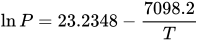
being about 48 torr at 0 °C, 424 torr at 25 °C, and 760 torr at 32 °C (9 °C below the melting point).[9]
When gaseous N2O5 is cooled rapidly ("quenched"), one can obtain the metastable molecular form, which exothermically converts to the ionic form above −70 °C.[10]
Gaseous N2O5 absorbs ultraviolet light with dissociation into the free radicals nitrogen dioxide NO2• and nitrogen trioxide NO3• (uncharged nitrate). The absorption spectrum has a broad band with maximum at wavelength 160 nm.[11]
Preparation
[edit source]N2O5 was first reported by the French chemist Henri Deville in 1840, who prepared it by treating silver nitrate (AgNO3) with chlorine.[12][13]
A recommended laboratory synthesis entails dehydrating nitric acid (HNO3) with phosphorus(V) oxide:[10]
- P4O10 + 12 HNO3 → 4 H3PO4 + 6 N2O5
Another laboratory process is the reaction of lithium nitrate LiNO3 and bromine pentafluoride BrF5, in the ratio exceeding 3:1. The reaction first forms nitryl fluoride FNO2 that reacts further with the lithium nitrate:[7]
- BrF5 + 3 LiNO3 → 3 LiF + BrONO2 + O2 + 2 FNO2
- FNO2 + LiNO3 → LiF + N2O5
The compound can also be created in the gas phase by reacting nitrogen dioxide NO2 or N2O4 with ozone:[14]
- 2 NO2 + O3 → N2O5 + O2
However, the product catalyzes the rapid decomposition of ozone:[14]
- 2 O3 + N2O5 → 3 O2 + N2O5
Dinitrogen pentoxide is also formed when a mixture of oxygen and nitrogen is passed through an electric discharge.[7] Another route is the reactions of phosphoryl chloride POCl3 or nitryl chloride NO2Cl with silver nitrate AgNO3[7][15]
Reactions
[edit source]
Dinitrogen pentoxide reacts with water (hydrolyses) to produce nitric acid HNO3. Thus, dinitrogen pentoxide is an acidic oxide, the anhydride of nitric acid:[10]
- N2O5 + H2O → 2 HNO3
Solutions of dinitrogen pentoxide in nitric acid can be seen as nitric acid with more than 100% concentration. The phase diagram of the system H2O−N2O5 shows the well-known negative azeotrope at 60% N2O5 (that is, 70% HNO3), a positive azeotrope at 85.7% N2O5 (100% HNO3), and another negative one at 87.5% N2O5 ("102% HNO3").[16]
The reaction with hydrogen chloride HCl also gives nitric acid and nitryl chloride NO2Cl:[17]
- N2O5 + HCl → HNO3 + NO2Cl
Dinitrogen pentoxide reacts with ammonia NH3 to give several products, including nitrous oxide N2O, ammonium nitrate NH4NO3, nitramide NH2NO2, and ammonium dinitramide NH4N(NO2)2, depending on reaction conditions.[18]
Thermal decomposition
[edit source]Decomposition is negligible if the solid is kept at 0 °C.[7] It decomposes at room temperature into NO2 and O2:[19][14][20]
- N2O5 → 2 NO2 + 0.5 O2
Its solutions in carbon tetrachloride decompose at 30 °C (303 K).[21] Both N2O5 and NO2 are soluble in CCl4 and remain in solution while oxygen is insoluble and escapes. The volume of the oxygen allows determination of the reaction kinetics:
- 2 N2O5 → 4 NO2 + O2(g)
In the presence of nitric oxide, the decomposition proceeds as follows:[22]
- N2O5 + NO → 3 NO2
Applications
[edit source]Nitration of organic compounds
[edit source]Dinitrogen pentoxide, for example as a solution in chloroform, has been used as a reagent to introduce the −NO2 functionality in organic compounds. This nitration reaction is represented as follows:
- N2O5 + Ar−H → HNO3 + Ar−NO2
where Ar represents an arene moiety.[23] The reactivity of the NO+2 can be further enhanced with strong acids that generate the superelectrophile HNO2+2.
In this use, N2O5 has been largely replaced by nitronium tetrafluoroborate [NO2]+[BF4]−. This salt retains the high reactivity of NO+2, but it is thermally stable, decomposing at about 180 °C (into NO2F and BF3).
Dinitrogen pentoxide is relevant to the preparation of explosives.[13][24]
Atmospheric occurrence
[edit source]In Earth's atmosphere, dinitrogen pentoxide is an important reservoir of the NOx species that are responsible for ozone depletion: its formation provides a null cycle with which NO and NO2 are temporarily held in an unreactive state.[25] Mixing ratios of several parts per billion by volume have been observed in polluted regions of the nighttime troposphere.[26] Dinitrogen pentoxide has also been observed in the stratosphere[27] at similar levels, the reservoir formation having been postulated in considering the puzzling observations of a sudden drop in stratospheric NO2 levels above 50 °N, the so-called 'Noxon cliff'.
Variations in N2O5 reactivity in aerosols can result in significant losses in tropospheric ozone, hydroxyl radicals, and NOx concentrations.[28] Two important reactions of N2O5 in atmospheric aerosols are hydrolysis to form nitric acid[29] and reaction with halide ions, particularly Cl−, to form ClNO2 molecules which may serve as precursors to reactive chlorine atoms in the atmosphere.[30][31]
Hazards
[edit source]N2O5 is a strong oxidizer that forms explosive mixtures with organic compounds and ammonium salts. Dinitrogen pentoxide can degrade to the highly toxic nitrogen dioxide gas.
References
[edit source]- 1 2 Haynes, p. 4.76
- ↑ Simon, Arndt; Horakh, Jörg; Obermeyer, Axel; Borrmann, Horst (1992). "Kristalline Stickstoffoxide — Struktur von N2O3 mit einer Anmerkung zur Struktur von N2O5". Angewandte Chemie (in German). 104 (3). Wiley: 325–327. Bibcode:1992AngCh.104..325S. doi:10.1002/ange.19921040321.
- ↑ Haynes, p. 5.29
- ↑ Connell, Peter Steele. (1979) The Photochemistry of Dinitrogen Pentoxide. Ph. D. thesis, Lawrence Berkeley National Laboratory.
- ↑ Grison, E.; Eriks, K.; De Vries, J. L. (1950). "Structure cristalline de l'anhydride azotique, N2O5". Acta Crystallographica. 3 (4): 290–294. doi:10.1107/S0365110X50000744.
- ↑ Angus, W.R.; Jones, R.W.; Phillips, G.O. (1949). "Existence of Nitrosyl Ions (NO+) in Dinitrogen Tetroxide and of Nitronium Ions (NO2+) in Liquid Dinitrogen Pentoxide". Nature. 164 (4167): 433. Bibcode:1949Natur.164..433A. doi:10.1038/164433a0. PMID 18140439. S2CID 4136455.
- 1 2 3 4 5 Wilson, William W.; Christe, Karl O. (1987). "Dinitrogen pentoxide. New synthesis and laser Raman spectrum". Inorganic Chemistry. 26 (10): 1631–1633. doi:10.1021/ic00257a033.
- ↑ Parthiban, S.; Raghunandan, B.N.; Sumathi, R. (1996). "Structures, energies and vibrational frequencies of dinitrogen pentoxide". Journal of Molecular Structure: Theochem. 367: 111–118. doi:10.1016/S0166-1280(96)04516-2.
- ↑ McDaniel, A. H.; Davidson, J. A.; Cantrell, C. A.; Shetter, R. E.; Calvert, J. G. (1988). "Enthalpies of formation of dinitrogen pentoxide and the nitrate free radical". The Journal of Physical Chemistry. 92 (14): 4172–4175. doi:10.1021/j100325a035.
- 1 2 3 Holleman, Arnold Frederik; Wiberg, Egon (2001), Wiberg, Nils (ed.), Inorganic Chemistry, translated by Eagleson, Mary; Brewer, William, San Diego/Berlin: Academic Press/De Gruyter, ISBN 0-12-352651-5
- ↑ Osborne, Bruce A.; Marston, George; Kaminski, L.; Jones, N.C; Gingell, J.M; Mason, Nigel; Walker, Isobel C.; Delwiche, J.; Hubin-Franskin, M.-J. (2000). "Vacuum ultraviolet spectrum of dinitrogen pentoxide". Journal of Quantitative Spectroscopy and Radiative Transfer. 64 (1): 67–74. Bibcode:2000JQSRT..64...67O. doi:10.1016/S0022-4073(99)00104-1.
- ↑ Deville, M.H. (1849). "Note sur la production de l'acide nitrique anhydre". Compt. Rend. 28: 257–260.
- 1 2 Agrawal, Jai Prakash (2010). High Energy Materials: Propellants, Explosives and Pyrotechnics. Wiley-VCH. p. 117. ISBN 978-3-527-32610-5. Retrieved 20 September 2011.
- 1 2 3 Yao, Francis; Wilson, Ivan; Johnston, Harold (1982). "Temperature-dependent ultraviolet absorption spectrum for dinitrogen pentoxide". The Journal of Physical Chemistry. 86 (18): 3611–3615. doi:10.1021/j100215a023.
- ↑ Schott, Garry; Davidson, Norman (1958). "Shock Waves in Chemical Kinetics: The Decomposition of N2O5 at High Temperatures". Journal of the American Chemical Society. 80 (8): 1841–1853. Bibcode:1958JAChS..80.1841S. doi:10.1021/ja01541a019.
- ↑ Lloyd, L.; Wyatt, P. A. H. (1955). "The vapour pressures of nitric acid solutions. Part I. New azeotropes in the water–dinitrogen pentoxide system". J. Chem. Soc.: 2248–2252. doi:10.1039/JR9550002248.
- ↑ Wilkins, Robert A.; Hisatsune, I. C. (1976). "The Reaction of Dinitrogen Pentoxide with Hydrogen Chloride". Industrial & Engineering Chemistry Fundamentals. 15 (4): 246–248. doi:10.1021/i160060a003.
- ↑ Frenck, C.; Weisweiler, W. (2002). "Modeling the Reactions Between Ammonia and Dinitrogen Pentoxide to Synthesize Ammonium Dinitramide (ADN)". Chemical Engineering & Technology. 25 (2): 123. doi:10.1002/1521-4125(200202)25:2<123::AID-CEAT123>3.0.CO;2-W.
- ↑ Gruenhut, N. S.; Goldfrank, M.; Cushing, M. L.; Caesar, G. V.; Caesar, P. D.; Shoemaker, C. (1950). "Nitrogen(V) Oxide (Nitrogen Pentoxide, Dinitrogen Pentoxide, Nitric Anhydride)". Inorganic Syntheses. pp. 78–81. doi:10.1002/9780470132340.ch20. ISBN 9780470132340.
{{cite book}}: ISBN / Date incompatibility (help) - ↑ Schott, Garry; Davidson, Norman (1958). "Shock Waves in Chemical Kinetics: The Decomposition of N2O5 at High Temperatures". Journal of the American Chemical Society. 80 (8): 1841–1853. Bibcode:1958JAChS..80.1841S. doi:10.1021/ja01541a019.
- ↑ Jaime, R. (2008). Determinación de orden de reacción haciendo uso de integrales definidas. Universidad Nacional Autónoma de Nicaragua, Managua.
- ↑ Wilson, David J.; Johnston, Harold S. (1953). "Decomposition of Nitrogen Pentoxide in the Presence of Nitric Oxide. IV. Effect of Noble Gases". Journal of the American Chemical Society. 75 (22): 5763. Bibcode:1953JAChS..75.5763W. doi:10.1021/ja01118a529.
- ↑ Bakke, Jan M.; Hegbom, Ingrid; Verne, Hans Peter; Weidlein, Johann; Schnöckel, Hansgeorg; Paulsen, Gudrun B.; Nielsen, Ruby I.; Olsen, Carl E.; Pedersen, Christian; Stidsen, Carsten E. (1994). "Dinitrogen Pentoxide--Sulfur Dioxide, a New Nitration System". Acta Chemica Scandinavica. 48: 181–182. doi:10.3891/acta.chem.scand.48-0181.
- ↑ Talawar, M. B. (2005). "Establishment of Process Technology for the Manufacture of Dinitrogen Pentoxide and its Utility for the Synthesis of Most Powerful Explosive of Today—CL-20". Journal of Hazardous Materials. 124 (1–3): 153–64. Bibcode:2005JHzM..124..153T. doi:10.1016/j.jhazmat.2005.04.021. PMID 15979786.
- ↑ Finlayson-Pitts, Barbara J.; Pitts, James N. (2000). Chemistry of the upper and lower atmosphere: theory, experiments, and applications. San Diego: Academic Press. ISBN 9780080529073. OCLC 162128929.
- ↑ Wang, Haichao; Lu, Keding; Chen, Xiaorui; Zhu, Qindan; Chen, Qi; Guo, Song; Jiang, Meiqing; Li, Xin; Shang, Dongjie; Tan, Zhaofeng; Wu, Yusheng; Wu, Zhijun; Zou, Qi; Zheng, Yan; Zeng, Limin; Zhu, Tong; Hu, Min; Zhang, Yuanhang (2017). "High N2O5 Concentrations Observed in Urban Beijing: Implications of a Large Nitrate Formation Pathway". Environmental Science and Technology Letters. 4 (10): 416–420. Bibcode:2017EnSTL...4..416W. doi:10.1021/acs.estlett.7b00341.
- ↑ Rinsland, C.P. (1989). "Stratospheric N2O5 profiles at sunrise and sunset from further analysis of the ATMOS/Spacelab 3 solar spectra". Journal of Geophysical Research. 94: 18341–18349. Bibcode:1989JGR....9418341R. doi:10.1029/JD094iD15p18341.
- ↑ Macintyre, H. L.; Evans, M. J. (2010-08-09). "Sensitivity of a global model to the uptake of N2O5 by tropospheric aerosol". Atmospheric Chemistry and Physics. 10 (15): 7409–7414. Bibcode:2010ACP....10.7409M. doi:10.5194/acp-10-7409-2010.
- ↑ Brown, S. S.; Dibb, J. E.; Stark, H.; Aldener, M.; Vozella, M.; Whitlow, S.; Williams, E. J.; Lerner, B. M.; Jakoubek, R. (2004-04-16). "Nighttime removal of NOx in the summer marine boundary layer". Geophysical Research Letters. 31 (7): n/a. Bibcode:2004GeoRL..31.7108B. doi:10.1029/2004GL019412.
- ↑ Gerber, R. Benny; Finlayson-Pitts, Barbara J.; Hammerich, Audrey Dell (2015-07-15). "Mechanism for formation of atmospheric Cl atom precursors in the reaction of dinitrogen oxides with HCl/Cl− on aqueous films" (PDF). Physical Chemistry Chemical Physics. 17 (29): 19360–19370. Bibcode:2015PCCP...1719360H. doi:10.1039/C5CP02664D. PMID 26140681. S2CID 39157816.
- ↑ Kelleher, Patrick J.; Menges, Fabian S.; DePalma, Joseph W.; Denton, Joanna K.; Johnson, Mark A.; Weddle, Gary H.; Hirshberg, Barak; Gerber, R. Benny (2017-09-18). "Trapping and Structural Characterization of the XNO2·NO3− (X=Cl, Br, I) Exit Channel Complexes in the Water-Mediated X− + N2O5 Reactions with Cryogenic Vibrational Spectroscopy". The Journal of Physical Chemistry Letters. 8 (19): 4710–4715. doi:10.1021/acs.jpclett.7b02120. PMID 28898581.
Cited sources
[edit source]- Haynes, William M., ed. (2016). CRC Handbook of Chemistry and Physics (97th ed.). CRC Press. ISBN 9781498754293.