


Moduli stack of principal bundles
In algebraic geometry, given a smooth projective curve X over a finite field and a smooth affine group scheme G over it, the moduli stack of principal bundles over X, denoted by , is an algebraic stack given by:[1] for any -algebra R,


- the category of principal G-bundles over the relative curve .

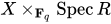
In particular, the category of -points of , that is, , is the category of G-bundles over X.
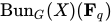
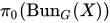
Similarly, can also be defined when the curve X is over the field of complex numbers. Roughly, in the complex case, one can define as the quotient stack of the space of holomorphic connections on X by the gauge group. Replacing the quotient stack (which is not a topological space) by a homotopy quotient (which is a topological space) gives the homotopy type of .
In the finite field case, it is not common to define the homotopy type of . But one can still define a (smooth) cohomology and homology of .
Basic properties
[edit]It is known that is a smooth stack of dimension where is the genus of X. It is not of finite type but locally of finite type; one thus usually uses a stratification by open substacks of finite type (cf. the Harder–Narasimhan stratification), also for parahoric G over curve X see [2] and for G only a flat group scheme of finite type over X see.[3]


If G is a split reductive group, then the set of connected components is in a natural bijection with the fundamental group .[4]

The Atiyah–Bott formula
[edit]Behrend's trace formula
[edit]This is a (conjectural) version of the Lefschetz trace formula for when X is over a finite field, introduced by Behrend in 1993.[5] It states:[6] if G is a smooth affine group scheme with semisimple connected generic fiber, then

where (see also Behrend's trace formula for the details)
- l is a prime number that is not p and the ring of l-adic integers is viewed as a subring of .
- is the geometric Frobenius.
- , the sum running over all isomorphism classes of G-bundles on X and convergent.
- for a graded vector space , provided the series on the right absolutely converges.



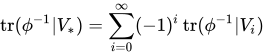

A priori, neither left nor right side in the formula converges. Thus, the formula states that the two sides converge to finite numbers and that those numbers coincide.
Notes
[edit]- ↑ Lurie, Jacob (April 3, 2013), Tamagawa Numbers in the Function Field Case (Lecture 2) (PDF), archived from the original (PDF) on 2013-04-11, retrieved 2014-01-30
- ↑ Heinloth 2010, Proposition 2.1.2
- ↑ Arasteh Rad, E.; Hartl, Urs (2021), "Uniformizing the moduli stacks of global G-shtukas", International Mathematics Research Notices (21): 16121–16192, arXiv:1302.6351, doi:10.1093/imrn/rnz223, MR 4338216; see Theorem 2.5
- ↑ Heinloth 2010, Proposition 2.1.2
- ↑ Behrend, Kai A. (1991), The Lefschetz Trace Formula for the Moduli Stack of Principal Bundles (PDF) (PhD thesis), University of California, Berkeley
- ↑ Gaitsgory & Lurie 2019, Chapter 5: The Trace Formula for BunG(X), p. 260
References
[edit]- Heinloth, Jochen (2010), "Lectures on the moduli stack of vector bundles on a curve" (PDF), in Schmitt, Alexander (ed.), Affine flag manifolds and principal bundles, Trends in Mathematics, Basel: Birkhäuser/Springer, pp. 123–153, doi:10.1007/978-3-0346-0288-4_4, ISBN 978-3-0346-0287-7, MR 3013029
- J. Heinloth, A.H.W. Schmitt, The Cohomology Ring of Moduli Stacks of Principal Bundles over Curves, 2010 preprint, available at http://www.uni-essen.de/~hm0002/.
- Gaitsgory, Dennis; Lurie, Jacob (2019), Weil's conjecture for function fields, Vol. 1 (PDF), Annals of Mathematics Studies, vol. 199, Princeton, NJ: Princeton University Press, ISBN 978-0-691-18214-8, MR 3887650