// Workers AI · traducción al español
Polinomios de Meixner-Pollaczek
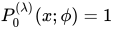
En matemáticas, los polinomios Meixner-Pollaczek son una familia de polinomios orthogonales P(λ)n(x,φ) introducidos por Meixner (1934), que hasta cambios elementales de variables son los mismos que los polinomios Pollaczek Pλn(x,a,b) redescubiertos por Pollaczek (1949) en el caso λ=1/2, y más tarde generalizados por él.
Traducción generada por IA. El artículo original en inglés continúa abajo.
// Workers AI · dad joke mode Why did Meixner–Pollaczek polynomials go to therapy? They had many degrees of anxiety.
From Wikipedia, the free encyclopedia
In mathematics, the Meixner–Pollaczek polynomials are a family of orthogonal polynomials P (λ) n x ,φ) introduced by Meixner ( 1934 ) , which up to elementary changes of variables are the same as the Pollaczek polynomials P λ n x ,a ,b ) rediscovered by Pollaczek ( 1949 ) in the case λ=1/2, and later generalized by him.
They are defined by
P
n
(
λ
)
(
x
;
ϕ
)
=
(
2
λ
)
n
n
!
e
i
n
ϕ
2
F
1
(
−
n
,
λ
+
i
x
2
λ
;
1
−
e
−
2
i
ϕ
)
{\displaystyle P_{n}^{(\lambda )}(x;\phi )={\frac {(2\lambda )_{n}}{n!}}e^{in\phi }{}_{2}F_{1}\left({\begin{array}{c}-n,~\lambda +ix\\2\lambda \end{array}};1-e^{-2i\phi }\right)}
P
n
λ
(
cos
ϕ
;
a
,
b
)
=
(
2
λ
)
n
n
!
e
i
n
ϕ
2
F
1
(
−
n
,
λ
+
i
(
a
cos
ϕ
+
b
)
/
sin
ϕ
2
λ
;
1
−
e
−
2
i
ϕ
)
{\displaystyle P_{n}^{\lambda }(\cos \phi ;a,b)={\frac {(2\lambda )_{n}}{n!}}e^{in\phi }{}_{2}F_{1}\left({\begin{array}{c}-n,~\lambda +i(a\cos \phi +b)/\sin \phi \\2\lambda \end{array}};1-e^{-2i\phi }\right)}
The Meixner–Pollaczek polynomials P m (λ) (x ;φ) are orthogonal on the real line with respect to the weight function
w
(
x
;
λ
,
ϕ
)
=
|
Γ
(
λ
+
i
x
)
|
2
e
(
2
ϕ
−
π
)
x
{\displaystyle w(x;\lambda ,\phi )=|\Gamma (\lambda +ix)|^{2}e^{(2\phi -\pi )x}}
and the orthogonality relation is given by[ 1]
∫
−
∞
∞
P
n
(
λ
)
(
x
;
ϕ
)
P
m
(
λ
)
(
x
;
ϕ
)
w
(
x
;
λ
,
ϕ
)
d
x
=
2
π
Γ
(
n
+
2
λ
)
(
2
sin
ϕ
)
2
λ
n
!
δ
m
n
,
λ
>
0
,
0
<
ϕ
<
π
.
{\displaystyle \int _{-\infty }^{\infty }P_{n}^{(\lambda )}(x;\phi )P_{m}^{(\lambda )}(x;\phi )w(x;\lambda ,\phi )dx={\frac {2\pi \Gamma (n+2\lambda )}{(2\sin \phi )^{2\lambda }n!}}\delta _{mn},\quad \lambda >0,\quad 0<\phi <\pi .}
Recurrence relation [ edit ] The sequence of Meixner–Pollaczek polynomials satisfies the recurrence relation[ 2]
(
n
+
1
)
P
n
+
1
(
λ
)
(
x
;
ϕ
)
=
2
(
x
sin
ϕ
+
(
n
+
λ
)
cos
ϕ
)
P
n
(
λ
)
(
x
;
ϕ
)
−
(
n
+
2
λ
−
1
)
P
n
−
1
(
x
;
ϕ
)
.
{\displaystyle (n+1)P_{n+1}^{(\lambda )}(x;\phi )=2{\bigl (}x\sin \phi +(n+\lambda )\cos \phi {\bigr )}P_{n}^{(\lambda )}(x;\phi )-(n+2\lambda -1)P_{n-1}(x;\phi ).}
The Meixner–Pollaczek polynomials are given by the Rodrigues-like formula[ 3]
P
n
(
λ
)
(
x
;
ϕ
)
=
(
−
1
)
n
n
!
w
(
x
;
λ
,
ϕ
)
d
n
d
x
n
w
(
x
;
λ
+
1
2
n
,
ϕ
)
,
{\displaystyle P_{n}^{(\lambda )}(x;\phi )={\frac {(-1)^{n}}{n!\,w(x;\lambda ,\phi )}}{\frac {d^{n}}{dx^{n}}}w\left(x;\lambda +{\tfrac {1}{2}}n,\phi \right),}
where w (x ;λ,φ) is the weight function given above.
Generating function [ edit ] The Meixner–Pollaczek polynomials have the generating function[ 4]
∑
n
=
0
∞
t
n
P
n
(
λ
)
(
x
;
ϕ
)
=
(
1
−
e
i
ϕ
t
)
−
λ
+
i
x
(
1
−
e
−
i
ϕ
t
)
−
λ
−
i
x
.
{\displaystyle \sum _{n=0}^{\infty }t^{n}P_{n}^{(\lambda )}(x;\phi )=(1-e^{i\phi }t)^{-\lambda +ix}(1-e^{-i\phi }t)^{-\lambda -ix}.}
↑ Koekoek, Lesky, & Swarttouw (2010), p. 213. ↑ Koekoek, Lesky, & Swarttouw (2010), p. 213. ↑ Koekoek, Lesky, & Swarttouw (2010), p. 214. ↑ Koekoek, Lesky, & Swarttouw (2010), p. 215.
Koekoek, Roelof; Lesky, Peter A.; Swarttouw, René F. (2010), Hypergeometric orthogonal polynomials and their q-analogues , Springer Monographs in Mathematics, Berlin, New York: Springer-Verlag , doi :10.1007/978-3-642-05014-5 , ISBN 978-3-642-05013-8 MR 2656096 Koornwinder, Tom H.; Wong, Roderick S. C.; Koekoek, Roelof; Swarttouw, René F. (2010), "Pollaczek Polynomials" , in Olver, Frank W. J. ; Lozier, Daniel M.; Boisvert, Ronald F.; Clark, Charles W. (eds.), NIST Handbook of Mathematical Functions ISBN 978-0-521-19225-5 MR 2723248 . Meixner, J. (1934), "Orthogonale Polynomsysteme Mit Einer Besonderen Gestalt Der Erzeugenden Funktion", J. London Math. Soc. , s1-9 : 6– 13, doi :10.1112/jlms/s1-9.1.6 Pollaczek, Félix (1949), "Sur une généralisation des polynomes de Legendre" , Les Comptes rendus de l'Académie des sciences 228 : 1363– 1365, MR 0030037