


Mean signed deviation
In statistics, the mean signed difference (MSD),[1] also known as mean signed deviation, mean signed error, or mean bias error[2] is a sample statistic that summarizes how well a set of estimates match the quantities that they are supposed to estimate. It is one of a number of statistics that can be used to assess an estimation procedure, and it would often be used in conjunction with a sample version of the mean square error.


For example, suppose a linear regression model has been estimated over a sample of data, and is then used to extrapolate predictions of the dependent variable out of sample after the out-of-sample data points have become available. Then would be the i-th out-of-sample value of the dependent variable, and would be its predicted value. The mean signed deviation is the average value of

Definition
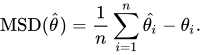
[edit]The mean signed difference is derived from a set of n pairs, , where is an estimate of the parameter in a case where it is known that . In many applications, all the quantities will share a common value. When applied to forecasting in a time series analysis context, a forecasting procedure might be evaluated using the mean signed difference, with being the predicted value of a series at a given lead time and being the value of the series eventually observed for that time-point. The mean signed difference is defined to be


Use Cases
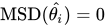
[edit]The mean signed difference is often useful when the estimations are biased from the true values in a certain direction. If the estimator that produces the values is unbiased, then . However, if the estimations are produced by a biased estimator, then the mean signed difference is a useful tool to understand the direction of the estimator's bias.

See also
[edit]
References
[edit]- ↑ Harris, D. J.; Crouse, J. D. (1993). "A Study of Criteria Used in Equating". Applied Measurement in Education. 6 (3): 203. doi:10.1207/s15324818ame0603_3.
- ↑ Willmott, C. J. (1982). "Some Comments on the Evaluation of Model Performance". Bulletin of the American Meteorological Society. 63 (11): 1310. Bibcode:1982BAMS...63.1309W. doi:10.1175/1520-0477(1982)063<1309:SCOTEO>2.0.CO;2.
 | This statistics-related article is a stub. You can help Wikipedia by adding missing information. |