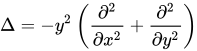
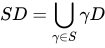
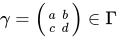
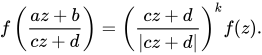
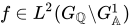
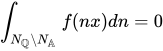
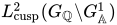
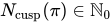
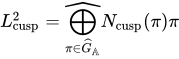
The group

operates on the upper half plane
- :\operatorname {Im} (z)>0\}}

by fractional linear transformations:
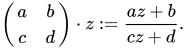
It can be extended to an operation on  by defining:

- :=\lim _{\operatorname {Im} (z)\to \infty }{\begin{pmatrix}a&b\\c&d\\\end{pmatrix}}\cdot z={\begin{cases}{\frac {a}{c}}&{\text{if }}c\neq 0\\\infty &{\text{if }}c=0\end{cases}}}

The Radon measure
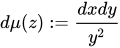
defined on  is invariant under the operation of
  .
.
Let  be a discrete subgroup of
  . A fundamental domain for is an open set
  , so that there exists a system of representatives
  of
of  with
with

A fundamental domain for the modular group  is given by

(see Modular form).
A function  is called -invariant, if
 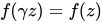 holds for all
  and all
  .
.
For every measurable, -invariant function the equation

holds. Here the measure  on the right side of the equation is the induced measure on the quotient
Let  be a Maass form. Since
- :={\begin{pmatrix}1&1\\0&1\\\end{pmatrix}}\in \Gamma (1)}
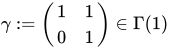
we have:

Therefore has a Fourier expansion of the form
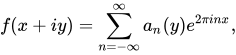
with coefficient functions 
It is easy to show that is Maass cusp form if and only if  .
.
We can calculate the coefficient functions in a precise way. For this we need the Bessel function  .
.
Definition: The Bessel function is defined as

The integral converges locally uniformly absolutely for  in
in  and the inequality

holds for all  .
.
Therefore,  decreases exponentially for
  . Furthermore, we have
  for all
  .
.
Proof: We have
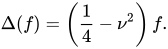
By the definition of the Fourier coefficients we get

for 
Together it follows that
![{\displaystyle {\begin{aligned}\left({\frac {1}{4}}-\nu ^{2}\right)a_{n}(y)&=\int _{0}^{1}\left({\frac {1}{4}}-\nu ^{2}\right)f(x+iy)e^{-2\pi inx}dx\\[4pt]&=\int _{0}^{1}(\Delta f)(x+iy)e^{-2\pi inx}dx\\[4pt]&=-y^{2}\left(\int _{0}^{1}{\frac {\partial ^{2}f}{\partial x^{2}}}(x+iy)e^{-2\pi inx}dx+\int _{0}^{1}{\frac {\partial ^{2}f}{\partial y^{2}}}(x+iy)e^{-2\pi inx}dx\right)\\[4pt]&{\overset {(1)}{=}}-y^{2}(2\pi in)^{2}a_{n}(y)-y^{2}{\frac {\partial ^{2}}{\partial y^{2}}}\int _{0}^{1}f(x+iy)e^{-2\pi inx}dx\\[4pt]&=-y^{2}(2\pi in)^{2}a_{n}(y)-y^{2}{\frac {\partial ^{2}}{\partial y^{2}}}a_{n}(y)\\[4pt]&=4\pi ^{2}n^{2}y^{2}a_{n}(y)-y^{2}{\frac {\partial ^{2}}{\partial y^{2}}}a_{n}(y)\end{aligned}}}](https://wikimedia.org/api/rest_v1/media/math/render/svg/8dbb275ae73da95b706ad5d037dd29f6a1e249c3)
for
In (1) we used that the nth Fourier coefficient of  is
is 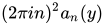 for the first summation term. In the second term we changed the order of integration and differentiation, which is allowed since f is smooth in y . We get a linear differential equation of second degree:

For  one can show, that for every solution there exist unique coefficients
  with the property
For  every solution has coefficients of the form

for unique  . Here
  and
and  are Bessel functions.
The Bessel functions  grow exponentially, while the Bessel functions decrease exponentially. Together with the polynomial growth condition 3) we get
  (also
(also  ) for a unique
  . Q.E.D.
Even and odd Maass forms: Let  . Then i operates on all functions by
 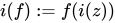 and commutes with the hyperbolic Laplacian. A Maass form is called even, if
  and odd if
  . If f is a Maass form, then
  is an even Maass form and
  an odd Maass form and it holds that
  .
.
Let

be a Maass cusp form. We define the L-function of as
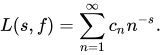
Then the series  converges for
  and we can continue it to a whole function on
  .
.
If is even or odd we get

Here  if is even and
  if is odd. Then
  satisfies the functional equation

Example: The non-holomorphic Eisenstein-series E
[edit]The non-holomorphic Eisenstein-series is defined for  and as

where  is the Gamma function.
The series converges absolutely in for  and locally uniformly in
  , since one can show, that the series
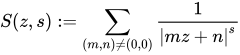
converges absolutely in , if  . More precisely it converges uniformly on every set
  , for every compact set
  and every
  .
.
We only show  -invariance and the differential equation. A proof of the smoothness can be found in Deitmar or Bump. The growth condition follows from the Fourier expansion of the Eisenstein series.
We will first show the -invariance. Let
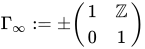
be the stabilizer group  corresponding to the operation of on
  .
.
- Proposition. E is
 -invariant.
Proof. Define:
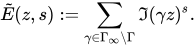
(a)  converges absolutely in for and
Since

we obtain

That proves the absolute convergence in for 
Furthermore, it follows that

since the map

is a bijection (a) follows.
(b) We have  for all
  .
.
For  we get

Together with (a),  is also invariant under . Q.E.D.
- Proposition. E is an eigenform of the hyperbolic Laplace operator
We need the following Lemma:
- Lemma:
 commutes with the operation of on
  . More precisely for all
  we have: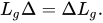
Proof: The group is generated by the elements of the form
- ;\quad S={\begin{pmatrix}0&-1\\1&0\\\end{pmatrix}}.}

One calculates the claim for these generators and obtains the claim for all  . Q.E.D.
Since  it is sufficient to show the differential equation for . We have:

Furthermore, one has

Since the Laplace Operator commutes with the Operation of , we get

and so

Therefore, the differential equation holds for E in  . In order to obtain the claim for all , consider the function
  . By explicitly calculating the Fourier expansion of this function, we get that it is meromorphic. Since it vanishes for , it must be the zero function by the identity theorem.
The Fourier-expansion of E
[edit]The nonholomorphic Eisenstein series has a Fourier expansion
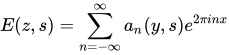
where

If ,  has a meromorphic continuation on . It is holomorphic except for simple poles at
The Eisenstein series satisfies the functional equation

for all .
Locally uniformly in  the growth condition

holds, where 
The meromorphic continuation of E is very important in the spectral theory of the hyperbolic Laplace operator.
Let be a congruence subgroup and 
We define the hyperbolic Laplace operator  of weight
  as
as


This is a generalization of the hyperbolic Laplace operator  .
.
We define an operation of on by
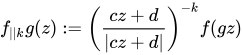
where

It can be shown that

holds for all  and every .
Therefore, operates on the vector space
 .
.
Definition. A Maass form of weight  for is a function
  that is an eigenfunction of and is of moderate growth at the cusps.
The term moderate growth at cusps needs clarification. Infinity is a cusp for  a function is of moderate growth at if
  is bounded by a polynomial in y as . Let
  be another cusp. Then there exists
  with
with  . Let
. Let  . Then
  , where
  is the congruence subgroup
  . We say is of moderate growth at the cusp
  , if
, if  is of moderate growth at .
Definition. If contains a principal congruence subgroup of level  , we say that is cuspidal at infinity, if

We say that is cuspidal at the cusp if is cuspidal at infinity. If is cuspidal at every cusp, we call a cusp form.
We give a simple example of a Maass form of weight  for the modular group:
Example. Let  be a modular form of even weight for
  Then
Then 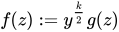 is a Maass form of weight for the group .
The spectral problem
[edit]Let be a congruence subgroup of and let  be the vector space of all measurable functions with
  for all satisfying

modulo functions with  The integral is well defined, since the function
  is -invariant. This is a Hilbert space with inner product

The operator can be defined in a vector space  which is dense in . There is a positive semidefinite symmetric operator. It can be shown, that there exists a unique self-adjoint continuation on
Define  as the space of all cusp forms
  Then operates on and has a discrete spectrum. The spectrum belonging to the orthogonal complement has a continuous part and can be described with the help of (modified) non-holomorphic Eisenstein series, their meromorphic continuations and their residues. (See Bump or Iwaniec).
If is a discrete (torsion free) subgroup of , so that the quotient is compact, the spectral problem simplifies. This is because a discrete cocompact subgroup has no cusps. Here all of the space is a sum of eigenspaces.
Embedding into the space L2(Γ \ G)
[edit] is a locally compact unimodular group with the topology of
  Let be a congruence subgroup. Since is discrete in , it is closed in as well. The group is unimodular and since the counting measure is a Haar-measure on the discrete group , is also unimodular. By the Quotient Integral Formula there exists a -right-invariant Radon measure
  on the locally compact space
  . Let
. Let  be the corresponding
  -space. This space decomposes into a Hilbert space direct sum:
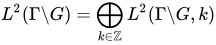
where

and

The Hilbert-space can be embedded isometrically into the Hilbert space  . The isometry is given by the map

Therefore, all Maass cusp forms for the congruence group can be thought of as elements of .
is a Hilbert space carrying an operation of the group , the so-called right regular representation:
- :=\phi (xg),{\text{ where }}x\in \Gamma \backslash G{\text{ and }}\phi \in L^{2}(\Gamma \backslash G).}

One can easily show, that is a unitary representation of on the Hilbert space . One is interested in a decomposition into irreducible subrepresentations. This is only possible if is cocompact. If not, there is also a continuous Hilbert-integral part. The interesting part is, that the solution of this problem also solves the spectral problem of Maass forms. (see Bump, C. 2.3)
Automorphic representations of the adele group
[edit]Let be a commutative ring with unit and let  be the group of
  matrices with entries in and invertible determinant. Let
  be the ring of rational adeles,
  the ring of the finite (rational) adeles and for a prime number
  let
let  be the field of p-adic numbers. Furthermore, let
  be the ring of the p-adic integers (see Adele ring). Define
  . Both
  and
and  are locally compact unimodular groups if one equips them with the subspace topologies of
  respectively
  . Then:
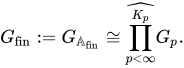
The right side is the restricted product, concerning the compact, open subgroups  of . Then
  locally compact group, if we equip it with the restricted product topology.
The group  is isomorphic to

and is a locally compact group with the product topology, since and are both locally compact.
Let

The subgroup
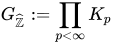
is a maximal compact, open subgroup of and can be thought of as a subgroup of , when we consider the embedding  .
.
We define  as the center of
  , that means is the group of all diagonal matrices of the form
  , where
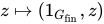
  . We think of as a subgroup of since we can embed the group by
  .
.
The group  is embedded diagonally in , which is possible, since all four entries of a
  can only have finite amount of prime divisors and therefore
  for all but finitely many prime numbers .
Let  be the group of all
  with
with  . (see Adele Ring for a definition of the absolute value of an Idele). One can easily calculate, that is a subgroup of .
With the one-to-one map  we can identify the groups
  and
and  with each other.
The group is dense in and discrete in . The quotient  is not compact but has finite Haar-measure.
Therefore, is a lattice of  similar to the classical case of the modular group and . By harmonic analysis one also gets that is unimodular.
We now want to embed the classical Maass cusp forms of weight 0 for the modular group into  . This can be achieved with the "strong approximation theorem", which states that the map

is a -equivariant homeomorphism. So we get

and furthermore

Maass cuspforms of weight 0 for modular group can be embedded into

By the strong approximation theorem this space is unitary isomorphic to

which is a subspace of 
In the same way one can embed the classical holomorphic cusp forms. With a small generalization of the approximation theorem, one can embed all Maass cusp forms (as well as the holomorphic cuspforms) of any weight for any congruence subgroup in 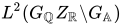 .
.
We call the space of automorphic forms of the adele group.
Cuspidal representations of the adele group
[edit]An irreducible representation  of the group is called cuspidal, if it is isomorphic to a subrepresentation of
  .
.
An irreducible representation of the group is called admissible if there exists a compact subgroup  of
of  , so that
  for all
  .
.
One can show, that every cuspidal representation is admissible.
The admissibility is needed to proof the so-called Tensorprodukt-Theorem anzuwenden, which says, that every irreducible, unitary and admissible representation of the group is isomorphic to an infinite tensor product

The  are irreducible representations of the group . Almost all of them need to be umramified.
(A representation of the group  is called unramified, if the vector space

is not the zero space.)
A construction of an infinite tensor product can be found in Deitmar,C.7.
Automorphic L-functions
[edit]Let be an irreducible, admissible unitary representation of . By the tensor product theorem, is of the form 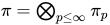 (see cuspidal representations of the adele group)
Let  be a finite set of places containing and all ramified places . One defines the global Hecke - function of as
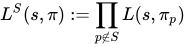
where  is a so-called local L-function of the local representation . A construction of local L-functions can be found in Deitmar C. 8.2.
If is a cuspidal representation, the L-function  has a meromorphic continuation on . This is possible, since , satisfies certain functional equations.