


Log reduction
Log reduction is a measure of how thoroughly a decontamination process reduces the concentration of a contaminant. It is defined as the common logarithm of the ratio of the levels of contamination before and after the process, so an increment of 1 corresponds to a reduction in concentration by a factor of 10. In general, an n-log reduction means that the concentration of remaining contaminants is only 10−n times that of the original. So for example, a 0-log reduction is no reduction at all, while a 1-log reduction corresponds to a reduction of 90 percent from the original concentration, and a 2-log reduction corresponds to a reduction of 99 percent from the original concentration.[1]
Mathematical definition
[edit]Let cb and ca be the numerical values of the concentrations of a given contaminant, respectively before and after treatment, following a defined process. It is irrelevant in what units these concentrations are given, provided that both use the same units.
Then an R-log reduction is achieved, where
- .

For the purpose of presentation, the value of R is rounded down to a desired precision, usually to a whole number.
- Example
Let the concentration of some contaminant be 580 ppm before and 0.725 ppm after treatment. Then

Rounded down, R is 2, so a 2-log reduction is achieved.
Conversely, an R-log reduction means that a reduction by a factor of 10R has been achieved.
Log reduction and percentage reduction
[edit]Reduction is often expressed as a percentage. The closer it is to 100%, the better. Letting cb and ca be as before, a reduction by P % is achieved, where
- [2]
- Example
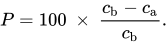
Let, as in the earlier example, the concentration of some contaminant be 580 ppm before and 0.725 ppm after treatment. Then

So this is (better than) a 99% reduction, but not yet quite a 99.9% reduction.
The following table summarizes the most common cases.
Log reduction Percentage 1-log reduction 90% 2-log reduction 99% 3-log reduction 99.9% 4-log reduction 99.99% 5-log reduction 99.999%
In general, if R is a whole number, an R-log reduction corresponds to a percentage reduction with R leading digits "9" in the percentage (provided that it is at least 10%).
See also
[edit]References
[edit]- ↑ "Final Report of an NWRI Independent Advisory Panel: Recommended DPR General Guidelines and Operational Requirements for New Mexico" (PDF). National Water Research Institute. January 22, 2016. Retrieved December 7, 2018.
- ↑ "Log and Percent Reductions in Microbiology and Antimicrobial Testing". Microchem Laboratory. December 16, 2015. Retrieved December 7, 2018.