


Log-linear model
 | This article needs more citations. (July 2012) |
A log-linear model is a mathematical model that takes the form of a function whose logarithm equals a linear combination of the parameters of the model, which makes it possible to apply (possibly multivariate) linear regression. That is, it has the general form
- ,
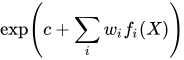
in which the fi(X) are quantities that are functions of the variable X, in general a vector of values, while c and the wi stand for the model parameters.
The term may specifically be used for:
- A log-linear plot or graph, which is a type of semi-log plot.
- Poisson regression for contingency tables, a type of generalized linear model.
The specific applications of log-linear models are where the output quantity lies in the range 0 to ∞, for values of the independent variables X, or more immediately, the transformed quantities fi(X) in the range −∞ to +∞. This may be contrasted to logistic models, similar to the logistic function, for which the output quantity lies in the range 0 to 1. Thus the contexts where these models are useful or realistic often depends on the range of the values being modelled.
See also
[edit]Further reading
[edit]- Gujarati, Damodar N.; Porter, Dawn C. (2009). "How to Measure Elasticity: The Log-Linear Model". Basic Econometrics. New York: McGraw-Hill/Irwin. pp. 159–162. ISBN 978-0-07-337577-9.
| National | |
|---|---|
| Other | |

 | This machine learning–related article is a stub. You can help Wikipedia by adding missing information. |
 | This applied mathematics–related article is a stub. You can help Wikipedia by adding missing information. |