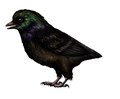
// Workers AI · dad joke modeWhat did Liaoningornis say? "Fowl" mood.
| Liaoningornis Temporal range: Early Cretaceous, | |
|---|---|
 | |
| Life restoration. | |
Scientific classification  | |
| Kingdom: | Animalia |
| Phylum: | Chordata |
| Class: | Reptilia |
| Clade: | Dinosauria |
| Clade: | Saurischia |
| Clade: | Theropoda |
| Clade: | Avialae |
| Clade: | †Enantiornithes |
| Order: | †Liaoningornithiformes Hou, 1996 |
| Family: | †Liaoningornithidae Hou, 1996 |
| Genus: | †Liaoningornis Hou, 1996 |
| Species: | †L. longidigitus |
| Binomial name | |
| †Liaoningornis longidigitus (Hou, 1996) Hou, 1997 | |
Liaoningornis (meaning "bird of Liaoning" in Greek) is a genus of bird from Lower Cretaceous China. It was collected from the dinosaur-bearing beds of the Sihetun locality, of the Yixian Formation, Shangyuan, near the city of Beipiao in Liaoning province. The only known species is Liaoningornis longidigitris. It was described by Linhai Hou in 1996 and 1997.[1] Longidigitris had been a lapsus calami; Hou emended the name in 1997 to Lioaningornis longidigitus.[2]
The single fossil is an incomplete semi-articulated skeleton the size of a sparrow. It includes both feet, the right leg, the sternum, part of the right arm, and fragmentary coracoids and pubes. Its accession number is IVPP11303. It is in the collection of the Institute of Vertebrate Paleontology and Paleoanthropology in Beijing. It has advanced flight, perching, and respiratory adaptations like a long, deeply keeled sternum, a pair of anterolateral processes on the sternum near the articulations with the coracoids, fused, short, metatarsals, and highly curved pedal claws indicating good perching ability. Hou et al. (1996) described the metatarsals as fused only distally, but Zhou and Hou (2002) revised this analysis, finding that the metatarsus was fused distally and proximally, but not along most of the length.[3][4]
Zhou and Hou in 2002 considered Liaoningornis to be the oldest known member of the Ornithurae. However, a 2012 re-analysis by Jingmai O'Connor showed that it was in fact an enantiornithean similar to Eoalulavis.[5]
References
[edit]- ↑ Zhou, Zhonghe, Hou, Lianhai. (2002) "The Discovery and Study of mesozoic Birds in China" in "Mesozoic Birds: above the heads of dinosaurs". Chiappe and Witmer, ed. 2002, University of California Press
- ↑ Hou, L. 1997. "A carinate bird from the Upper Jurassic of Western Liaoning, China". Chinese Science Bulletin 42(5): 413-417
- ↑ Hou, Lianhai, Shou, Zhonghe, Martin, Larry D., Feduccia, Alan (1996) "Early adaptive radiation of birds: evidence from fossils from northeastern China. "Science" 274:1164-1167.
- ↑ Hou, Lianhai. (1996) The discovery of a Jurassic carinate bird in China. "Chinese Science Bulletin" 41(2):1861-1864
- ↑ O’Connor, J.K. (2012). "A revised look at Liaoningornis longidigitrus (Aves)." Vertebrata PalAsiatica, 50(1): 25-37.