


// Workers AI · dad joke modeWhat did the Jacobian conjecture say to its friend? "You can't matrix around me.
| Planar Jacobian conjecture | |
|---|---|
| Field | Algebraic geometry |
| Conjectured by | Ludwig Kraus |
| Conjectured in | 1884 |
| Open problem | Yes |
| Jacobian conjecture | |
|---|---|
| Field | Algebraic geometry |
| Conjectured by | Ott-Heinrich Keller |
| Conjectured in | 1939 |
| Open problem | Counterexample found by Levent Alpöge in 2026 for all |
| Equivalent to | Dixmier conjecture |

In mathematics, the Jacobian conjecture is a conjecture concerning polynomials in several variables that states that if a polynomial function from an -dimensional space to itself has a Jacobian determinant that is a non-zero constant, then the function has a polynomial inverse.

The case (two variables), also called the plane Jacobian conjecture[1] or planar Jacobian conjecture,[2] is the only case that remains unresolved in 2026.[3] The case is trivially true, since the derivative of a polynomial is a nonzero constant only if the degree of the polynomial is 1, and linear polynomial functions are invertible.


On July 19, 2026, Levent Alpöge presented an explicit counterexample in three variables discovered using Claude Fable 5 software, which disproves the conjecture for .[2][3] The correctness of the counterexample is easy to verify with any computer algebra system. It has not been revealed, however, how it was found. Nevertheless, it led some mathematicians to elaborate on the mathematical reasons and the implications of the existence of the counterexample.[2]
History
[edit]Named after the German mathematician Carl Gustav Jacob Jacobi, the Jacobian conjecture was originally formulated in two dimensions by Ludwig Kraus in 1884.[4][5][1] Later, the modern version of the Jacobian conjecture in dimensions was formulated by Ott-Heinrich Keller in 1939,[6] for the case of polynomials with integer coefficients. Arno van den Essen claims that Keller only talked about the two dimensional case;[7] however, Keller in fact did talk about the general -dimensional case.[6] For nearly a century, Keller was considered to be the first person to formulate the two-dimensional case, but a 2025 search of the zbMATH database revealed that the two-dimensional case over had already been stated by Ludwig Kraus in 1884, who gave a flawed proof in the same paper.[1]

The conjecture was unnamed in either of Kraus's or Keller's original papers. The origin of the name Jacobian conjecture is not clearly documented. The earliest known published use of the term occurs in Masayoshi Miyanishi's 1973 paper, where it refers to the -dimensional conjecture.[8] Tzuong-Tsieng Moh later recalled that, after Oscar Zariski pointed out at a seminar at Purdue University in the late 1960s that the assertion remained unproved, "we decided to call it the Jacobian Conjecture".[9] Alexander Borisov later attributed the coinage specifically to Shreeram Abhyankar,[10] whose 1977 lecture notes treated the two-dimensional problem and presented results that he had obtained in 1970–71.[11]
The conjecture, also called Jacobian problem, was subsequently widely publicized by Abhyankar as an example of a difficult question in algebraic geometry that can be understood using little beyond a knowledge of calculus.[11][12] The Jacobian conjecture is number 16 in Stephen Smale's 1998 list of Mathematical Problems for the Next Century.[13]
According to Alexander Borisov, the conjecture in two dimensions has been especially well studied in the literature on the conjecture.[14] Historically, some mathematicians, such as Shreeram Abhyankar and Tzuong-Tsieng Moh, have even used the term Jacobian conjecture or Jacobian problem to refer to only the conjecture in two dimensions.[11][15][16][17][18] There have been a large number of false proofs of the conjecture in two dimensions,[19][20] some of them published.[21][22][17] Arno van der Essen in 1997, Tzuong-Tsieng Moh in 1998, and Edward Formanek in 2011 all hypothesized that the conjecture could be true in two dimensions and false in the general case,[23][9][24] prior to the discovery of a counterexample for the general case. After the counterexample in three dimensions was discovered in 2026 using Claude Fable 5, only the conjecture in two dimensions remains open.[3]
Formulation of the conjecture
[edit]Let be a fixed integer and consider polynomials in variables with coefficients in a field . Then we define a vector-valued function by setting:




Any map arising in this way is called a polynomial mapping.
The Jacobian determinant of , denoted by , is defined as the determinant of the Jacobian matrix consisting of the partial derivatives of with respect to :


then is itself a polynomial function of the variables .
It follows from the multivariable chain rule that if has a polynomial inverse function , then has a polynomial reciprocal, so is a nonzero constant. The Jacobian conjecture is the following partial converse:


The condition is related to the inverse function theorem in multivariable calculus. In fact for smooth functions (and so in particular for polynomials) a smooth local inverse function to exists at every point where is non-zero. This means there is a neighborhood of each such point that is mapped bijectively onto its image. For example, the map has a smooth global inverse, but the inverse is not polynomial.


Results
[edit]The case of polynomials over a field of characteristic zero can be reduced to using the Lefschetz principle.[19] Further, if is injective, it can be shown to already be bijective with a regular inverse[25] (cf. the Ax–Grothendieck theorem).

Many special cases and reductions of the Jacobian conjecture were established in the decades before it was disproved in 2026 for . In light of the counterexample, the positive partial results now describe conditions that any counterexample must violate, while the reductions show that counterexamples of quite special forms must exist.
The existence of a polynomial inverse is obvious if is simply a set of functions linear in the variables, because then the inverse will also be a set of linear functions. However, unlike the 1-dimensional case, in two or more dimensions, there exist nonlinear polynomial maps with constant Jacobian determinant and a polynomial inverse. A simple quadratic example is given by
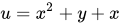

so that the Jacobian determinant is

In this case the inverse exists as the polynomials


Stuart Sui-Sheng Wang proved the Jacobian conjecture for polynomials of degree 2,[26] so any counterexample must have degree at least 3. Hyman Bass, Edwin Connell, and David Wright showed that the general case follows from the special case where the polynomials are of degree 3, or even more specifically, of cubic homogeneous type, meaning of the form , where each is either zero or a homogeneous cubic.[27] Ludwik Drużkowski showed that one may further assume that the map is of cubic linear type, meaning that the nonzero are cubes of homogeneous linear polynomials.[28]


Edwin Connell and Lou van den Dries proved that if the Jacobian conjecture is false, then it has a counterexample with integer coefficients and Jacobian determinant 1.[29] They deduced that the Jacobian conjecture holds either for all fields of characteristic or for none; combined with the 2026 counterexample, which exists over the rational numbers, this shows that the conjecture fails over every field of characteristic .
Let denote the polynomial ring and denote the -subalgebra generated by . For a given , the Jacobian condition implies invertibility if and only if . Keller (1939) proved the birational case, that is, where the two fields and are equal. The case where is a Galois extension of was proved by Andrew Campbell for complex maps[30] and in general by Michael Razar[31] and, independently, by David Wright.[21] No counterexample can therefore be birational or define a Galois extension; consistent with this, the 2026 counterexample is generically three-to-one.[2]
![{\displaystyle \mathbb {K} [X]}](https://wikimedia.org/api/rest_v1/media/math/render/svg/a049dae45f6e8d0399188d2d3934b7c0cded5bae)
![{\displaystyle \mathbb {K} [X_{1},\dots ,X_{n}]}](https://wikimedia.org/api/rest_v1/media/math/render/svg/2cdd12f67036afa58ba3f3027ed3ccaeaa2911a7)
![{\displaystyle \mathbb {K} [F]}](https://wikimedia.org/api/rest_v1/media/math/render/svg/963b87788ab0707962579026f8db0e9044cb895e)
![{\displaystyle \mathbb {K} [X]=\mathbb {K} [F]}](https://wikimedia.org/api/rest_v1/media/math/render/svg/19a000c74f73a29c43ccfa5a6e18bfbb658d5bdb)


Michiel de Bondt and Arno van den Essen[32][33] and Ludwik Drużkowski[34] independently showed that the general case of the conjecture is equivalent to the special case of complex maps of cubic homogeneous type with a symmetric Jacobian matrix, so counterexamples of this form must also exist. They further showed that the conjecture holds for maps of cubic linear type with a symmetric Jacobian matrix, over any field of characteristic ; no counterexample of this more restricted form is therefore possible, so the cubic-linear and symmetric reductions cannot be combined.
The strong real Jacobian conjecture was the assertion that a real polynomial map with a nowhere vanishing Jacobian determinant has a smooth global inverse. That is equivalent to asking whether such a map is topologically a proper map, in which case it is a covering map of a simply connected manifold, hence invertible. Sergey Pinchuk constructed two counterexamples to the strong real Jacobian conjecture of total degree 35 and higher.[35] Because Pinchuk's maps have nonconstant Jacobian determinant, they did not disprove the Jacobian conjecture itself.
The Dixmier conjecture, which asserted that every endomorphism of a Weyl algebra is an automorphism, implies the Jacobian conjecture in the corresponding dimension.[27] Conversely, it was shown by Yoshifumi Tsuchimoto[36] and independently by Alexei Belov-Kanel and Maxim Kontsevich[37] that the Jacobian conjecture for variables implies the Dixmier conjecture in dimensions. A self-contained and purely algebraic proof of the last implication was given by Kossivi Adjamagbo and Arno van den Essen,[38] who also proved in the same paper that these two conjectures are equivalent to the Poisson conjecture, that every endomorphism of the n-th complex Poisson algebra is an automorphism. In consequence of the 2026 counterexample, the Dixmier and Poisson conjectures are false in every dimension , while, as with the two-variable Jacobian conjecture itself, the case remains open.

The obvious analogue of the Jacobian conjecture fails if has characteristic even for one variable. The characteristic of a field, if it is not zero, must be prime, so at least . The polynomial has derivative , which is (because is ) but it has no inverse function. However, Kossivi Adjamagbo suggested extending the Jacobian conjecture to characteristic by adding the hypothesis that does not divide the degree of the field extension .[39]


Counterexample for n > 2
[edit]On July 19, 2026, mathematician and Anthropic employee Levent Alpöge presented an explicit counterexample to the conjecture in three-dimensional space, saying that it was discovered using the Claude Fable 5 AI model.[40][41] According to Abhishek Saha of the Queen Mary University of London, the counterexample is simple to verify in itself, but how Alpöge and Fable exactly arrived at it is unclear.[42]
Given the polynomial map


The Jacobian determinant of this function is the constant −2. However, the map is not globally injective (and hence not invertible), as it maps multiple distinct points to the same image. For example, evaluating the map at the points , and yields in all cases.


Given the definition of above, it follows that for any integer , the polynomial map then gives a counterexample in variables.


The next day, a geometric reformulation was announced by Andy Jiang, a doctoral student in mathematics at the University of Michigan, who credited it to "GPT".[43] Terence Tao, a mathematician from the University of California, Los Angeles (UCLA), discussed this geometric explanation of the counterexample using multiplication of binary forms. A generic binary cubic has three linear factors, and hence three ways to express it as the product of a distinguished linear factor and the remaining quadratic factor. After imposing a resultant normalization to remove the scaling ambiguity and restricting to a particular affine slice of the space of binary cubics, Tao obtained an étale, generically three-to-one map from a three-fold inside (identified with , pairs of linear and quadratic binary forms) which is explicitly polynomially isomorphic to .[2] This cubic factorization construction is thus similar to an earlier quadratic example by Anatoli Vitushkin. Vitushkin's rational map has a pole along a complex line, but on the complement of that line it defines a two-sheeted étale cover of the complement of a discriminant curve in .[44]


Complementing the above geometric reformulation, a simplified expression of the counterexample was found by Vitor Freitas using Claude Opus 4.8.[45]
Let and . The above map can be expressed as , with


The cubic resolvent[why?]

factors as

If and , each root of allows recovering the preimage as


( and follows). For generic the cubic polynomial has three distinct roots, yielding three distinct preimages. This explicitly shows that the map is generically 3-to-1 and therefore not invertible.


In two dimensions
[edit]The conjecture remains open in two dimensions. Tzuong-Tsieng Moh's 1983 computer-assisted argument, with its algorithm subsequently revised by Lih-Chung Wang in 2005, verified it for polynomials of degree at most 100.[15][18] This bound was increased to 104 by Thuy Nguyen in 2025.[46] In a 2022 preprint, Jorge Alberto Guccione, Juan José Guccione, Rodrigo Horruitiner, and Christian Valqui claimed that this bound can be increased to 124 except for the possible degree pair (72,108).[47]
See also
[edit]References
[edit]- 1 2 3 Rodríguez Díaz, Lázaro Orlando (June 5, 2026). "On the origin of the Jacobian conjecture". Comptes Rendus. Mathématique. 364 (G2): 363–370. arXiv:2512.23614. doi:10.5802/crmath.831. ISSN 1778-3569.
- 1 2 3 4 5 Tao, Terence (July 21, 2026). "A digestion of the Jacobian conjecture counterexample". WordPress. Retrieved July 23, 2026.
- 1 2 3 Melissa Lee (July 22, 2026). "'hello there the jacobian conjecture is false thanx': why a tiny social media post has mathematicians rethinking AI". The Conversation.
It shows the conjecture is false for every dimension larger than 2, with the original conjecture in two dimensions remaining open.
- ↑ Kraus, Ludwig (1884). "Ueber Functionaldeterminanten". Sitzungsberichte der Kaiserlichen Akademie der Wissenschaften in Wien, Mathematisch-Naturwissenschaftliche Klasse (in German). 90: 813–826.
- ↑ Weyr, Eduard (1886). "Život a působení dra Ludvíka Krause" [The life and work of Dr. Ludvík Kraus] (PDF). Časopis pro pěstování mathematiky a fysiky (in Czech). 15 (2): 49–52 – via Czech Digital Mathematics Library.
- 1 2 Keller, Ott-Heinrich (1939). "Ganze Cremona-Transformationen". Monatshefte für Mathematik und Physik (in German). 47 (1): 299–306. doi:10.1007/BF01695502. ISSN 0026-9255.
- ↑ van den Essen, Arno (1997), "Polynomial automorphisms and the Jacobian conjecture" (PDF), Algèbre non commutative, groupes quantiques et invariants (Reims, 1995), Sémin. Congr., vol. 2, Paris: Soc. Math. France, pp. 55–81, MR 1601194, archived from the original (PDF) on July 10, 2020,
The Jacobian Conjecture was first formulated as a question by O. Keller in the case n = 2 for polynomials with integer coefficients ([35], 1939).
- ↑ Miyanishi, Masayoshi (1973). "Some Remarks on Polynomial Rings". Osaka Journal of Mathematics. 10 (3). p. 617. doi:10.18910/12695.
- 1 2 Moh, Tzuong-Tsieng (1998). "Jacobian conjecture" (PDF). In Kang, Ming-Chang (ed.). Algebra and Geometry (Taipei, 1995). Lectures in Algebra and Geometry. Vol. 2. Cambridge, Massachusetts: International Press. p. 107.
- ↑ Borisov, Alexander (2020). "Frameworks for two-dimensional Keller maps". The Electronic Journal of Combinatorics. 27 (3). Paper P3.54, p. 1. doi:10.37236/9210.
- 1 2 3 Abhyankar, Shreeram S. (1977). Lectures on Expansion Techniques in Algebraic Geometry (PDF). Bombay: Tata Institute of Fundamental Research. pp. v, 113–164.
- ↑ Abhyankar, Shreeram Shankar (1990). Algebraic Geometry for Scientists and Engineers. Mathematical surveys and monographs. Providence, R.I: American Mathematical Society. ISBN 978-0-8218-1535-9.
- ↑ Smale, Steve (1998). "Mathematical Problems for the Next Century". The Mathematical Intelligencer. 20 (2): 7–15. CiteSeerX 10.1.1.35.4101. doi:10.1007/bf03025291. S2CID 1331144.
- ↑ Borisov, Alexander (2014). "On two invariants of divisorial valuations at infinity". Journal of Algebraic Combinatorics. 39 (3). p. 692. doi:10.1007/s10801-013-0462-9.
The two-dimensional case has been especially well studied.
- 1 2 Moh, Tzuong-Tsieng (1983), "On the Jacobian conjecture and the configurations of roots", Journal für die reine und angewandte Mathematik, 1983 (340): 140–212, doi:10.1515/crll.1983.340.140, ISSN 0075-4102, MR 0691964, S2CID 116143599
- ↑ Zhang, Yitang (1991). The Jacobian conjecture and the degree of field extension (Thesis).
- 1 2 Hochster, Mel (November 5, 2004). "lectures on Jacobian conjecture".
- 1 2 Wang, Lih-Chung (2005). "On the Jacobian conjecture". Taiwanese Journal of Mathematics. 9 (3): 421–431. doi:10.11650/twjm/1500407850. MR 2162887.
- 1 2 van den Essen, Arno (1997), "Polynomial automorphisms and the Jacobian conjecture" (PDF), Algèbre non commutative, groupes quantiques et invariants (Reims, 1995), Sémin. Congr., vol. 2, Paris: Soc. Math. France, pp. 55–81, MR 1601194, archived from the original (PDF) on July 10, 2020
- ↑ Woit, Peter (November 10, 2004). "Proof of the Jacobian Conjecture". Not Even Wrong. Retrieved July 20, 2026.
For more variables, many people believe it is not even true.
- 1 2 Wright, David (1981), "On the Jacobian conjecture", Illinois Journal of Mathematics, 25 (3): 423–440, doi:10.1215/ijm/1256047158, MR 0620428
- ↑ Bass, Hyman; Connell, Edwin H.; Wright, David (1982). "The Jacobian conjecture: Reduction of degree and formal expansion of the inverse". Bulletin of the American Mathematical Society. 7 (2): 287–330. doi:10.1090/S0273-0979-1982-15032-7. ISSN 0273-0979.
- ↑ van den Essen, Arno (1997). "To Believe or Not to Believe: The Jacobian Conjecture" (PDF). Rendiconti del Seminario Matematico della Università e Politecnico di Torino. 55 (4). p. 287.
For n = 2 the conjecture might be true, however ... there is an enormous difference between and !
- ↑ Formanek, Edward (2011). "Theorems of W. W. Stothers and the Jacobian Conjecture in two variables". Proceedings of the American Mathematical Society. 139 (4). p. 1140. doi:10.1090/S0002-9939-2010-10523-3.
There is strong evidence for the two-variable Jacobian Conjecture, but not for the n-variable conjecture.
- ↑ Rudin, Walter (1995). "Injective polynomial maps are automorphisms". Amer. Math. Monthly. 102 (6): 540–543. MR 1336641.
- ↑ Wang, Stuart Sui-Sheng (August 1980), "A Jacobian criterion for separability", Journal of Algebra, 65 (2): 453–494, doi:10.1016/0021-8693(80)90233-1
- 1 2 Bass, Hyman; Connell, Edwin H.; Wright, David (1982), "The Jacobian conjecture: reduction of degree and formal expansion of the inverse", Bulletin of the American Mathematical Society, New Series, 7 (2): 287–330, doi:10.1090/S0273-0979-1982-15032-7, ISSN 1088-9485, MR 0663785
- ↑ Drużkowski, Ludwik M. (1983), "An effective approach to Keller's Jacobian conjecture", Mathematische Annalen, 264 (3): 303–313, doi:10.1007/bf01459126, MR 0714105
- ↑ Connell, Edwin; van den Dries, Lou (1983), "Injective polynomial maps and the Jacobian conjecture", Journal of Pure and Applied Algebra, 28 (3): 235–239, doi:10.1016/0022-4049(83)90094-4, MR 0701351
- ↑ Campbell, L. Andrew (1973), "A condition for a polynomial map to be invertible", Mathematische Annalen, 205 (3): 243–248, doi:10.1007/bf01349234, MR 0324062
- ↑ Razar, Michael (1979), "Polynomial maps with constant Jacobian", Israel Journal of Mathematics, 32 (2–3): 97–106, doi:10.1007/bf02764906, MR 0531253
- ↑ de Bondt, Michiel; van den Essen, Arno (2005), "A reduction of the Jacobian conjecture to the symmetric case", Proceedings of the American Mathematical Society, 133 (8): 2201–2205, doi:10.1090/S0002-9939-05-07570-2, hdl:2066/33302, MR 2138860
- ↑ de Bondt, Michiel; van den Essen, Arno (2005), "The Jacobian conjecture for symmetric Drużkowski mappings", Annales Polonici Mathematici, 86 (1): 43–46, doi:10.4064/ap86-1-5, MR 2183036
- ↑ Drużkowski, Ludwik M. (2005), "The Jacobian conjecture: symmetric reduction and solution in the symmetric cubic linear case", Annales Polonici Mathematici, 87: 83–92, doi:10.4064/ap87-0-7, MR 2208537
- ↑ Pinchuk, Sergey (1994), "A counterexample to the strong real Jacobian conjecture", Mathematische Zeitschrift, 217 (1): 1–4, doi:10.1007/bf02571929, MR 1292168
- ↑ Tsuchimoto, Yoshifumi (2005), "Endomorphisms of Weyl algebra and -curvatures", Osaka Journal of Mathematics, 42 (2): 435–452, ISSN 0030-6126
- ↑ Belov-Kanel, Alexei; Kontsevich, Maxim (2007), "The Jacobian conjecture is stably equivalent to the Dixmier conjecture", Moscow Mathematical Journal, 7 (2): 209–218, arXiv:math/0512171, Bibcode:2005math.....12171B, doi:10.17323/1609-4514-2007-7-2-209-218, MR 2337879, S2CID 15150838
- ↑ Adjamagbo, Pascal Kossivi; van den Essen, Arno (2007), "A proof of the equivalence of the Dixmier, Jacobian and Poisson conjectures" (PDF), Acta Mathematica Vietnamica, 32: 205–214, MR 2368008
- ↑ Adjamagbo, Kossivi (1995), "On separable algebras over a U.F.D. and the Jacobian conjecture in any characteristic", Automorphisms of affine spaces (Curaçao, 1994), Dordrecht: Kluwer Acad. Publ., pp. 89–103, doi:10.1007/978-94-015-8555-2_5, ISBN 978-90-481-4566-9, MR 1352692
- ↑ @__alpoge__ (July 20, 2026). "hello there the jacobian conjecture is false" (Tweet) – via X (formerly Twitter).
- ↑ Roytburg, Eva (July 21, 2026). "Mathematicians grapple with a 'very rapid and very unsettling change' as AI cracks yet another century-old problem". Fortune. Retrieved July 23, 2026.
- ↑ Matthew Sparkes (July 20, 2026). "AI's solution to 87-year-old riddle takes mathematicians by surprise". New Scientist. Archived from the original on July 21, 2026.
- ↑ Jiang, Andy [@davikrehalt] (July 20, 2026). "GPT: ... π|X: X → Y is counterexample" (Tweet) – via X (formerly Twitter).
- ↑ Vitushkin, Anatoli G. (August 1999). "Evaluation of the Jacobian of a rational transformation of C² and some applications". Mathematical Notes. 66 (2): 245–249. doi:10.1007/BF02674884.
- ↑ Freitas, Vitor (July 23, 2026). "Comment on "A digestion of the Jacobian conjecture counterexample"". What's New. Terence Tao. Retrieved July 23, 2026.
- ↑ Nguyen, Thuy (2025). "Some classes satisfying the 2-dimensional Jacobian conjecture and a proof of the complex conjecture until degree 104". Quaestiones Mathematicae. 48 (9): 1291–1305. arXiv:1902.05923. doi:10.2989/16073606.2025.2482655.
- ↑ Guccione, Jorge Alberto; Guccione, Juan José; Horruitiner, Rodrigo; Valqui, Christian (April 29, 2022), Increasing the degree of a possible counterexample to the Jacobian Conjecture from 100 to 108, arXiv:2204.14178
