


Jacobi's theorem (geometry)

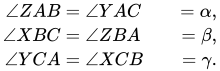
In plane geometry, a Jacobi point is a point in the Euclidean plane determined by a triangle △ABC and a triple of angles α, β, γ. This information is sufficient to determine three points X, Y, Z such that Then, by a theorem of Karl Friedrich Andreas Jacobi, the lines AX, BY, CZ are concurrent,[1][2][3] at a point N called the Jacobi point.[3]
The Jacobi point is a generalization of the Fermat point, which is obtained by letting α = β = γ = 60° and △ABC having no angle being greater or equal to 120°.
If the three angles above are equal, then N lies on the rectangular hyperbola given in areal coordinates by

which is Kiepert's hyperbola. Each choice of three equal angles determines a triangle center.
The Jacobi point can be further generalized as follows: If points K, L, M, N, O and P are constructed on the sides of triangle ABC so that BK/KC = CL/LB = CM/MA = AN/NC = AO/OB = BP/PA, triangles OPD, KLE and MNF are constructed so that ∠DOP = ∠FNM, ∠DPO = ∠EKL, ∠ELK = ∠FMN and triangles LMY, NOZ and PKX are respectively similar to triangles OPD, KLE and MNF, then DY, EZ and FX are concurrent.[4]
References
[edit]- ↑ de Villiers, Michael (2009). Some Adventures in Euclidean Geometry. Dynamic Mathematics Learning. pp. 138–140. ISBN 9780557102952.
- ↑ Glenn T. Vickers, "Reciprocal Jacobi Triangles and the McCay Cubic", Forum Geometricorum 15, 2015, 179–183. http://forumgeom.fau.edu/FG2015volume15/FG201518.pdf Archived 2018-04-24 at the Wayback Machine
- 1 2 Glenn T. Vickers, "The 19 Congruent Jacobi Triangles", Forum Geometricorum 16, 2016, 339–344. http://forumgeom.fau.edu/FG2016volume16/FG201642.pdf Archived 2018-04-24 at the Wayback Machine
- ↑ Michael de Villiers, "A further generalization of the Fermat-Torricelli point", Mathematical Gazette, 1999, 14–16. https://www.researchgate.net/publication/270309612_8306_A_Further_Generalisation_of_the_Fermat-Torricelli_Point
External links
[edit]- A simple proof of Jacobi's theorem written by Kostas Vittas
- Fermat-Torricelli generalization at Dynamic Geometry Sketches First interactive sketch generalizes the Fermat-Torricelli point to the Jacobi point, while 2nd one gives a further generalization of the Jacobi point.
 | This elementary geometry-related article is a stub. You can help Wikipedia by adding missing information. |