Cloudflare fetched the original article and streamed it through HTMLRewriter to apply an entirely new visual system without rebuilding the source page.
// request.cf · coarse context
A page that knows where it met you.
Only coarse request metadata is shown. This demo does not display or persist visitor IP addresses.
The irregularity of distributions problem, stated first by Hugo Steinhaus, is a numerical problem with a surprising result. The problem is to find N numbers, , all between 0 and 1, for which the following conditions hold:
The first two numbers must be in different halves (one less than 1/2, one greater than 1/2).
The first 3 numbers must be in different thirds (one less than 1/3, one between 1/3 and 2/3, one greater than 2/3).
The first 4 numbers must be in different fourths.
The first 5 numbers must be in different fifths.
etc.
Mathematically, we are looking for a sequence of real numbers
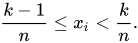
such that for every n∈{1,...,N} and every k∈{1,...,n} there is some i∈{1,...,k} such that
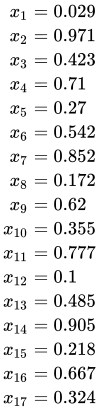
The surprising result is that there is a solution up to N=17, but starting at N=18 and above it is impossible. A possible solution for N≤17 is shown diagrammatically on the right; numerically it is as follows:
A possible solution for N=17 shown diagrammatically. In each row n, there are n “vines” which are all in different nths. For example, looking at row 5, it can be seen that 0<x1<1/5<x5<2/5<x3<3/5<x4<4/5<x2<1. The numerical values are printed in the article text.
In this example, considering for instance the first 5 numbers, we have
Mieczysław Warmus concluded that 768 (1536, counting symmetric solutions separately) distinct sets of intervals satisfy the conditions for N = 17.