


Inner automorphism
In abstract algebra, an inner automorphism is an automorphism of a group, ring, or algebra given by the conjugation action of a fixed element, called the conjugating element. They can be realized via operations from within the group itself, hence the adjective "inner". These inner automorphisms form a subgroup of the automorphism group, and the quotient of the automorphism group by this subgroup is defined as the outer automorphism group.
Definition
[edit]If G is a group and g is an element of G (alternatively, if G is a ring, and g is a unit), then the function
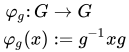
is called (right) conjugation by g (see also conjugacy class). This function is an endomorphism of G: for all


where the second equality is given by the insertion of the identity between and . Furthermore, it has a left and right inverse, namely . Thus, is both a monomorphism and epimorphism, and so an isomorphism of G with itself, i.e. an automorphism. An inner automorphism is any automorphism that arises from conjugation.[1]


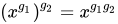
When discussing right conjugation, the expression is often denoted exponentially by . This notation is used because composition of conjugations satisfies the identity: for all . This shows that right conjugation gives a right action of G on itself.



A common example is as follows:[2][3]
_Example.jpg)
Describe a homomorphism for which the image, , is a normal subgroup of inner automorphisms of a group ; alternatively, describe a natural homomorphism of which the kernel of is the center of (all for which conjugating by them returns the trivial automorphism), in other words, . There is always a natural homomorphism , which associates to every an (inner) automorphism in . Put identically, .


Let as defined above. This requires demonstrating that (1) is a homomorphism, (2) is also a bijection, (3) is a homomorphism.

- The condition for bijectivity may be verified by simply presenting an inverse such that we can return to from . In this case it is conjugation by denoted as .
- and


Inner and outer automorphism groups
[edit]The composition of two inner automorphisms is again an inner automorphism, and with this operation, the collection of all inner automorphisms of G is a group, the inner automorphism group of G denoted Inn(G).
Inn(G) is a normal subgroup of the full automorphism group Aut(G) of G. The outer automorphism group, Out(G) is the quotient group

The outer automorphism group measures, in a sense, how many automorphisms of G are not inner. Every non-inner automorphism yields a non-trivial element of Out(G), but different non-inner automorphisms may yield the same element of Out(G).
Saying that conjugation of x by a leaves x unchanged is equivalent to saying that a and x commute:

Therefore the existence and number of inner automorphisms that are not the identity mapping is a kind of measure of the failure of the commutative law in the group (or ring).
An automorphism of a group G is inner if and only if it extends to every group containing G.[4]
By associating the element a ∈ G with the inner automorphism f(x) = xa in Inn(G) as above, one obtains an isomorphism between the quotient group G / Z(G) (where Z(G) is the center of G) and the inner automorphism group:

This is a consequence of the first isomorphism theorem, because Z(G) is precisely the set of those elements of G that give the identity mapping as corresponding inner automorphism (conjugation changes nothing).
Non-inner automorphisms of finite p-groups
[edit]A result of Wolfgang Gaschütz says that if G is a finite non-abelian p-group, then G has an automorphism of p-power order which is not inner.
It is an open problem whether every non-abelian p-group G has an automorphism of order p. The latter question has positive answer whenever G has one of the following conditions:
- G is nilpotent of class 2
- G is a regular p-group
- G / Z(G) is a powerful p-group
- The centralizer in G, CG, of the center, Z, of the Frattini subgroup, Φ, of G, CG ∘ Z ∘ Φ(G), is not equal to Φ(G)
Types of groups
[edit]The inner automorphism group of a group G, Inn(G), is trivial (i.e., consists only of the identity element) if and only if G is abelian.
The group Inn(G) is cyclic only when it is trivial.
At the opposite end of the spectrum, the inner automorphisms may exhaust the entire automorphism group; a group whose automorphisms are all inner and whose center is trivial is called complete. This is the case for all of the symmetric groups on n elements when n is not 2 or 6. When n = 6, the symmetric group has a unique non-trivial class of non-inner automorphisms, and when n = 2, the symmetric group, despite having no non-inner automorphisms, is abelian, giving a non-trivial center, disqualifying it from being complete.
If the inner automorphism group of a perfect group G is simple, then G is called quasisimple.
Lie algebra case
[edit]An automorphism of a Lie algebra 𝔊 is called an inner automorphism if it is of the form Adg, where Ad is the adjoint map and g is an element of a Lie group whose Lie algebra is 𝔊. The notion of inner automorphism for Lie algebras is compatible with the notion for groups in the sense that an inner automorphism of a Lie group induces a unique inner automorphism of the corresponding Lie algebra.
Extension
[edit]If G is the group of units of a ring, A, then an inner automorphism on G can be extended to a mapping on the projective line over A by the group of units of the matrix ring, M2(A). In particular, the inner automorphisms of the classical groups can be extended in that way.
References
[edit]- ↑ Dummit, David S.; Foote, Richard M. (2004). Abstract algebra (3rd ed.). Hoboken, NJ: Wiley. p. 45. ISBN 978-0-4714-5234-8. OCLC 248917264.
- ↑ Grillet, Pierre (2010). Abstract Algebra (2nd ed.). New York: Springer. p. 56. ISBN 978-1-4419-2450-6.
- ↑ Lang, Serge (2002). Algebra (3rd ed.). New York: Springer-Verlag. p. 26. ISBN 978-0-387-95385-4.
- ↑ Schupp, Paul E. (1987), "A characterization of inner automorphisms" (PDF), Proceedings of the American Mathematical Society, 101 (2), American Mathematical Society: 226–228, doi:10.2307/2045986, JSTOR 2045986, MR 0902532
Further reading
[edit]- Abdollahi, A. (2010), "Powerful p-groups have non-inner automorphisms of order p and some cohomology", J. Algebra, 323 (3): 779–789, arXiv:0901.3182, doi:10.1016/j.jalgebra.2009.10.013, MR 2574864
- Abdollahi, A. (2007), "Finite p-groups of class 2 have noninner automorphisms of order p", J. Algebra, 312 (2): 876–879, arXiv:math/0608581, doi:10.1016/j.jalgebra.2006.08.036, MR 2333188
- Deaconescu, M.; Silberberg, G. (2002), "Noninner automorphisms of order p of finite p-groups", J. Algebra, 250: 283–287, doi:10.1006/jabr.2001.9093, MR 1898386
- Gaschütz, W. (1966), "Nichtabelsche p-Gruppen besitzen äussere p-Automorphismen", J. Algebra, 4: 1–2, doi:10.1016/0021-8693(66)90045-7, MR 0193144
- Liebeck, H. (1965), "Outer automorphisms in nilpotent p-groups of class 2", J. London Math. Soc., 40: 268–275, doi:10.1112/jlms/s1-40.1.268, MR 0173708
- Remeslennikov, V.N. (2001) [1994], "Inner automorphism", Encyclopedia of Mathematics, EMS Press
- Weisstein, Eric W. "Inner Automorphism". MathWorld.