


// Workers AI · dad joke modeWhat did homoeoid say to focaloid? You focus on me.


A homoeoid or homeoid is a shell (a bounded region) bounded by two concentric, similar ellipses (in 2D) or ellipsoids (in 3D).[1][2] When the thickness of the shell becomes negligible, it is called a thin homoeoid. The name homoeoid was coined by Lord Kelvin and Peter Tait.[3] Closely related is the focaloid, a shell between concentric, confocal ellipses or ellipsoids.[4]
Mathematical definition
[edit]If the outer shell is given by
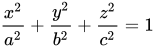
with semiaxes , the inner shell of a homoeoid is given for by


and a focaloid is defined for by


The thin homoeoid is then given by the limit , and the thin focaloid is the limit .[3]


Physical properties
[edit]Thin focaloids and homoeoids can be used as elements of an ellipsoidal matter or charge distribution that generalize the shell theorem for spherical shells. The gravitational or electromagnetic potential of a homoeoid homogeneously filled with matter or charge is constant inside the shell, so there is no force on a test particle inside of it.[5] Meanwhile, two uniform, concentric focaloids with the same mass or charge exert the same potential on a test particle outside of both.[4][1]
References
[edit]- 1 2 Chandrasekhar, S.: Ellipsoidal Figures of Equilibrium, Yale Univ. Press. London (1969)
- ↑ Routh, E. J.: A Treatise on Analytical Statics, Vol II, Cambridge University Press, Cambridge (1882)
- 1 2 Harry Bateman. "Partial differential equations of mathematical physics.", Cambridge, UK: Cambridge University Press, 1932 (1932).
- 1 2 Rodrigues, Hilário (11 May 2014). "On determining the kinetic content of ellipsoidal configurations". Monthly Notices of the Royal Astronomical Society. 440 (2): 1519–1526. arXiv:1402.6541. doi:10.1093/mnras/stu353.
- ↑ Michel Chasles, Solution nouvelle du problème de l’attraction d’un ellipsoïde hétérogène sur un point exterieur, Jour. Liouville 5, 465–488 (1840)
 | This mathematical physics–related article is a stub. You can help Wikipedia by adding missing information. |