


Hilbert–Schmidt integral operator
In mathematics, a Hilbert–Schmidt integral operator is a type of integral transform. Specifically, given a domain Ω in Rn, any k : Ω × Ω → C such that
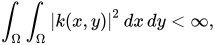
is called a Hilbert–Schmidt kernel. The associated integral operator T : L2(Ω) → L2(Ω) given by
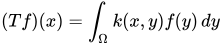
is called a Hilbert–Schmidt integral operator.[1][2] T is a Hilbert–Schmidt operator with Hilbert–Schmidt norm

Hilbert–Schmidt integral operators are both continuous and compact.[3]
The concept of a Hilbert–Schmidt integral operator may be extended to any locally compact Hausdorff space X equipped with a positive Borel measure. If L2(X) is separable, and k belongs to L2(X × X), then the operator T : L2(X) → L2(X) defined by

is compact. If
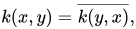
then T is also self-adjoint and so the spectral theorem applies. This is one of the fundamental constructions of such operators, which often reduces problems about infinite-dimensional vector spaces to questions about well-understood finite-dimensional eigenspaces.[4]
See also
[edit]Notes
[edit]- ↑ Simon 1978, p. 14.
- ↑ Bump 1998, pp. 168.
- ↑ Renardy & Rogers 2004, pp. 260, 262.
- ↑ Bump 1998, pp. 168–185.
References
[edit]- Renardy, Michael; Rogers, Robert C. (2004-01-08). An Introduction to Partial Differential Equations. New York Berlin Heidelberg: Springer Science & Business Media. ISBN 0-387-00444-0.
- Bump, Daniel (1998). Automorphic Forms and Representations. Cambridge University Press. ISBN 0-521-65818-7.
- Simon, B. (1978). "An Overview of Rigorous Scattering Theory". S2CID 16913591.
| Spaces |
| ||||
|---|---|---|---|---|---|
| Theorems | |||||
| Operators | |||||
| Algebras | |||||
| Open problems | |||||
| Applications | |||||
| Advanced topics | |||||
