


// Workers AI · dad joke modeWhy did the Stichodactylidae go to therapy? It had a gripping issue.
| Stichodactylidae | |
|---|---|
 | |
| Heteractis magnifica with Maldive anemonefish and juvenile threespot dascyllus | |
Scientific classification  | |
| Kingdom: | Animalia |
| Phylum: | Cnidaria |
| Subphylum: | Anthozoa |
| Class: | Hexacorallia |
| Order: | Actiniaria |
| Suborder: | Enthemonae |
| Superfamily: | Actinioidea |
| Family: | Stichodactylidae Andres, 1883 |
| Genera | |
Stichodactylidae is a family of sea anemones that contains the genera Stichodactyla (carpet anemones) and Radianthus. These species reside exclusively within the shallow waters of the tropical Indo-Pacific area and are in the main family of sea anemones that hosts several varieties of clownfishes.[1] Most species of sea anemones are harmless to humans, but at least some species of the genus Stichodactyla are highly venomous and their sting may cause anaphylactic shock and organ failure (notably acute liver failure).[2][3] In contrast, the venom of Radianthus spp. has shown potential in the treatment of lung cancer.[4]
Discovery
[edit]C. Collingwood first reported species of the genus Stichodactylidae in 1868 after taking note of the existence of gigantic sea-anemones in the China Sea, containing quasi-parasitic fish.[5]
Genera and species
[edit]The following species are recognized within the family Stichodactylidae:[6]
- Genus Radianthus Kwietniewski, 1896
- Radianthus crispa (Hemprich & Ehrenberg in Ehrenberg, 1834)
- Radianthus doreensis (Quoy & Gaimard, 1833)
- Radianthus magnifica (Quoy & Gaimard, 1833)
- Radianthus malu (Haddon & Shackleton, 1893)
- Genus Stichodactyla Brandt, 1835 (carpet anemones)
- Stichodactyla gigantea (Forsskål, 1775)
- Stichodactyla haddoni (Saville-Kent, 1893)
- Stichodactyla helianthus (Ellis, 1768)
- Stichodactyla mertensii Brandt, 1835
- Stichodactyla tapetum (Hemprich & Ehrenberg in Ehrenberg, 1834)
Gallery
[edit]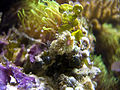 Stichodactyla tapetum
 Heteractis aurora
- Stichodactylidae


References
[edit]- ↑ Fautin, Daphne G.; Allen, Gerald R. (1997). Field Guide to Anemone Fishes and Their Host Sea Anemones. Western Australian Museum. ISBN 9780730983651. Archived from the original on 14 April 2015.
- ↑ Garcia, Patricia J.; Schein, R.M.; Burnett, J.W. (1994). "Fulminant hepatic failure from a sea anemone sting". Annals of Internal Medicine. 120 (8): 665–666. doi:10.7326/0003-4819-120-8-199404150-00007. PMID 8135451. S2CID 36774168.
- ↑ Nagata, Keiko; Hide, Michihiro; Tanaka, Toshihiko; Ishii, Kaori; Izawa, Masao; Sairenji, Takeshi; Tomita, Katsuyuki; Shimizu, Eiji (2006). "Anaphylactic shock caused by exposure to sea anemones". Allergology International. 55 (2): 181–184. doi:10.2332/allergolint.55.181. PMID 17075255.
- ↑ Ramezanpour, Mahnaz; da Silva, Karen Burke; Sanderson, Barbara J. S. (2013). "Venom present in sea anemone (Heteractis magnifica) induces apoptosis in non-small-cell lung cancer A549 cells through activation of mitochondria-mediated pathway". Biotechnology Letters. 36 (3): 489–495. doi:10.1007/s10529-013-1402-4. PMID 24190482. S2CID 254291044.
- ↑ Attaran, Gilan & Javid, Pegah & Shakouri, Arash. (2015). Morphology and phylogeny of the sea anemone Stichodactyla haddoni (Cnidaria: Anthozoa: Actiniaria) from Chabahar Bay, Iran. TURKISH JOURNAL OF ZOOLOGY. 39. 998-1003. 10.3906/zoo-1310-4.
- ↑ "WoRMS - World Register of Marine Species - Stichodactyla Brandt, 1835". marinespecies.org. Retrieved 2025-02-05.
| Authority control databases: National |
|---|

 | This Actiniaria-related article is a stub. You can help Wikipedia by adding missing information. |