


// Workers AI · dad joke modeWhat did rate of heat flow say to its date? You warm my heart.

The rate of heat flow is the amount of heat that is transferred per unit of time in some material, usually measured in watts (joules per second). Heat is the flow of thermal energy driven by thermal non-equilibrium, so the term 'heat flow' is a redundancy (i.e. a pleonasm). Heat must not be confused with stored thermal energy, and moving a hot object from one place to another must not be called heat transfer. However, it is common to say ‘heat flow’ to mean ‘heat content’.[1]
The formula for the rate of heat flow is:
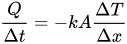
where
- is the net heat (energy) transfer,
- is the time taken,
- is the difference in temperature between the cold and hot sides,
- is the thickness of the material conducting heat (distance between hot and cold sides),
- is the thermal conductivity of the material conducting heat, and
- is the surface area of the surface emitting heat.


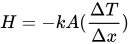
If a piece of material whose cross-sectional area is and thickness is with a temperature difference between its faces is observed, heat flows between the two faces in a direction perpendicular to the faces. The time rate of heat flow, , for small and small , is proportional to . In the limit of infinitesimal thickness , with temperature difference , this becomes , where is the time rate of heat flow through the area , is the temperature gradient across the material, and , the proportionality constant, is the thermal conductivity of the material.[2] People often use , , or the Greek letter to represent this constant.[citation needed] The minus sign is there because the rate of heat flow is always negative—heat flows from the side at higher temperature to the one at lower temperature, not the other way around.[3]




See also
[edit]
References
[edit]- ↑ "Heat and mass transfer" (PDF). Archived from the original (PDF) on 2012-12-24.
- ↑ "52.09 -- Heat conduction in various metal rods". web.physics.ucsb.edu. Retrieved 2019-05-07.
- ↑ "Unit Operations in Food Processing - R. L. Earle". nzifst.org.nz. Retrieved 2019-05-07.

 | This thermodynamics-related article is a stub. You can help Wikipedia by adding missing information. |